Skin Dimpling, Edge Finishing, Priming, Riveting

January 30, 2010

Prev | Next

I worked in sections today.

There was a big storm here last night, (and all of today), but I’ve learned that cleaning off the driveway is a lot easier if you do it when it is 3″ two times instead of once after 6″ has accumulated. Here’s what I woke up to this morning.
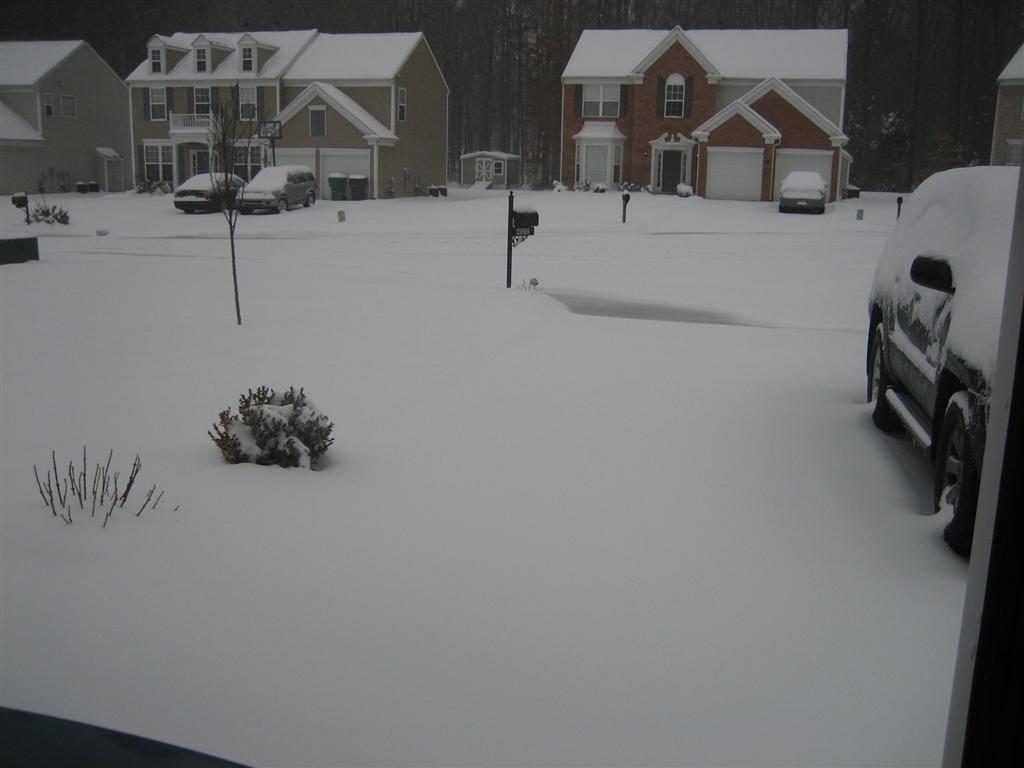
Snow!

Here’s after about an hour of shoveling. Good workout.
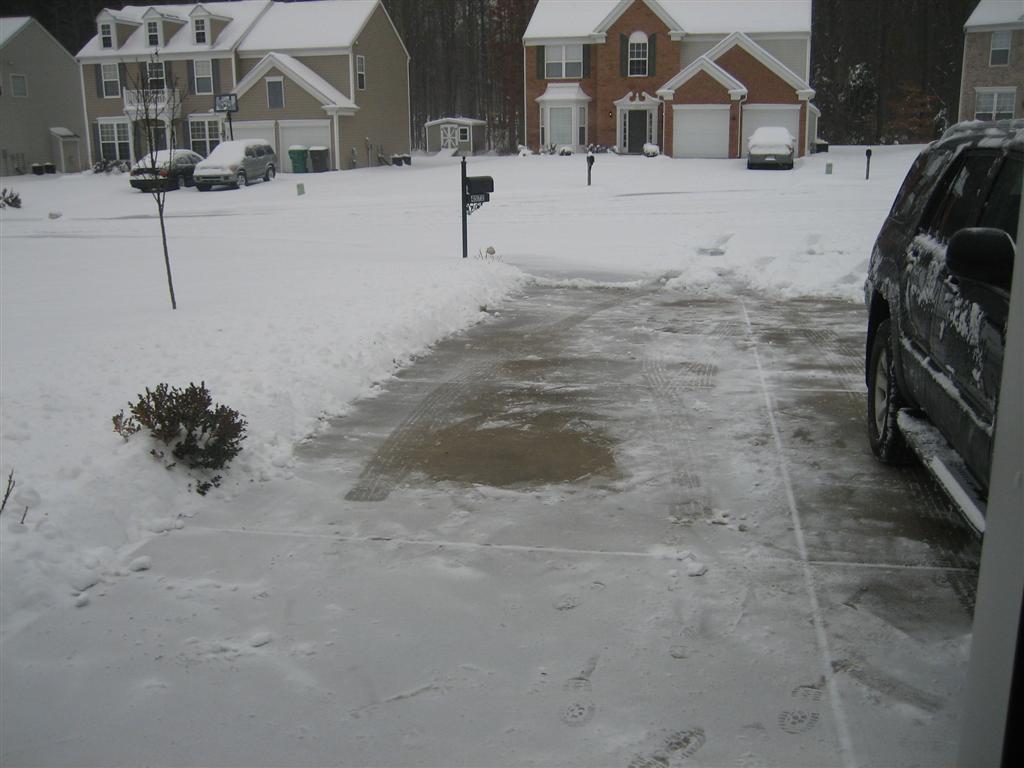
Coming down fast, but at least I cleared off the first 6".

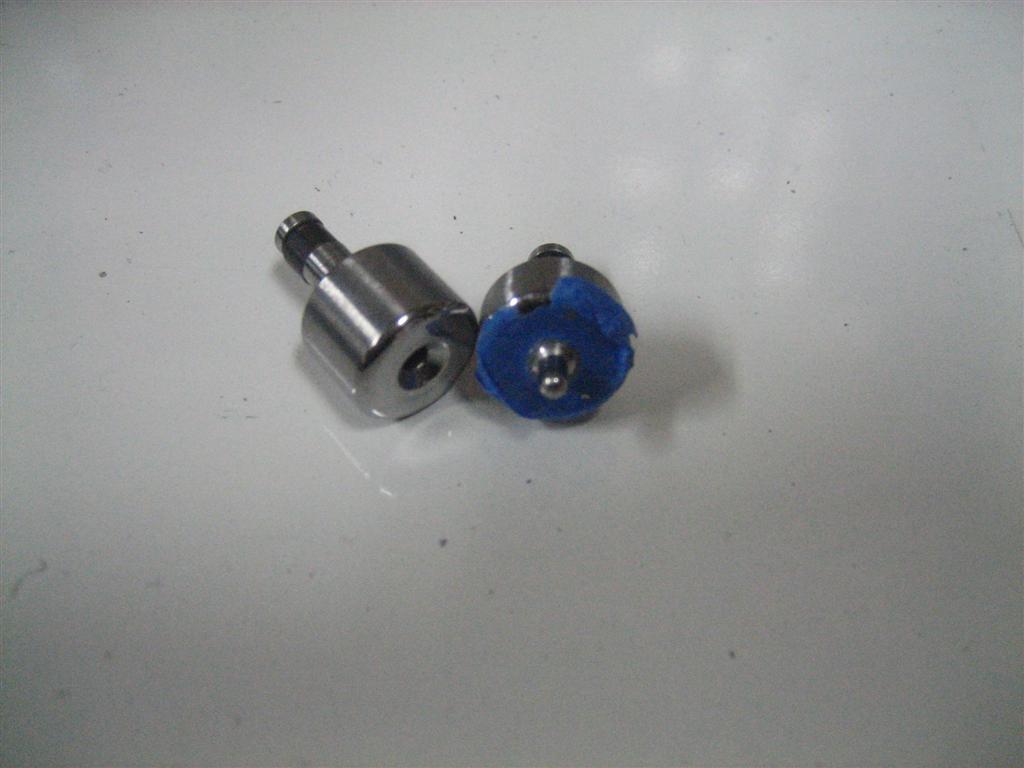
Then, I got the c-frame out and finished the VS skin dimpling. I replaced the blue tape on the male die, and got almost no circles.
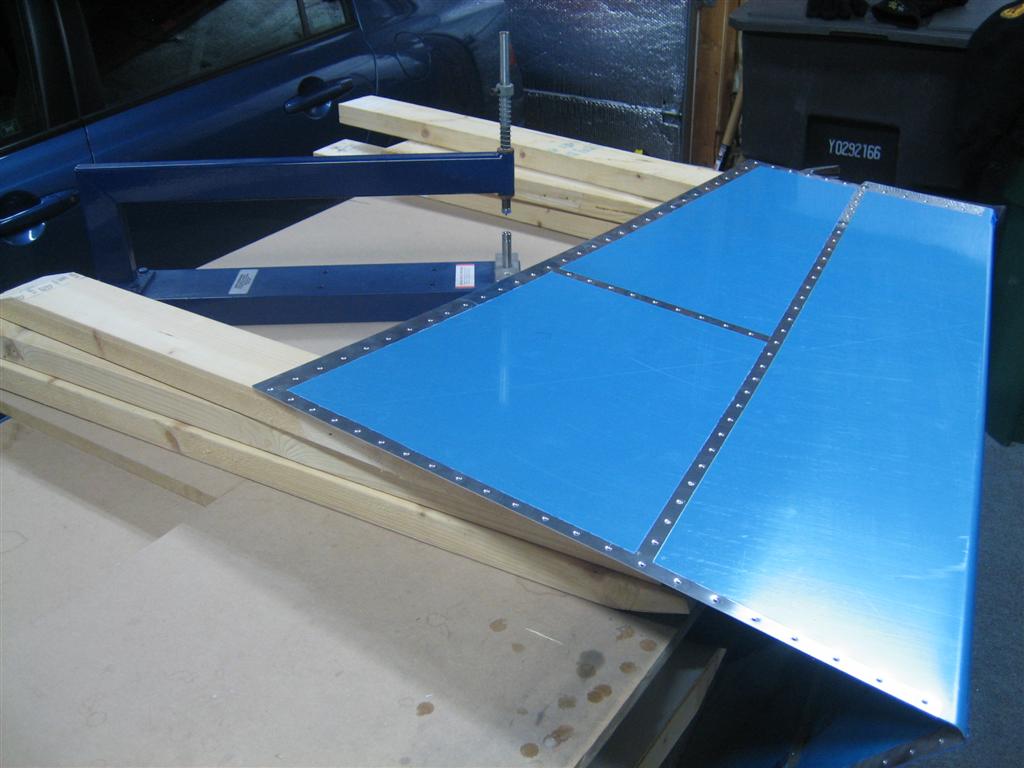
Simple but effective dimpling setup.

Then I countersunk all of the lower forward spar reinforcement holes from the plans. I haven’t used the countersink since I had to countersink HS-710 and HS-714 to accept a #30 dimple, so the countersink cage was already set up. All I had to do was verify in a piece of scrap. Yup. It’s perfect.
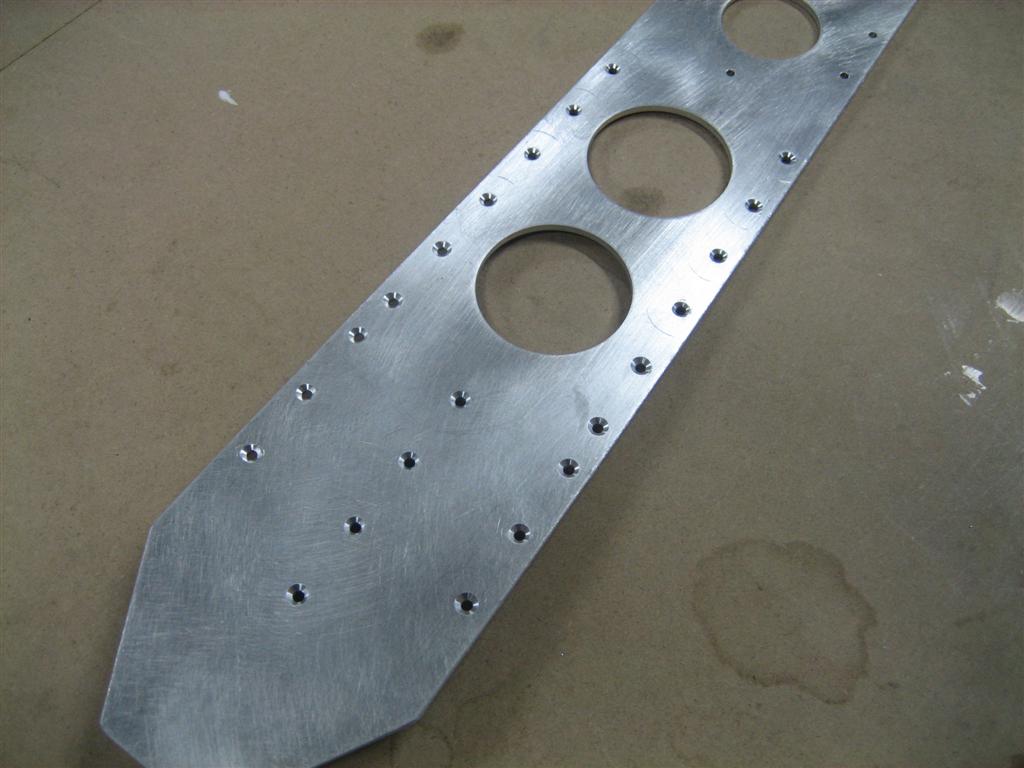
Beautiful countersinking.

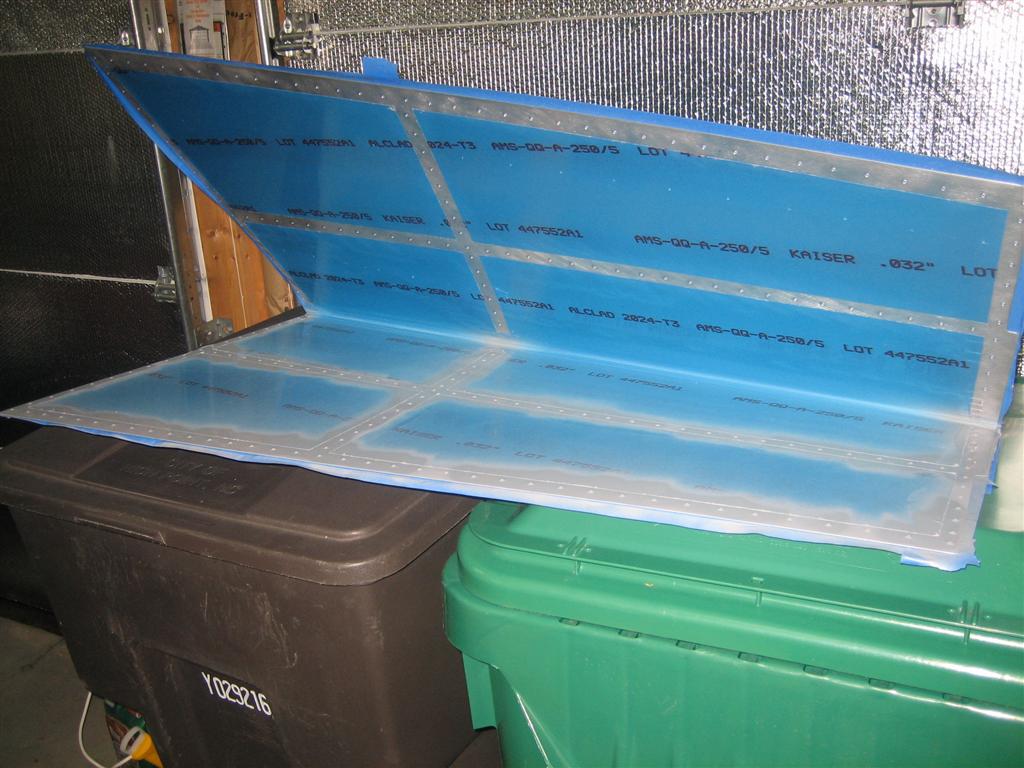
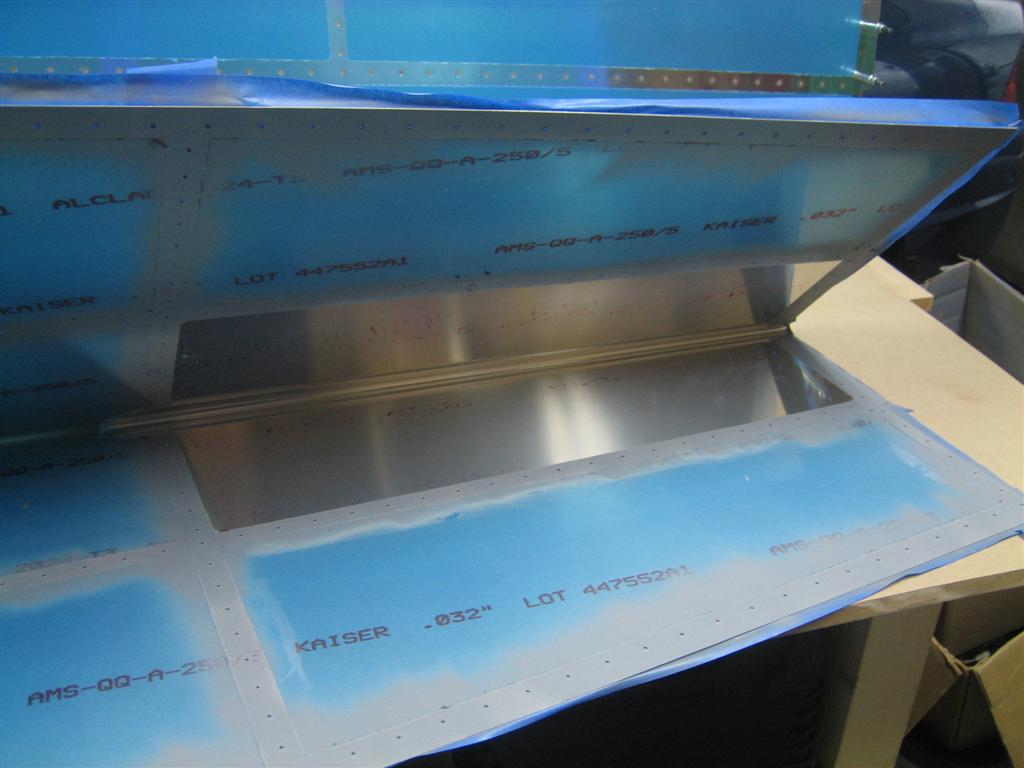
Then, I cleaned and primed one interior side of the vertical skin, then the other. Here’s the first side drying.
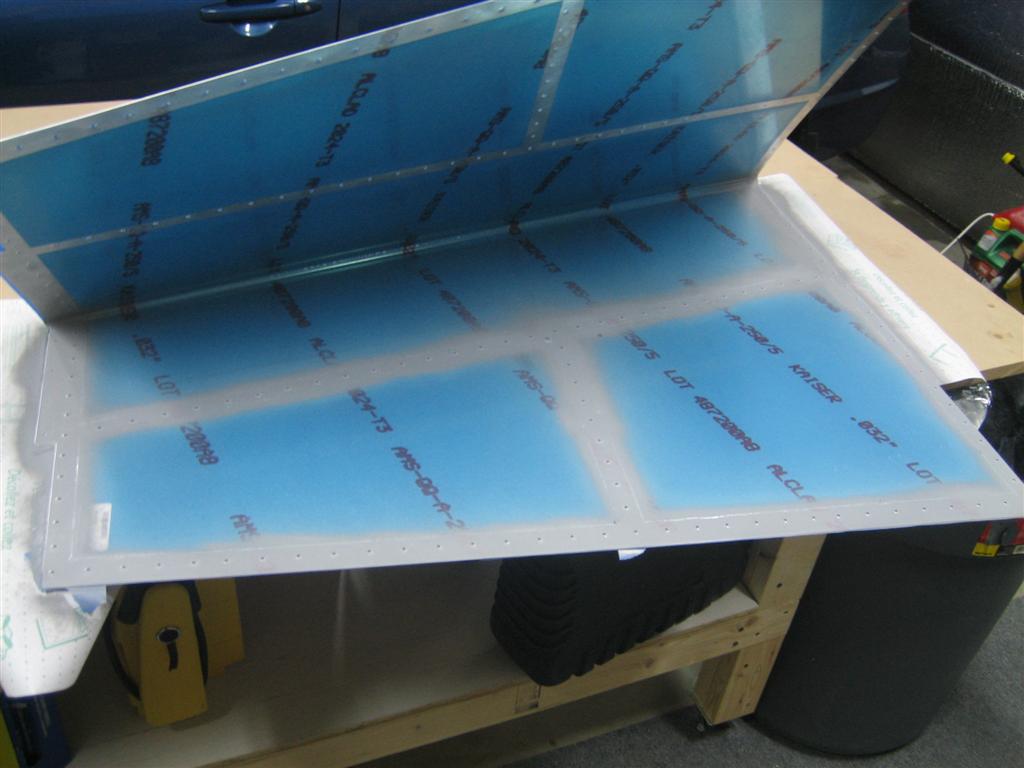
Hurry up and wait to dry.

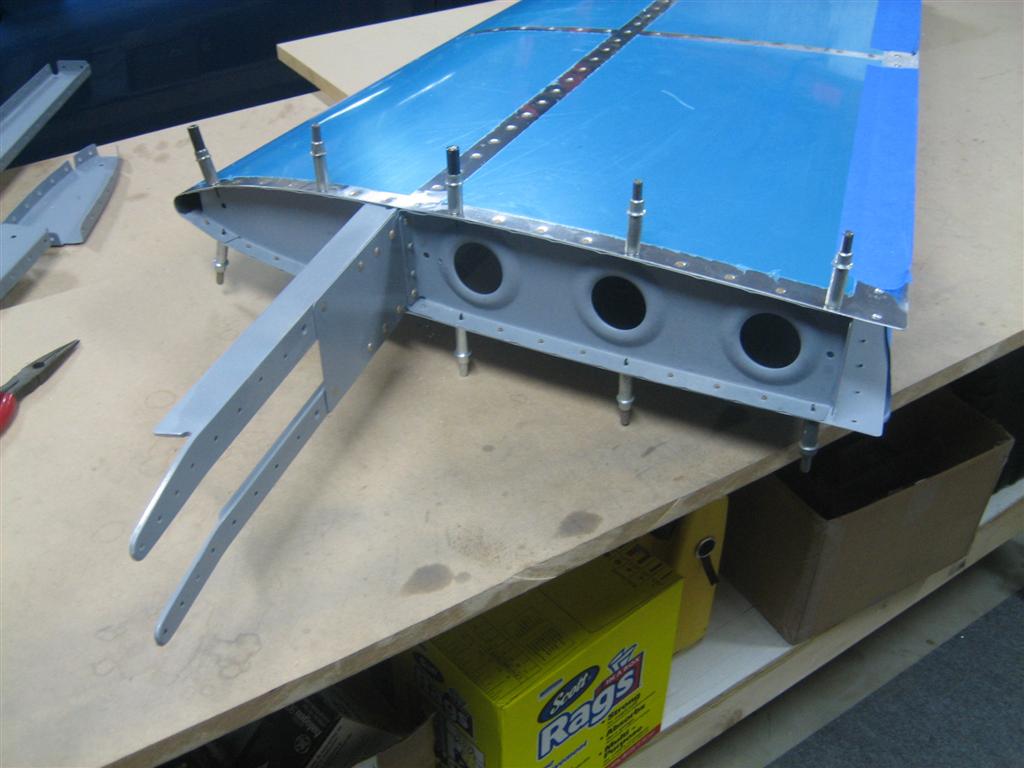
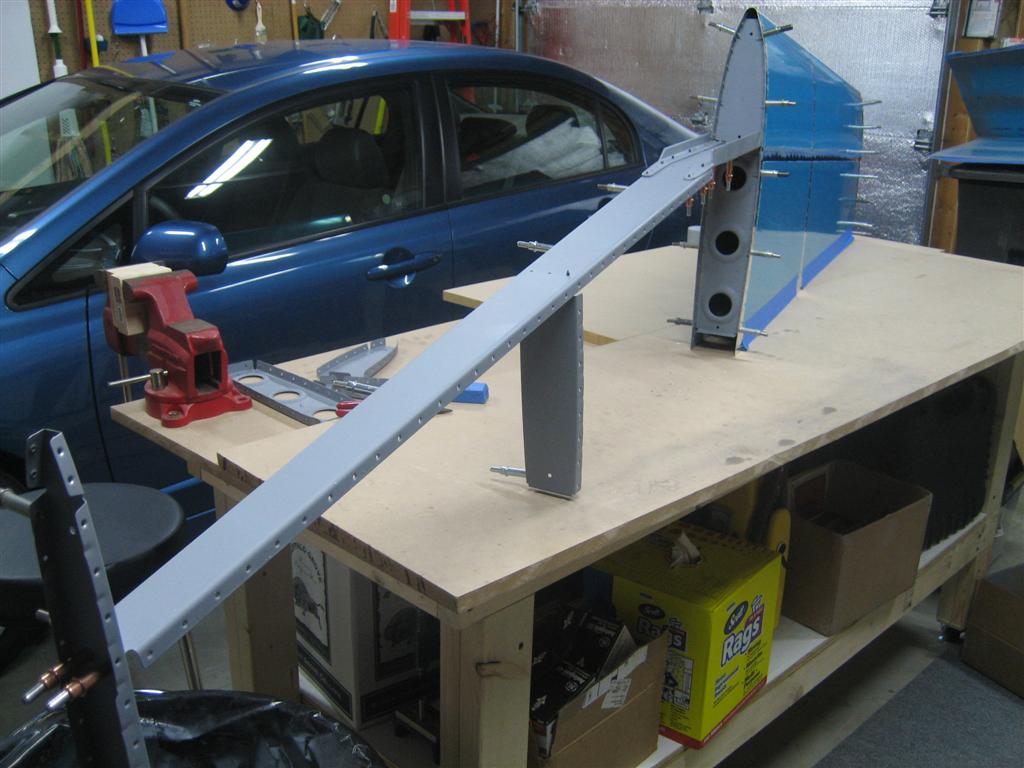
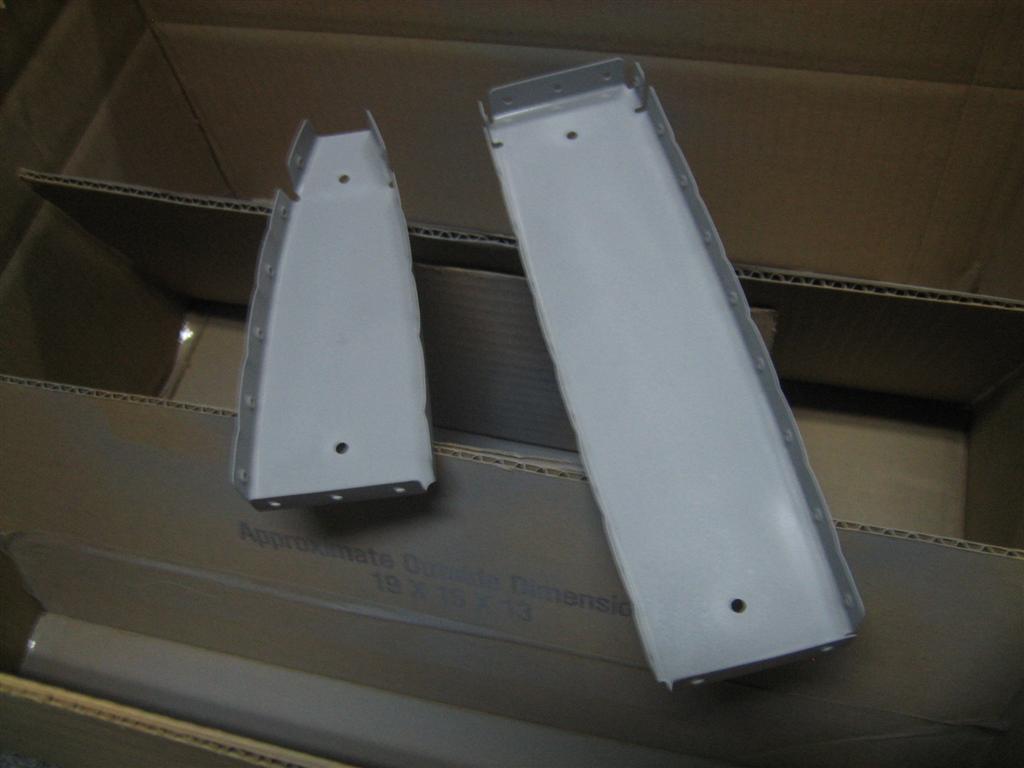
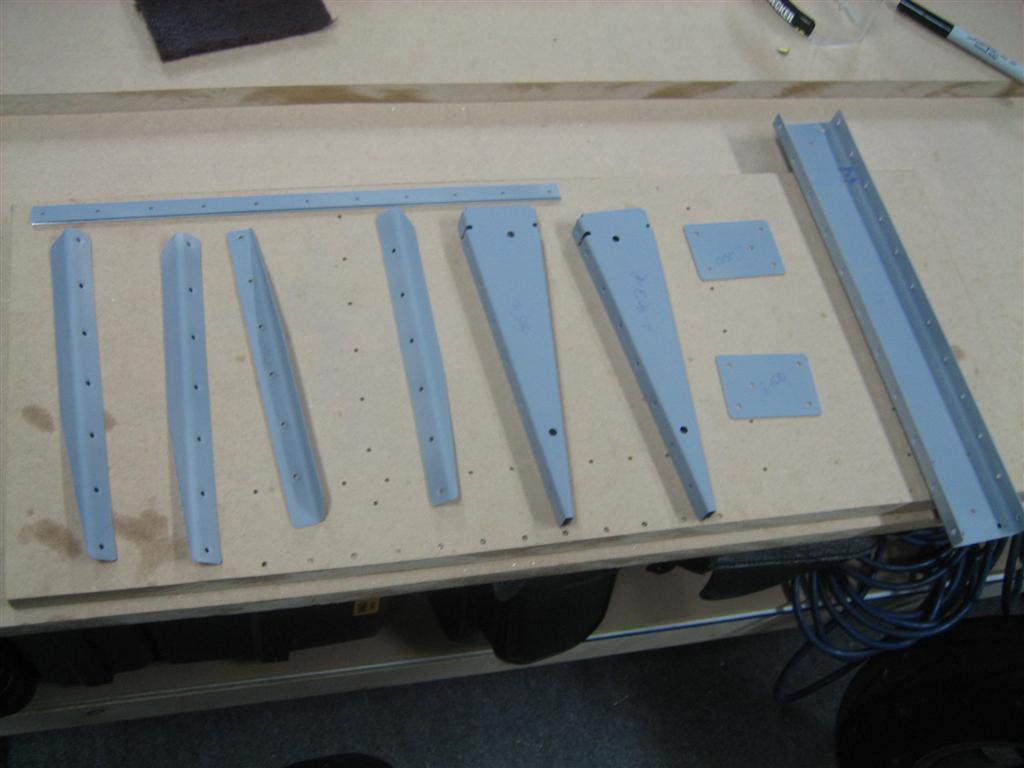
After finishing the second side and letting it dry, I pulled the forward section of vinyl off of the interior side of the skin. During assembly, no bucking bars will be needed in there, so there is no risk of scratching. Then I finished edge finishing the ribs, spars, and rear spar reinforcement, and primed each one. I didn’t prime them sitting perfectly horizontal, so I got some runs and some nastiness; some of them ended up getting touched up, and some got a second coat.  After they were all dry, I cleco those bad boys together in preparation for riveting.
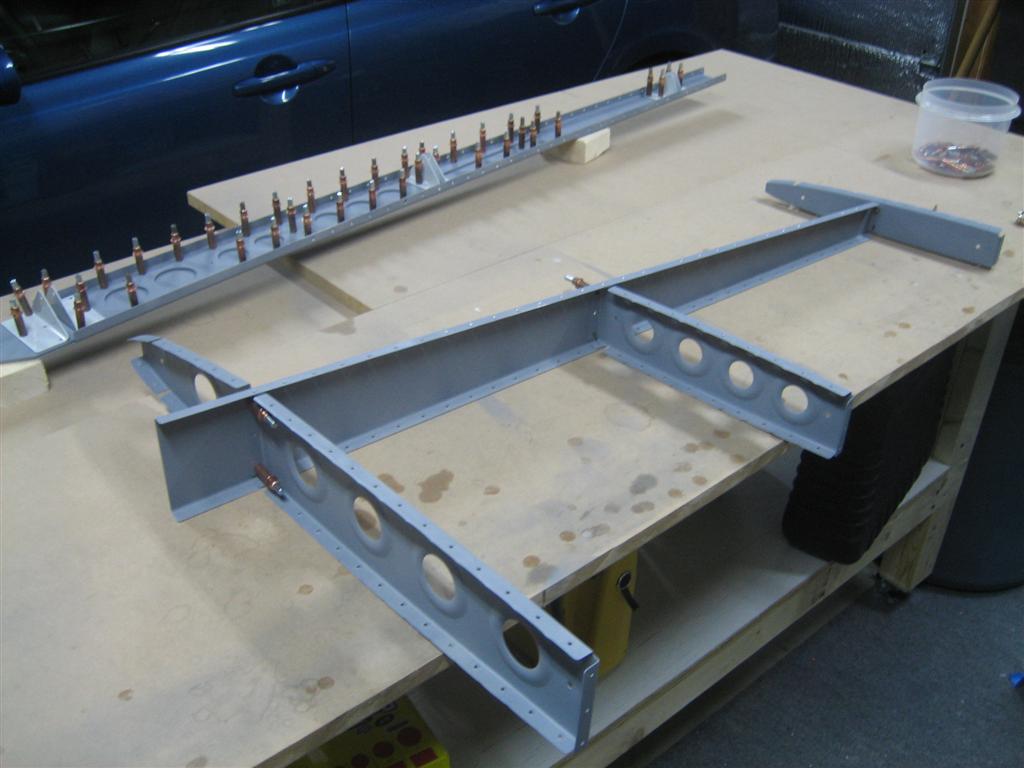
Skeleton and rear spar taking shape.

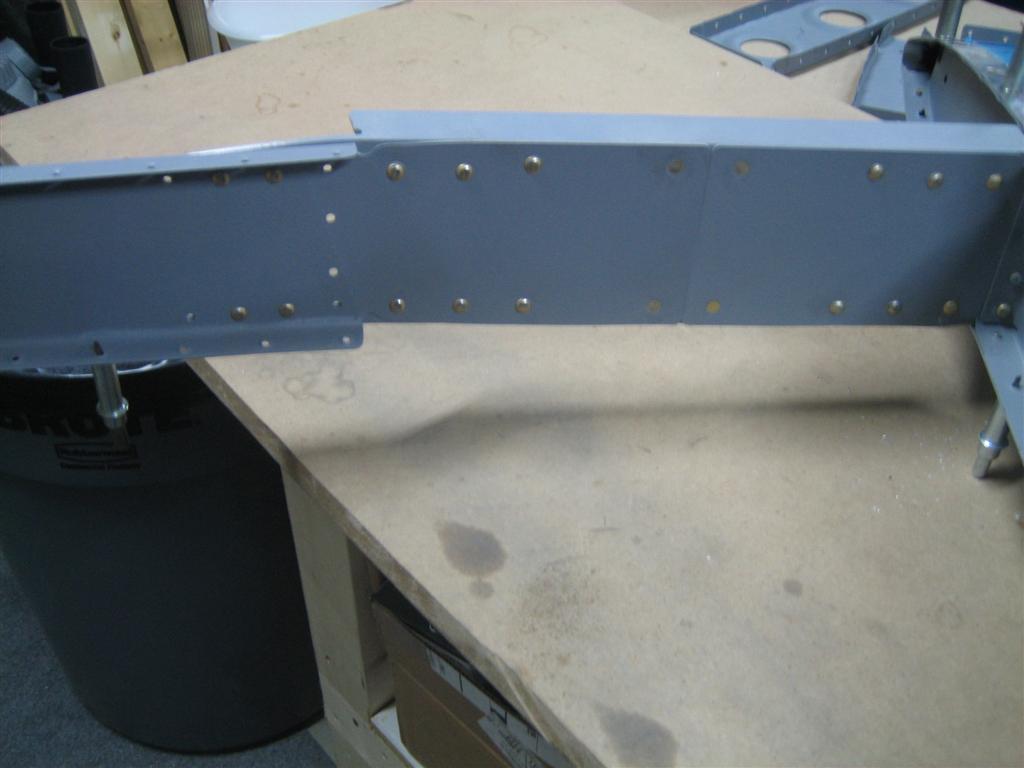
I started with the skeleton, middle rib. Here’s my first VS rivet.
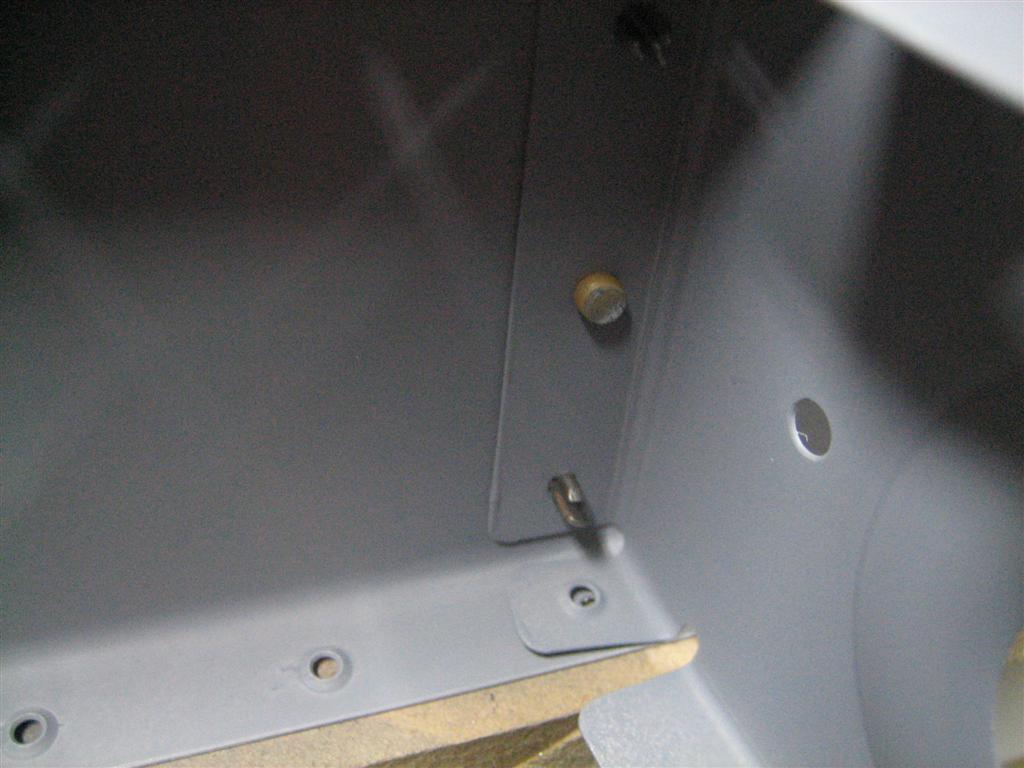
First VS rivet.

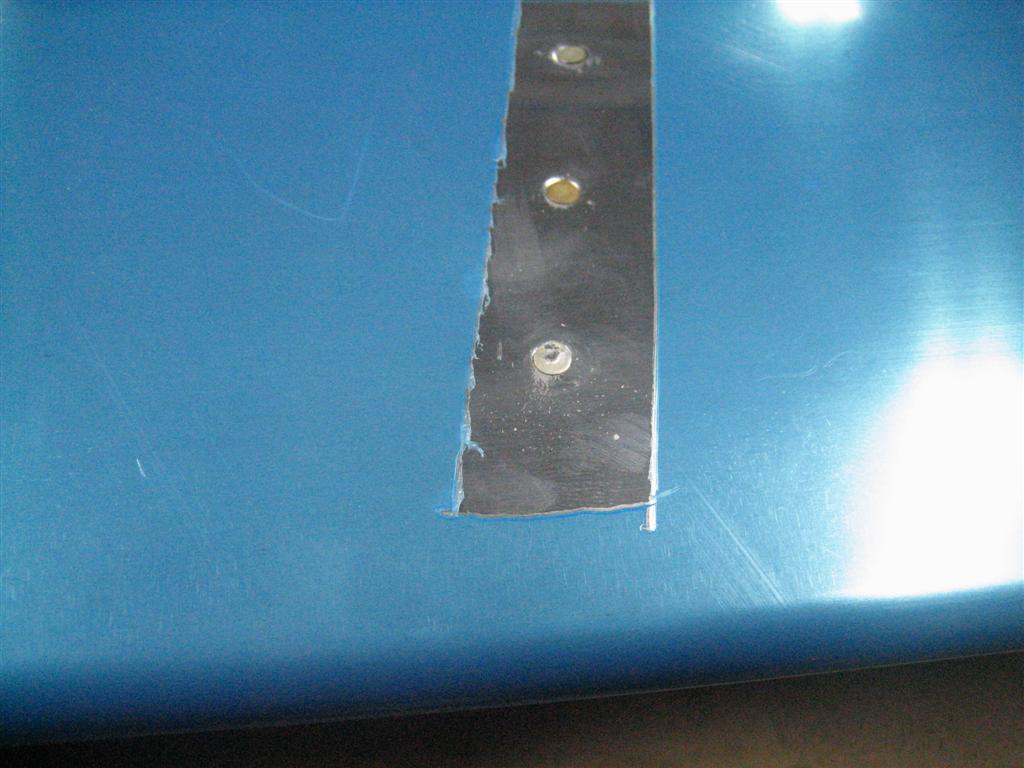
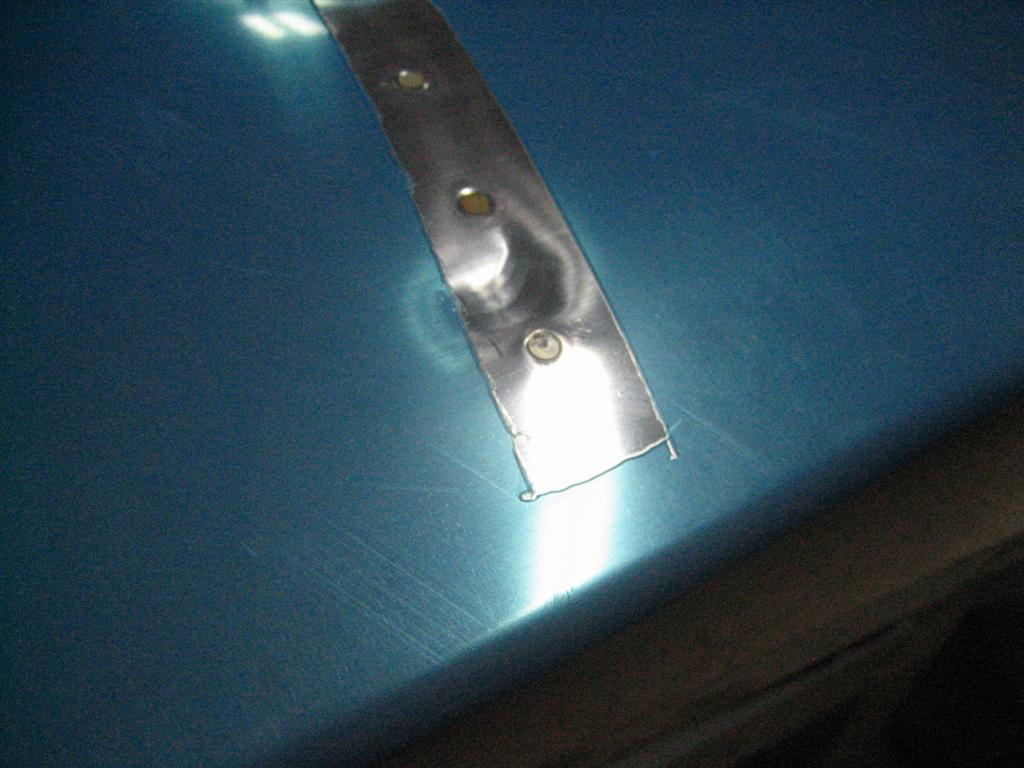
Then, I moved to the tip. See the upper rivet? The skins are sitting flush, this will have to be drilled out.
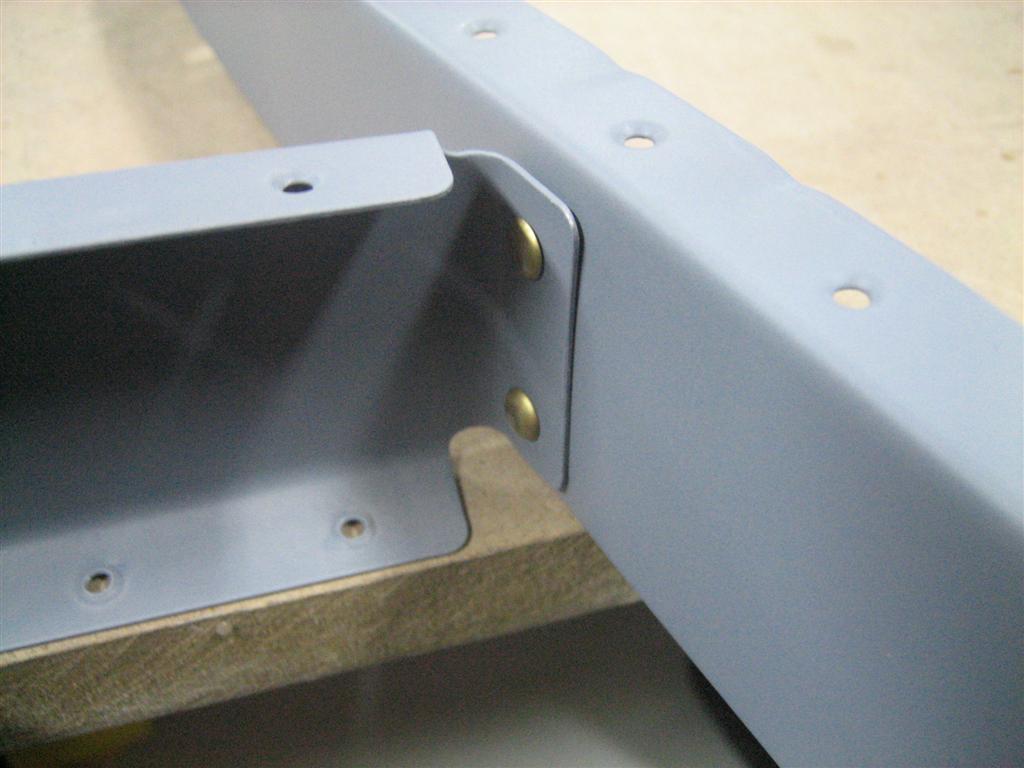
Ahhh! I suck at riveting.

And the lower rivet there started to bend over. I’ll have to drill out both rivets.
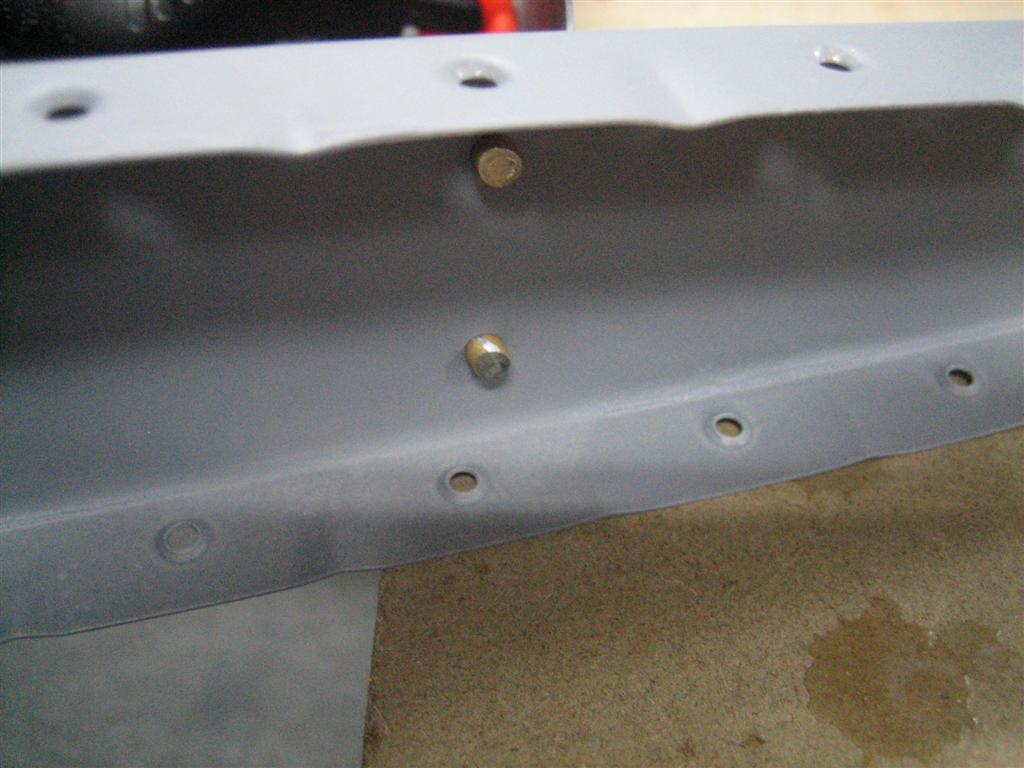
Two rivets to be drilled out.

Back to the middle rib, two more perfect rivets.
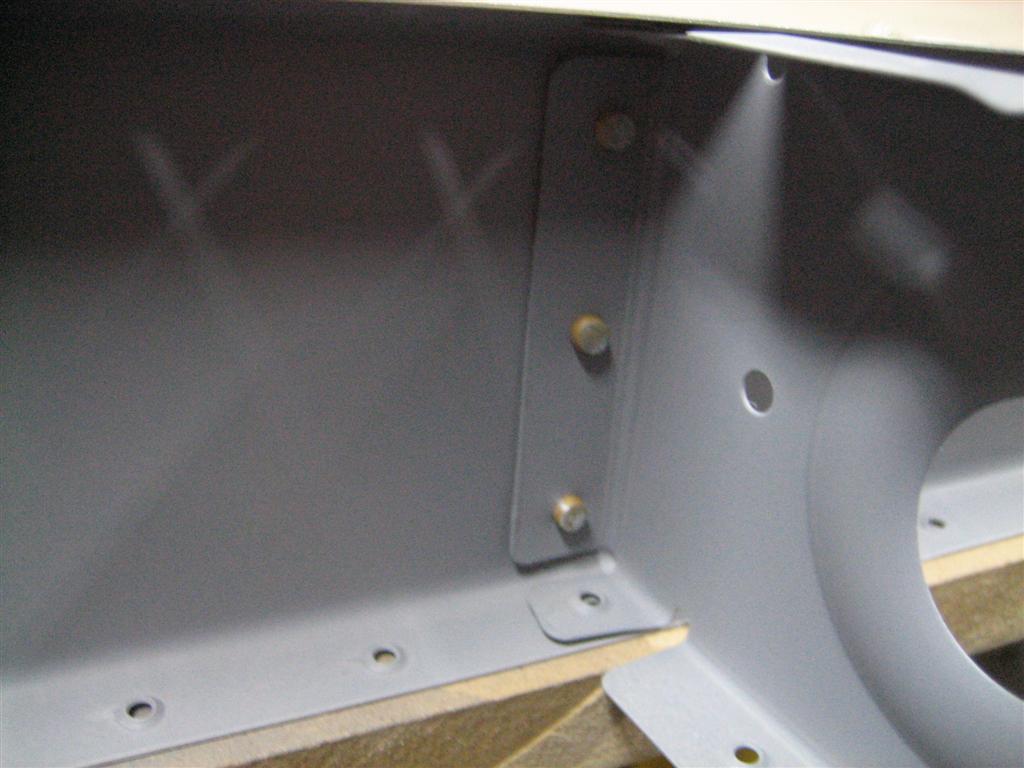
There are pretty good. I need to make sure that bottom one is driven enough.

See the fourth rivet from the right? Started to bend over, so I’m going to drill it out. Also, I’m going to put the shop heads on the thicker material here, also, they’ll be easier to inspect.

Uh oh. See the third rivet from the right? I was supposed to wait and rivet this with the skeleton. Slow down and follow the directions!
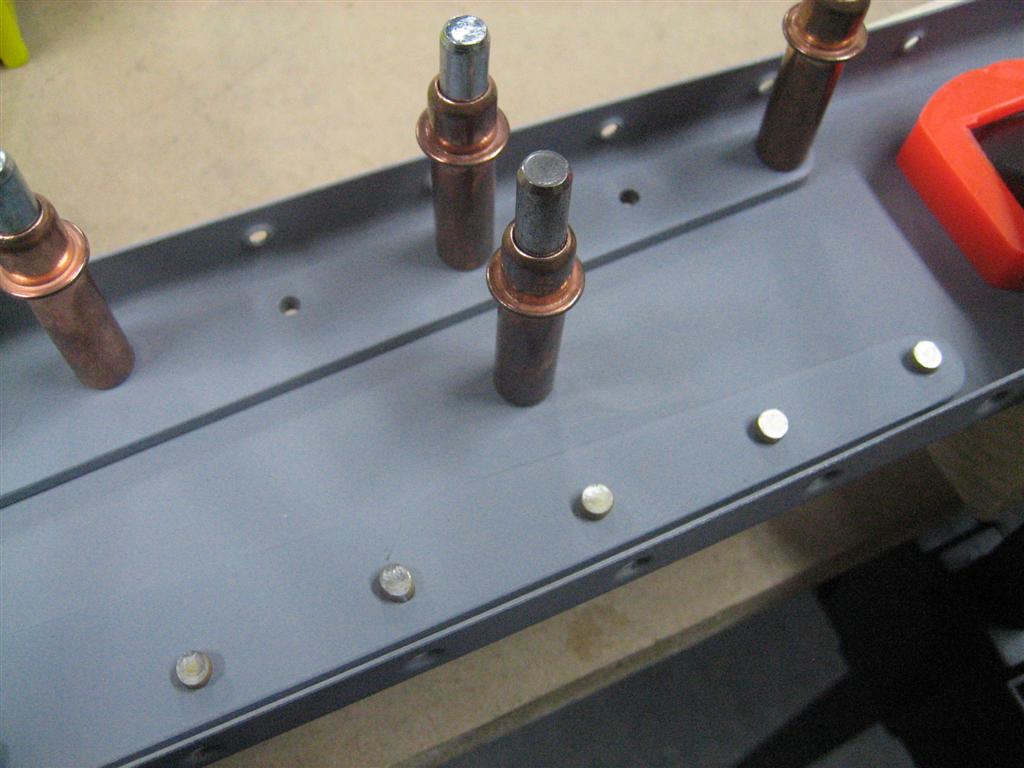
Two more rivets to be drilled out.

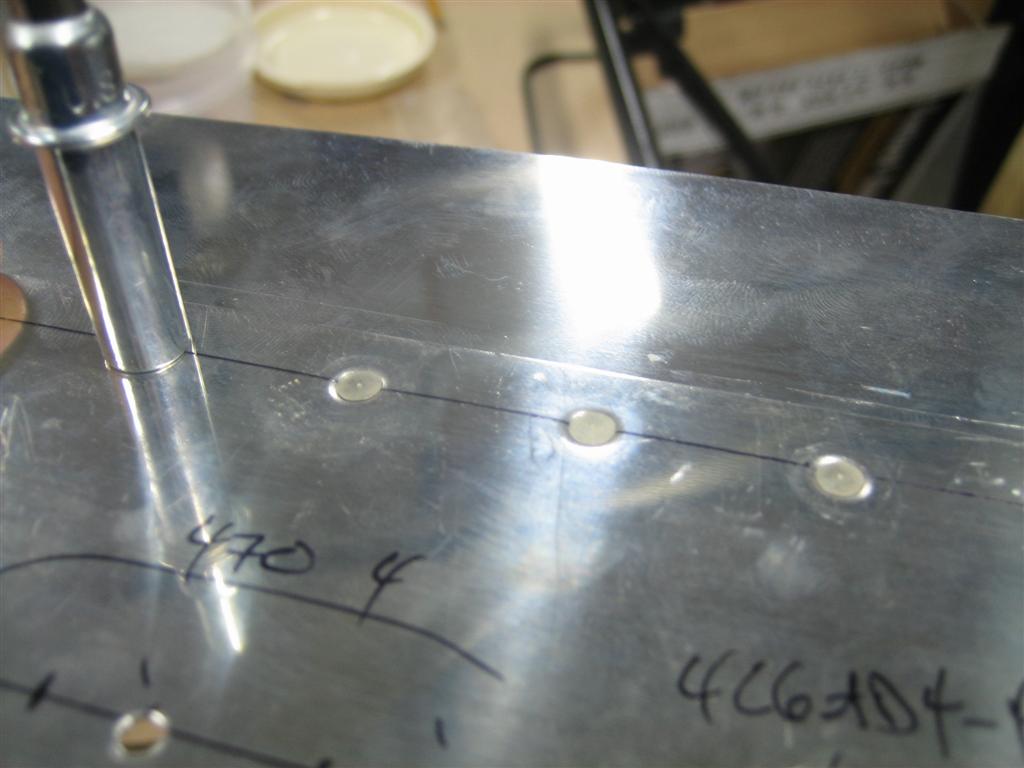
But I was feeling good about squeezing, so I kept going. Until these 4 rivets. Terrible…they all started to bend over. I think my rivet squeezer sucks. I have to squeeze really hard and it it tough to keep everything aligned. I think after I drill these out I am going to shoot and buck these.
4 bad rivets to be drilled out.

At this point, I had to walk away, I was tired, frustrated, and not making any progress. Ugh.

So far, 3.5 hours. I set some rivets today, but I’m not going to count any of them until I drill them out. I’ll update the rivet count later.

Prev | Next


Started riveting right HS

January 15, 2010

Prev | Next

I managed a couple hours in the shop today, even though I was as sick as a dog. In between frantically running to the bathroom to pray to the porcelain god, I did get a couple things done. I planned to get some of the right HS done today, which needed more prep on the skin, and then some riveting.

First, I cleaned and primed right HS skin interior.

Right HS skin all primed and such. Well, on one side, at least.

After flipping, priming the other side, and letting it dry, I decided to fix some of the bad rivets from the other day. They look better now.

HS-710/HS-712 to HS-702 rivets fixed.

Then, I grabbed the right HS ribs and front spar and clecoed some of them to the left HS. I

Right spar clecoed to the left HS assembly. This thing is getting big.

I started by riveting the front spar to HS-710 and HS-714. This time, I was following the directions a little more closely. All of the rivets today turned out great. I had switched from my offset cupped set to a straight set, and they were all perfect. (Don’t mind the two empty holes on the far left, I remembered them later and shot those rivets, too.)

Great rivets if I do say so myself.

Then I riveted HS-405 and HS-404 to front spar. Again, no mistakes. Then, I turned back to the skin once it was dry. On the left side, I waiting until riveting HS-707 and HS-706 to the skin before I devinyled this area. On this skin, I figured that I wouldn’t be holding a bucking bar (that I could drop and scratch the skin) in this area, so why not take the blue off before making it hard on myself. Much easier this way, but I could only do it here. (I have to admit, those nice straight primer lines make me happy.)

Back to the skin. Devinyling the easy way.

The directions have you cleco in HS-707, rivet to the bottom skin, then cleco in HS-706 and HS-708 (to help the skin take shape and sit tight against the aft holes of HS-707), and then rivet HS-707 to the top skin. Just like the left side, I needed AN426AD3-4 rivets where they sometimes call out an AN426AD3-3.5.

The, I let this happen.

Uh oh...

What? Don’t see anything? Try this angle.

AAAAAAAHHHHHHHHHHHHHH!

NO!!!!!!!!!!!!!!!!!

:-(

It was completely my fault. I was getting confident, and was holding the rivet gun with my left hand. I had the pressure set near 50psi (I usually use 40psi for the AD3- rivets) and the gun got away from me.

I stared at it for about 5 minutes, realizing that it was probably okay, but would essentially force me to bondo and paint the tail, which would not have been the end of the world, except I still might want to polish the airplane.

I decided to drill out the 4 rivets I had set in the bottom skin to see if I could help it any with a flush set from the back side. I managed to get my backrivet set in there a little, and it helped, but I came inside as I was getting chilled and frustrated.

Later, I realized that I have a c-frame, and with two flush sets in there, I may be able to very gently hammer it back into shape (or at least get it close). I’ll have to re-dimple, too, because I flattened out the dimple while trying to fix the dents.)

…so…mad…

Maybe this weekend I can fix it up a little and keep going.

Prev | Next


Right HS – Primed skeleton, Dimpled skin

January 14, 2010

PrevNext

Today, I used my lunch hour to swing by NAPA to pick up some more self-etching primer and then get a few minutes of work done before playing with the puppies. Jack and Ginger love it when they get to go outside and play during the middle of the day.

Anyway, I finished edge-prepping, cleaning, and drying the right HS ribs and front spar before priming them.

Then, I broke out the c-frame and finished dimpling the right HS skin. This time, I put a piece of blue painter’s tape (sticky side toward the male (exterior side of the skin) dimple die) between the dies and squeezed them together. I figured this layer of tape would help prevent some of the circles I am getting during dimpling.

3/32" Dimple Dies covered in blue tape.

The resulting dimples don’t have as much of a circle around them, and the dimples are just as deep. I wish I had known that the first time around. I’m not very happy that my right HS is going to end up looking a lot nicer than the left.

It was a little short of an hour today, but I ran a little long yesterday, so I’ll log an hour.

Prev | Next


Primed Front LH Spar, Devinyled RH Skin

January 6, 2010

Prev | Next

After getting home late from work and running back out for some takeout, I got in about an hour before heading to bed.

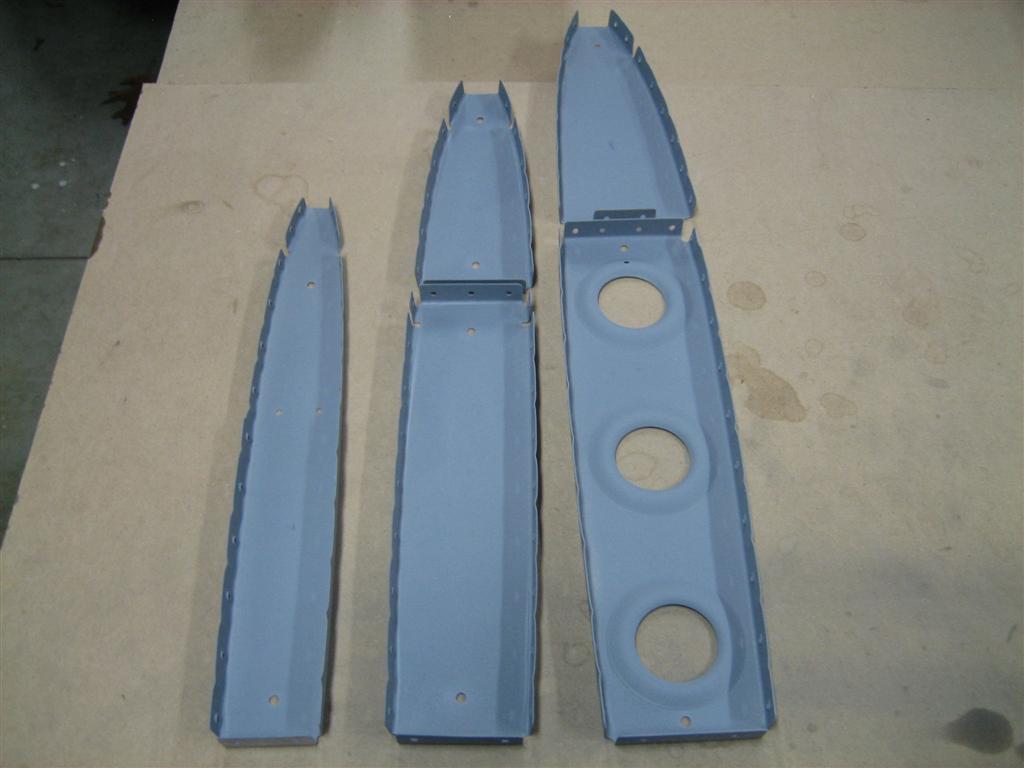
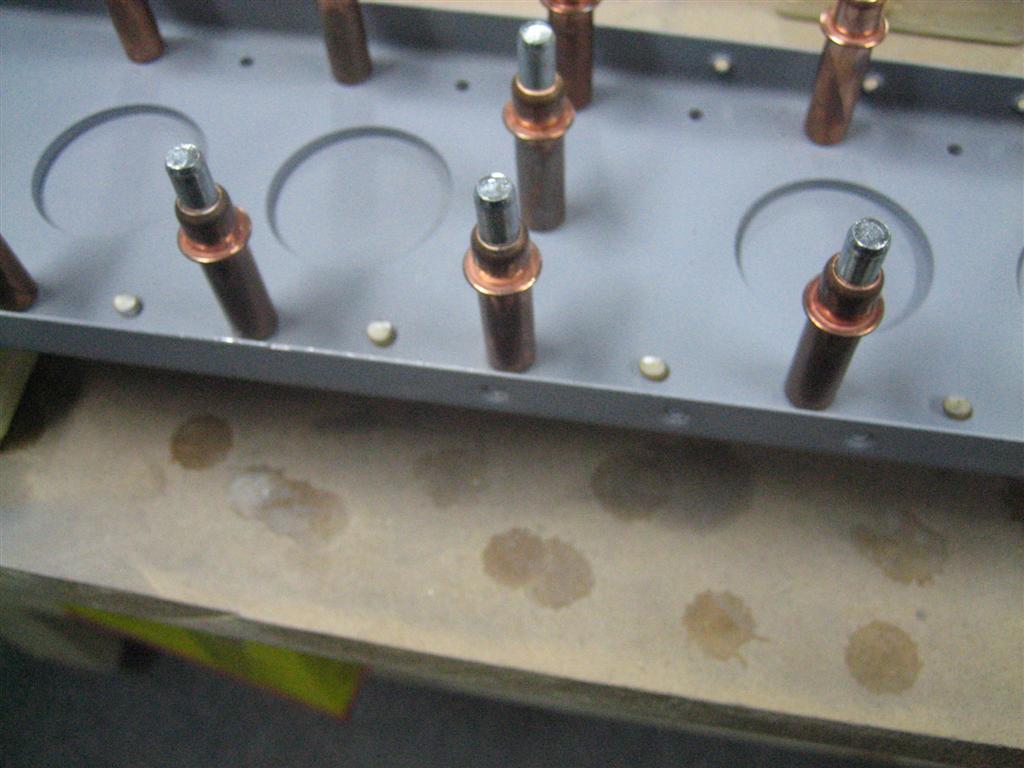
First, I finished cleaning up (scotchbrite, dawn detergent, and lacquer thinner) the left HS front spar in preparation for priming. I don’t love doing these one piece at a time, but the spray can makes it easy, and I can complete a few parts in an evening. I did the front spar so I can maybe start riveting stuff together this weekend. I still have some work to do on cleaning up the rear spars and rear spar reinforcement bars, but I could start with the skins and ribs, then finish the rear spar stuff once I have to plug it into the back of the completed HS.
Left front spar (HS-702) sitting next to the left ribs I finished the other day.

Then I devinyled the right HS skin, which went much faster than the left skin.

Right HS skin. Doesn't that look nice?

Here's the inside...

Also, a fellow RV (-8A) builder at work was kind enough to lend me his Avery C-frame. Maybe I’ll get a chance to do a little skin dimpling this weekend.

Borrowed c-frame. Wuhoo saving money!

Next up:

1) Finish dimpling left HS skin
2) Deburr right HS skin
3) Dimple right HS skin
4) Prep and prime inside of both skins
5) Finish prep for right HS ribs and front spar
6) Prime right HS Ribs and front spar
7) Prep and Prime rear spar components
8) Rivet HS together

Prev | Next


More HS Priming, Dimpling

January 5, 2010

Prev | Next

I got in 30 minutes cleaning the remaining left HS ribs and getting a coat of self-etching primer on both sides. After looking at last night’s primed ribs, I am still very happy with the decision to use self-etching primer.

Here are all 5 ribs from the left HS.

I was going to put in an hour or two dimpling the left HS skin with the pop-rivet dimplers, but I broke another nail (I should point out this is a real nail, not my fingernail), and getting frustrated, started questioning using the pop-rivet dimplers for the skins. Then I decided to test out the dimples with an AN4263-3.5 rivet. Here is the result:

Spring back dimple die used on the upper left dimple. Pop-rivet dimple dies used on the bottom right dimple.

I am not very happy with the dimples from the pop-rivet dimples. I am going to put these back in the tool chest, and only use them in tight places. Tomorrow, I am going start asking around for a c-frame to use on the skins.

I also worked for 30 minutes on preliminary edge-prep for the VS ribs, but I’m going to log that under another post.

Prev | Next


Left skin work, primed two ribs

January 4, 2010

Prev | Next

“I need to get something other than deburring and dimpling tonight, so I think I will finish prepping the rear spars and rear spar reinforcement bars, prime, and maybe start riveting. We’ll see how it goes.”

That’s what I said to myself yesterday at about 2pm. Guess what I spent all night doing? Deburring and dimpling!

Here's my new skin deburring and dimpling station. Notice the glass of wine and the UNC game on the projector. Essentials for successful deburring/dimpling.

Then, I decided to finish prepping a few of the ribs. I’m going to prime a few components at a time while I am working on other stuff.

I believe this is HS-707 and HS-708.

2 of 10 HS ribs ready to go.

After deburring the left HS skin, I dimpled all the holes I could reach with my 3″ yoke, then broke out the pop-rivet dimple dies and started on the interior holes. I broke the nails used to squeeze the dies together on the first 3 holes consecutively, but then found a good sweet spot on the next two. Then it was time for bed. I don’t know whether I’ll continue with the pop-rivet dimple dies or opt for a c-frame. I think the c-frame is going to be loud, which means I can’t work late with it. Hmm.

All of the edge holes dimpled, and the 5 top interior holes on one side dimpled. More tomorrow, I guess.

I think I put in about 2.5 hours today.

Prev | Next


Rear Spar, Front Spar

December 30, 2009

Prev | Next

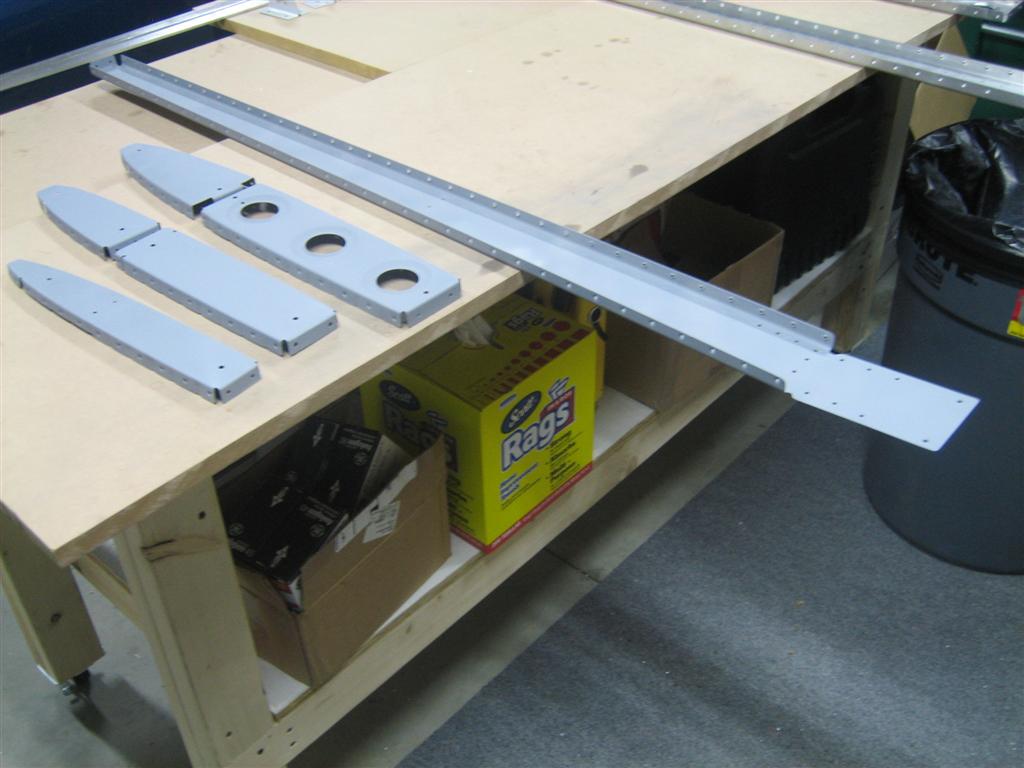
Well, I finally started today. First thing I did was break the corners of the HS-609PP. I used my grinder, which did a good job, but got clogged with aluminum pretty quickly. I think my next big investment will be a bandsaw.

The requisite shot of before and after rounding edges.

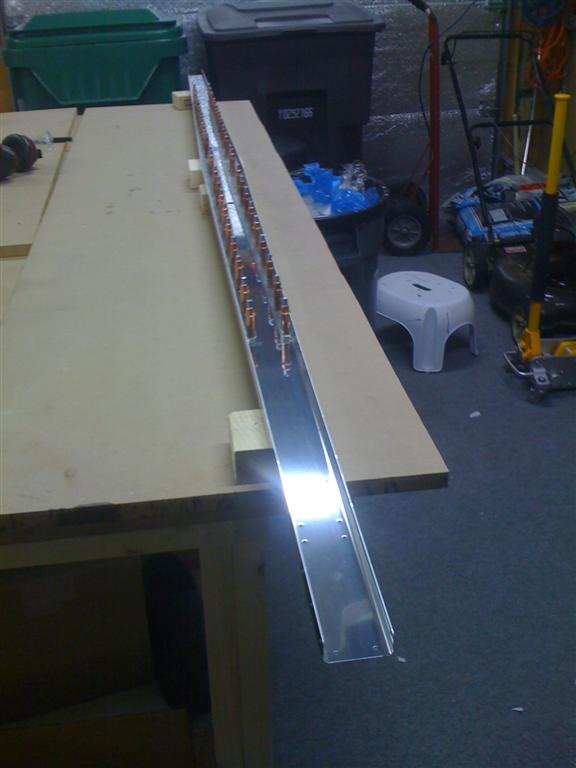
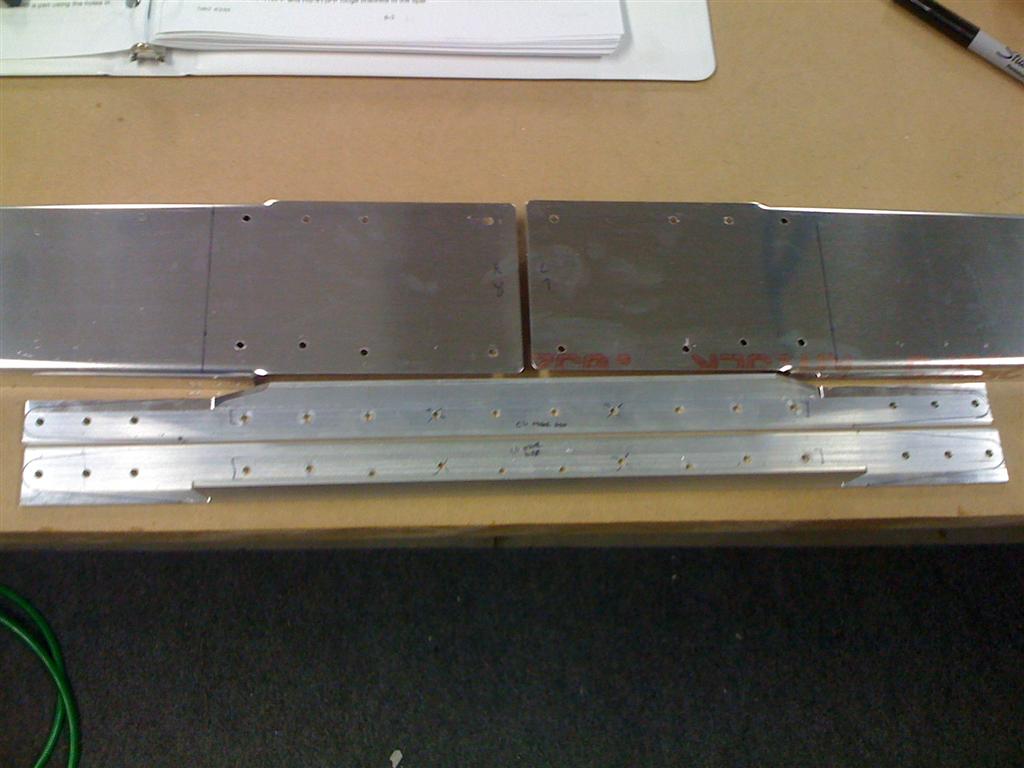
Then I removed the blue vinyl from the rear spars (HS-603PP) and clecoed the 609s to the 603s. To do this, I needed to increase the radius of the 609s that rests against the web/flange intersection of the 603s. No big deal. Once I did this, they fit great. I didn’t finish the edge prep on the 609s, I’ll do this prior to priming everything. Then, I match-drilled all the holes, including enlarging the HS-708/HS-603PP (inboard rib attachment) holes to #21.

Rear spar reinforcements clecoed to Rear spar channels. It's starting to look like an airplane? Ha.

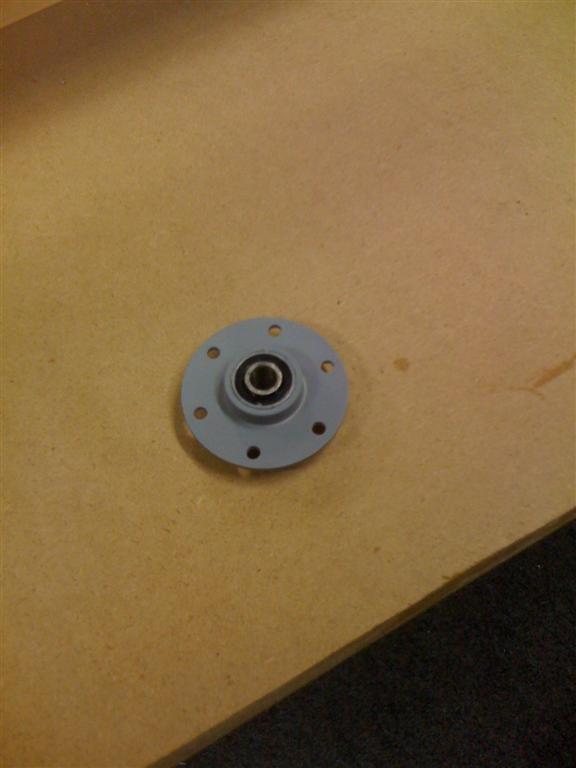
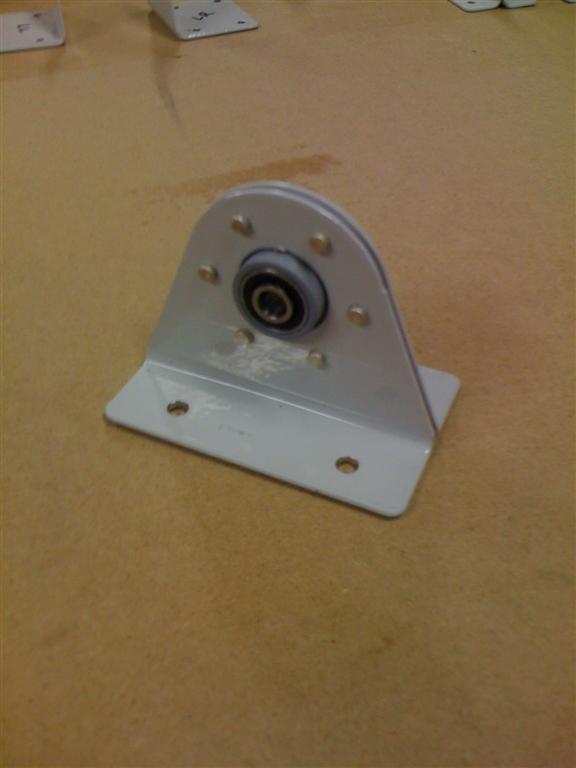
Next, the directions have you attach the elevator hinge brackets. After match-drilling all of the outboard brackets, they have you sandwich the VA-146 bearing in between HS-411APP to HS-411BPP.

Clecoing the center bearing supports in.

One one side is pre-punced, so you clamp, drill 4 holes, cleco, remove from the spar, and drill the rest of the holes.

Getting ready to drill.

Then I masked off special parts of the VA-146 to prep for priming.

Taped off the important stuff.

And then shoot some primer. (I’m using the rattle can self-etching primer.)

Scotchbrited, cleaned, and primed the center bearing.

Then reassemble and rivet. I found (contrary to some other builders) that the rivets called out in the plans made a great shop head. I think other builders went up a size.  I’m definitely happy with my first six rivets.

The first six rivets.

Here’s everything on the rear spar clecoed back together.

All the hinge brackets clecoed in place.

Then, per the plans, I marked the taper and radius locations for the HS-710 and HS-714 reinforcement angles.

Marked the tapers on HS-710 and HS-714 per the plans.

It was a little late to be running the power tools, so instead, I marked the bend lines on the HS-702 front spar channels. This takes some careful measurement and marking, so take your time.

I also marked the bend lines on the front spar channels. (HS-702)

Then, I strayed from the plans a little. They have you use a 1/8″ bit to create a notch relief hole, then enlarge to 1/4″ using a unibit. I used snips and then a file. The second one turned out better than the first (which I hear is pretty common on everything in the project), and I had some trouble making them look perfect. (I know, things don’t have to be perfect, but it bugs me, anyway.) Biggest lesson learned: cut the flange in the correct place first, then unbend the flange to give you more material to work with. You can see in the top one in the picture below that I didn’t do this, and had to taper into the bend relief notch. (The bottom one below is better, nice straight line back to the relief notch.)

Finished HS-702 shaping with bend relief notches.

Then I bent HS-710, HS-714, and both HS-702s. I created a cardboard template using trigonometry. I took the tangent of 6 degrees. Which is a little over 0.1. (This means fromthe bend line, for every inch you go laterally, the angle will be just over 0.1 inches up.) That’s a little hard to measure, so I took the inverse (to figure out how many inches laterally I need to go for 1 inch up), and got just over 9.5 inches. I have a calibrated 6 inch ruler, so I divided by two, and ended up with mike’s numbers; 4.75″ over, and 0.5″ up.

Now that I have my template for six degrees, let’s get bending.

After trying a few methods in the vise, I ended up just lining up my bend line with the edge if the table, holding a wooden block over the piece, and putting a little pressure on it. If you go slowly, you can get 6 degrees pretty dead nuts on. I laid everything on top of eachother, and it all lined up very nicely.

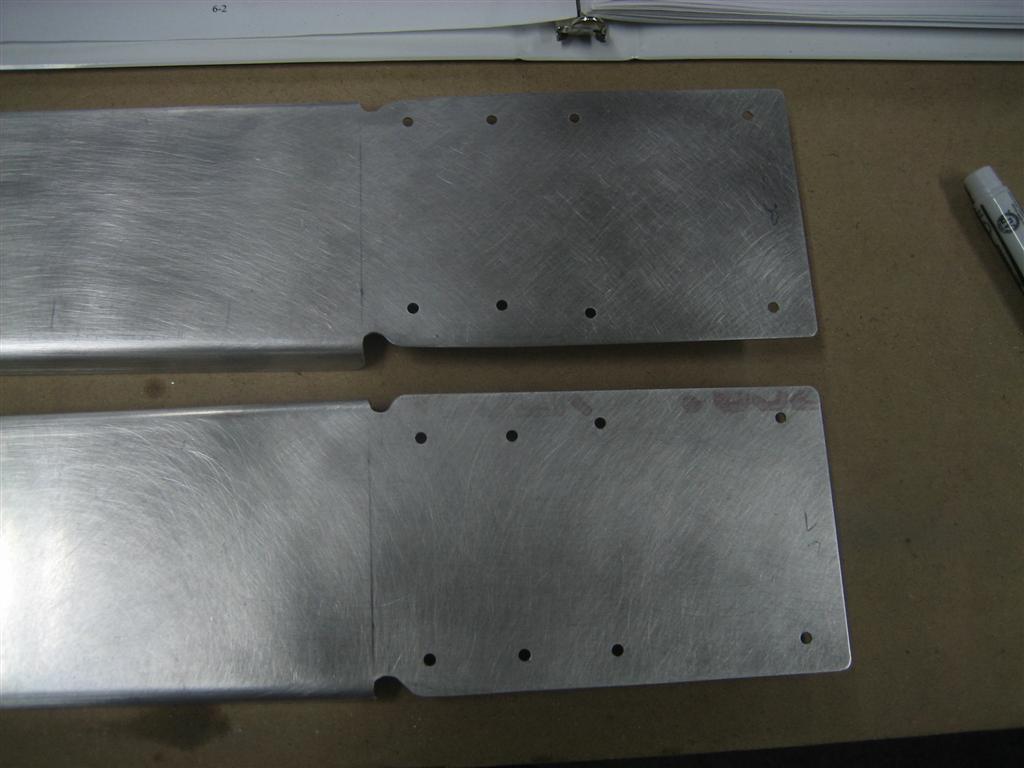
Lastly, I finished the front spar section by dimpling the HS-702s, and countersinking (first ever countersink!) the HS-710 and HS-714 for the center two holes only. Remember, flush rivets go on the aft side here, so the countersink and the male dimple die go from back to front.

Countersunk HS-710 and HS-714, dimpled HS-702.

A solid 5.5 hours today.

Prev | Next


Practice Kit – Finished

October 4, 2009

Prev | Next

Sunday morning, I managed to finish off the practice kit. Here are the pictures.

Here are the skins riveted to the spar. Notice how I didn't make the jig to hold it to the table.

Here are the skins riveted to the spar. Notice how I didn't make the jig to hold it to the table.

Another shot of the skins riveted to the spar.

Another shot of the skins riveted to the spar.

After the skins were riveted to the ribs and the trailing edge wedge, I rolled the leading edge and clecloed it together. I haven't edge formed the top skin yet, hence the ripples.

After the skins were riveted to the ribs and the trailing edge wedge, I rolled the leading edge and clecloed it together. I haven't edge formed the top skin yet, hence the ripples.

The finished product.

The finished product.

Overall, I am happy with the results. I don’t think they are airplane worthy (I don’t know if I will ever be happy with the final product), but I feel like I am ready to start on the real kit. All of the riveting came out nice, but some of the other aspects (dimpling, countersinking, edge rolling) are still not up to par.

Biggest lesson so far:

1) Go slow, take your time, read the plans, and be careful.
2) The skins don’t look too bad, but I have a feeling there will be too many scratches to polish the final airplane. I’m planning on paint anyway, so I should be okay.
3) Other things, I want to acquire some of the tank dimple dies for the understructure. Some of the skin to rib seams didn’t sit as nicely as I wanted, and I think the slightly deeper dimples in the ribs will accept the dimple in the skin better.
4) Buy a bigger backriveting plate. I just have a 1 x1/2 x 36 inch steel stock. I had to be really careful to keep the rivets lined up. With a wider plate, I wouldn’t’ have had to move the skin around, which caused…
5) …scratches in the skin. Next time I removed the vinyl from the skin, I am going to immediately replace it with painters tape. All of the scratches on the skin are where I removed the vinyl. This can be prevented.
6) Priming. Using the self-etching primer is so easy, I think I may do all of the interior skin next time ( I only primed the rivet lines, where two pieces of metal would meet this time).
7) I need a no-hole yoke for the rivets near the rear of the trailing edge. I managed with a thin bucking bar, but I didn’t like the results. A no-hole would make this a non-issue.

Prev | Next


Practice Kit – Priming

October 1, 2009

Prev | Next

I decided to prep and prime the practice kit to smooth out the process before starting on the airplane. i don’t know if this is the final process, but it was I did for the practice kit.

First, I scrubbed all of the surfaces to be primed with a soapy red scotchbrite pad. Then clean with acetone and let dry, then prime with a medium gray self-etching primer. I’ll continue tomorrow.

One of the skins, primed and de-blued.

One of the skins, primed and de-blued. Stiffeners, doublers, trailing edge wedge, spar, and ribs ready to rivet.

Stiffeners, doublers, trailing edge wedge, spar, and ribs ready to rivet.

Stiffeners, doublers, trailing edge wedge, spar, and ribs ready to rivet.

Prev | Next


Finished the first assembly in the Practice Kit

September 29, 2009

Prev | Next

Tonight, I finished the first assembly in the practice kit. Only a few notes, and some lessons learned.

Big lessons learned:

  1. The soldering iron leaves a mark if you aren’t careful, be gentle, and go slow enough that it melts the vinyl.
  2. Deburring holes was very easy, even with just an oversize drill bit.
  3. Buy a nice countersink. I faked it with a drill bit, and the results will not be acceptable on the real project.
  4. Less scratches tonight, but still a lot. I need to get some scotchbrite pads and self-etching primer to rehearse the prep and priming phases.
  5. I want to experiment with priming before dimpling. I’ve heard people have had good results (said another way, no bad results due to priming a weirdly angled surface in the dimple.)
I got out the soldering gun and tried my hand at removing the vinyl covering in a straight line.

I got out the soldering gun and tried my hand at removing the vinyl covering in a straight line.

MY FIRST RIVET. It is so beautiful.

MY FIRST RIVET. AN426AD3-3. It is so beautiful.

Three more rivets. I squeezed and bucked with flush and cupped sets. I am using a 4X gun, which means I had the pressure all the way down to 20 psig. It worked really well for the AD3s, but I might need more pressure for the AD4-4s.

Three more rivets. I squeezed and bucked with flush and cupped sets. I am using a 4X gun, which means I had the pressure all the way down to 20 psig. It worked really well for the AD3s, but I might need more pressure for the AD4-4s.

The final (and blurry) product. It's probably for the best that you can't see the fingerprints and scratches on it.

The final (and blurry) product. It's probably for the best that you can't see the fingerprints and scratches on it.

I am very happy that I did this part of the practice kit first. Now I know how to proceed on the real kit, and nothing with drilling, deburring, dimpling, countersinking, or riveting will be new to me, even on the practice kit. (I plan on displaying the practice kit prominently, so it better look good.)

Prev | Next