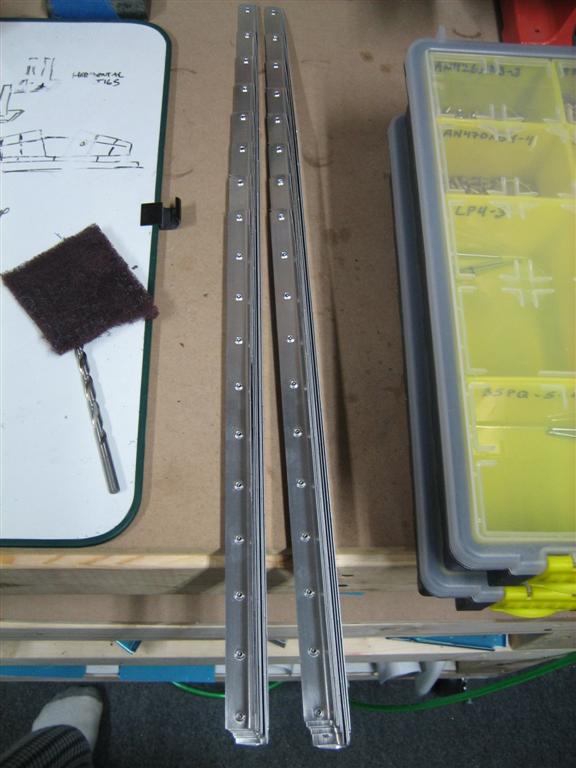
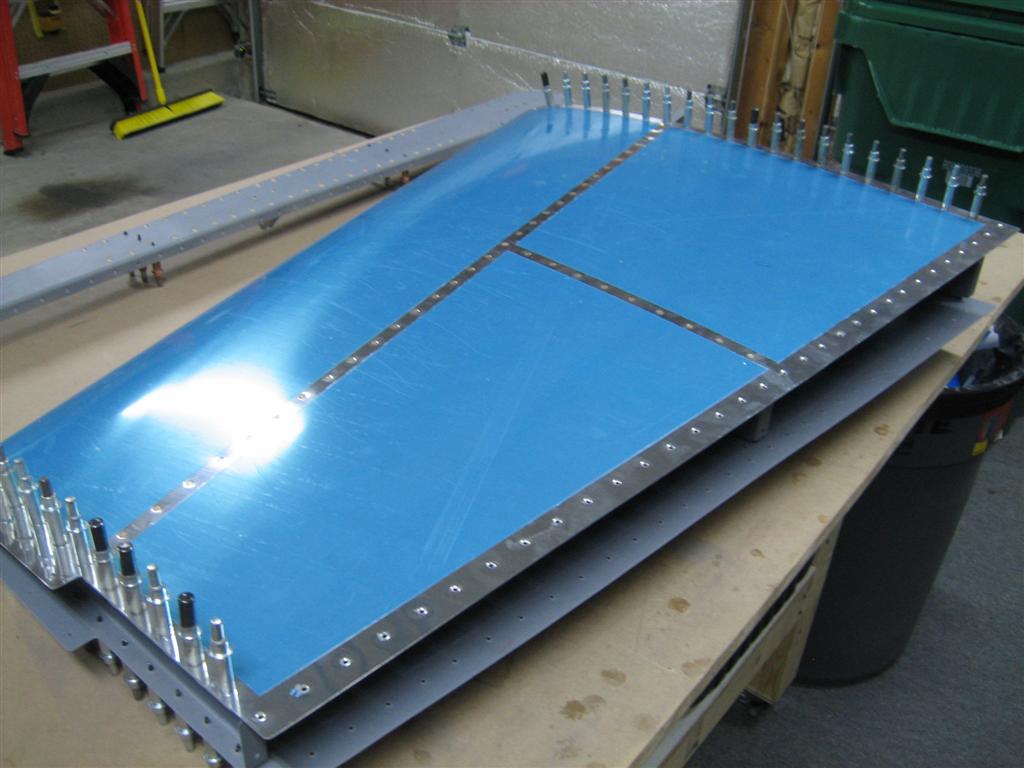
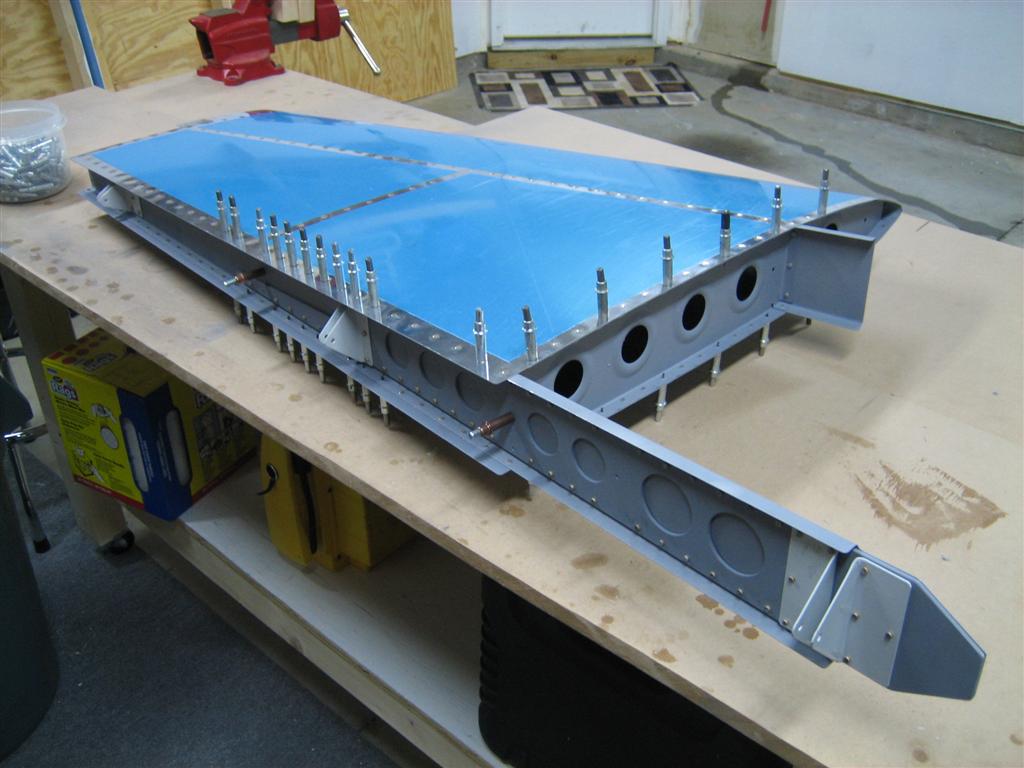
Rudder 99 Percent Complete

April 5, 2010

Prev | Next

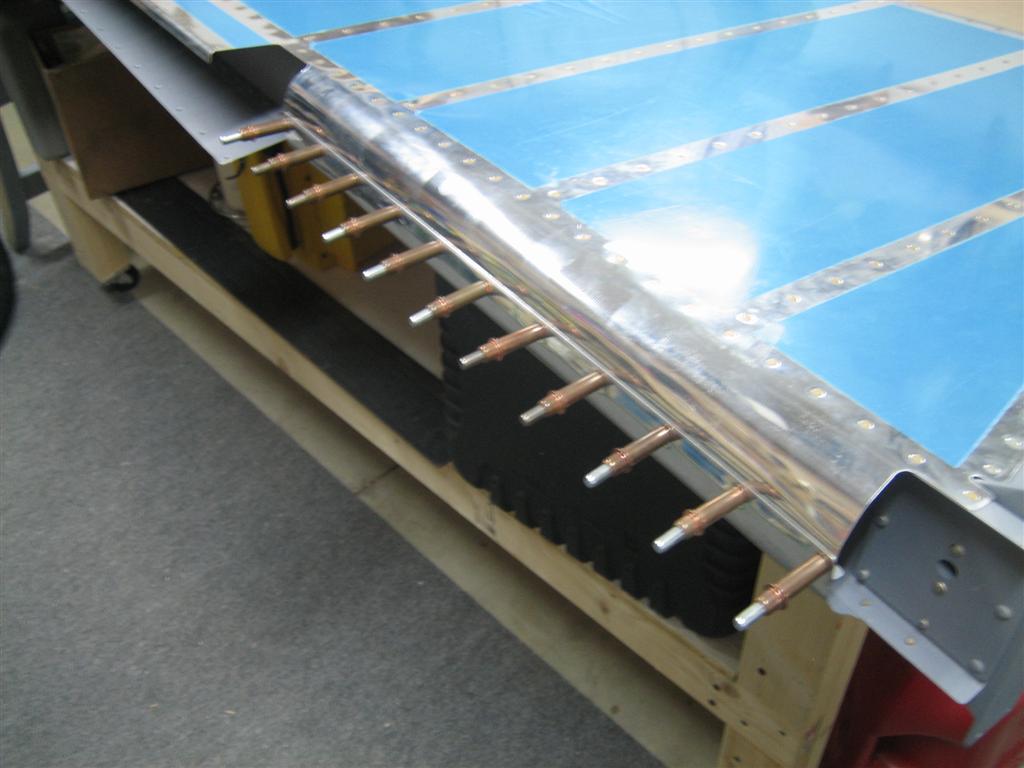
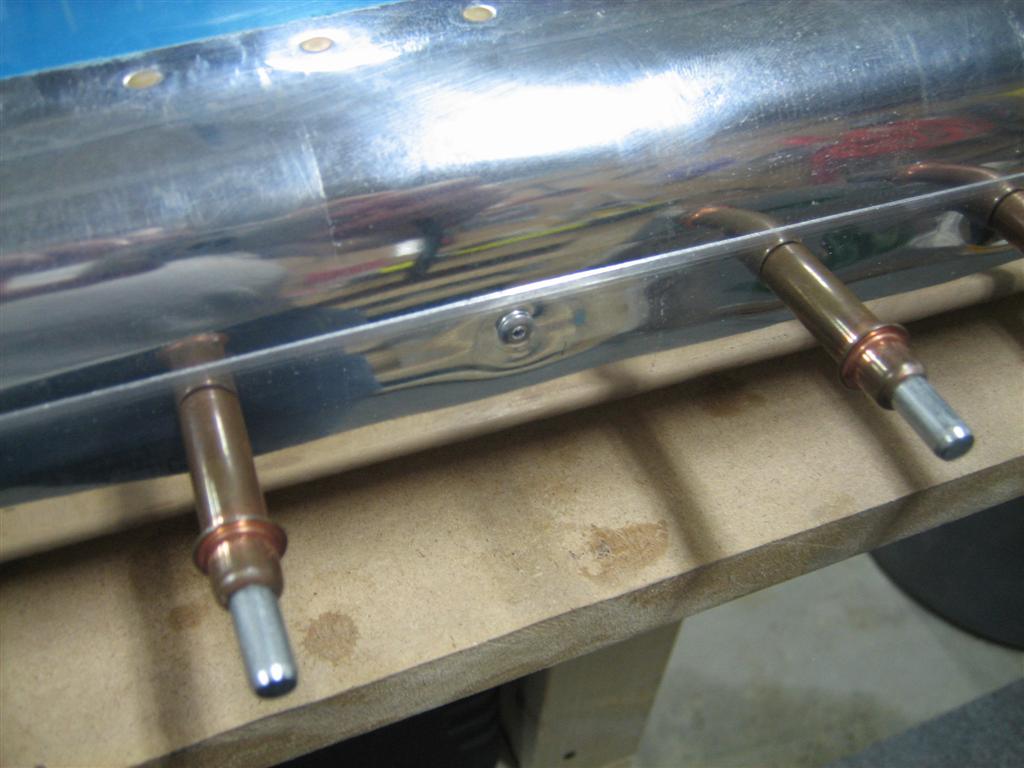
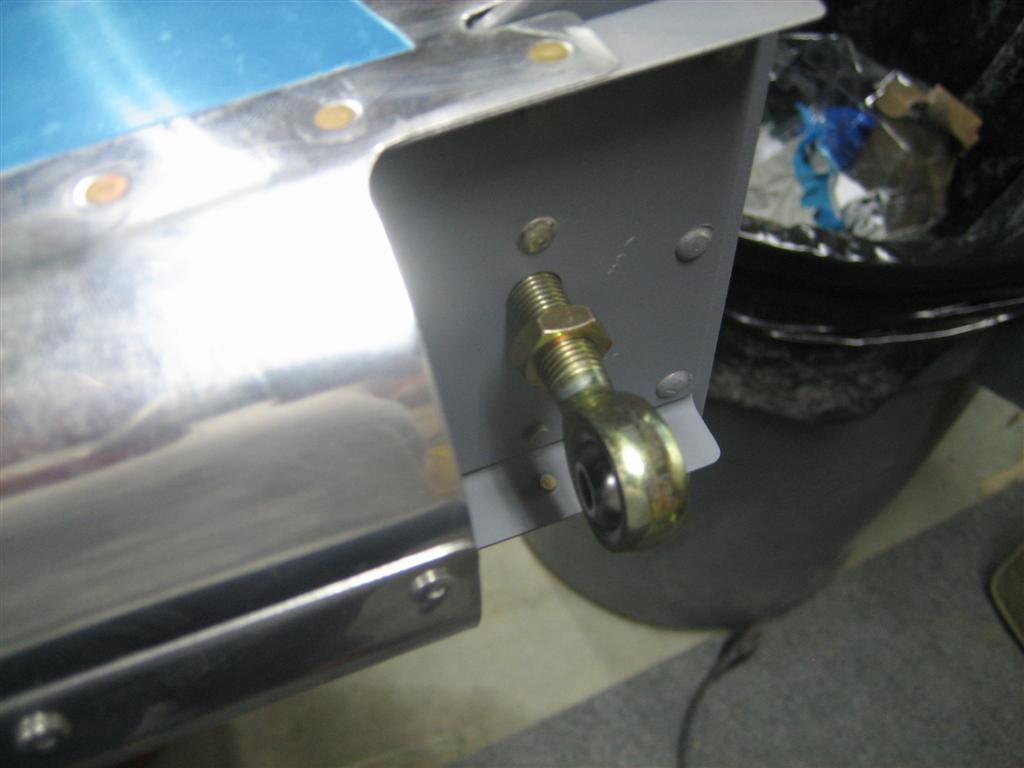
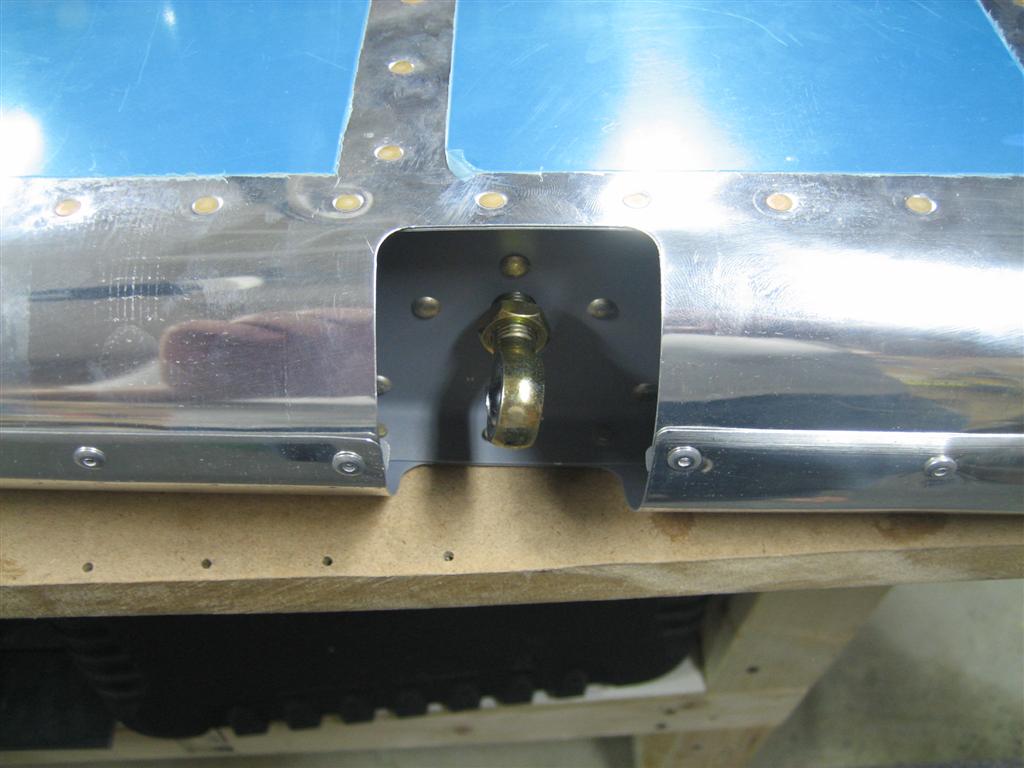
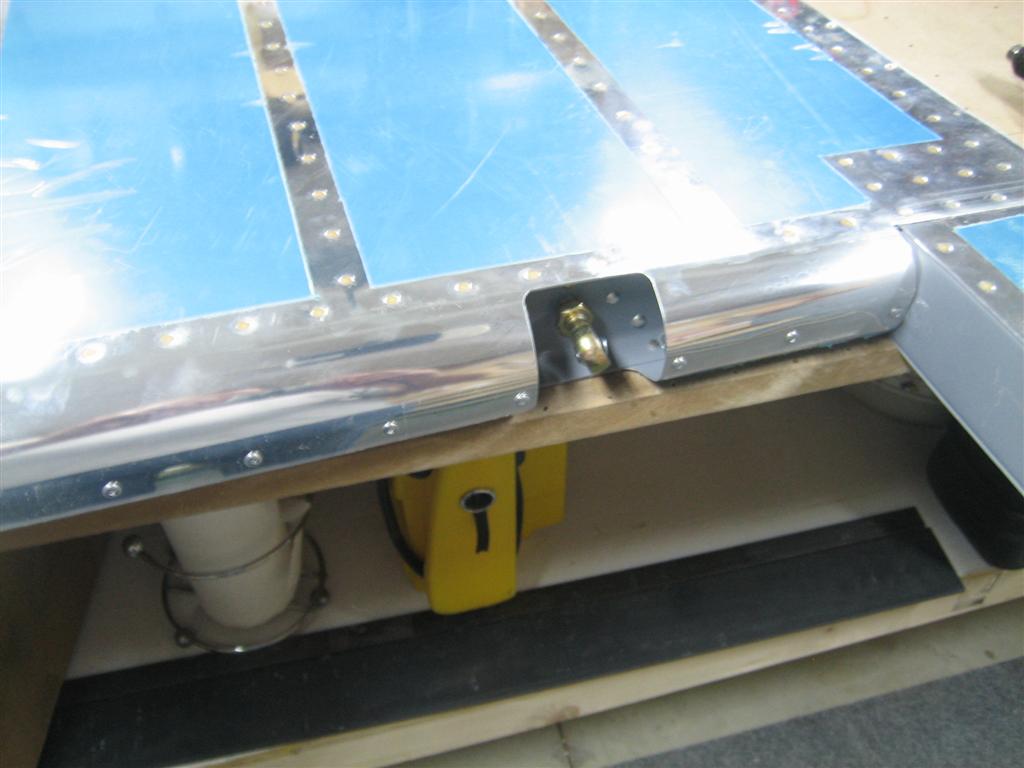
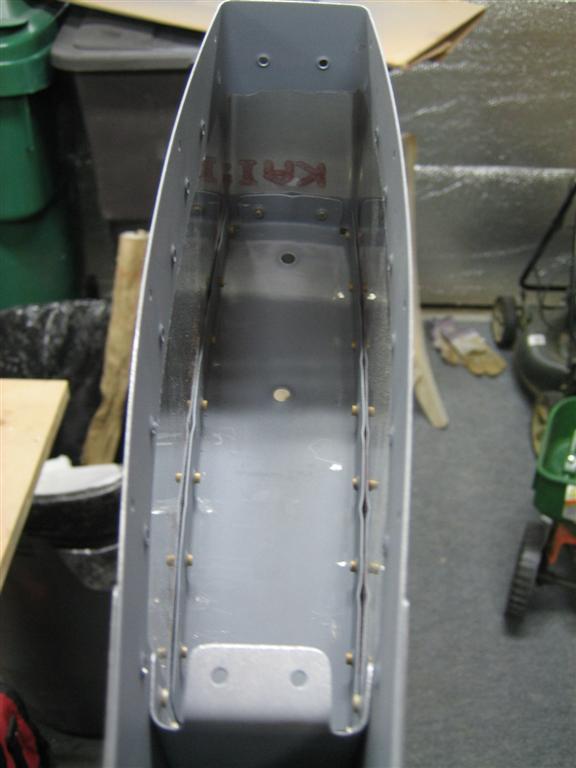
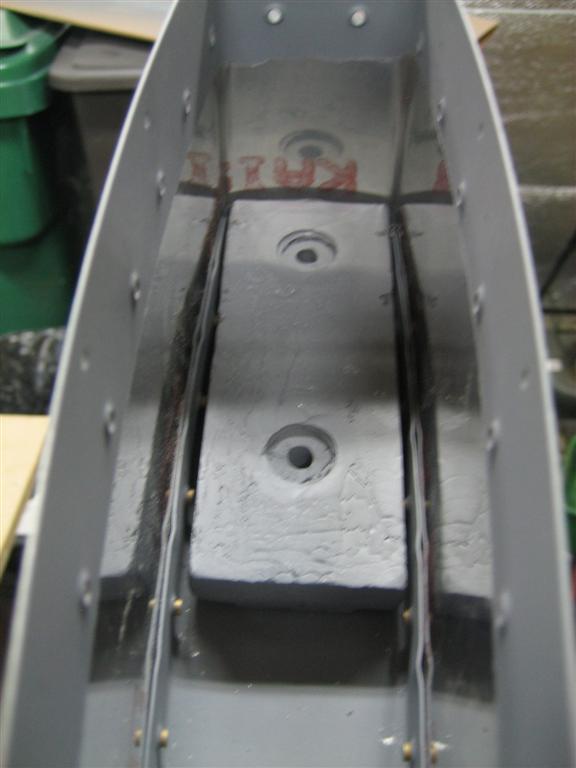
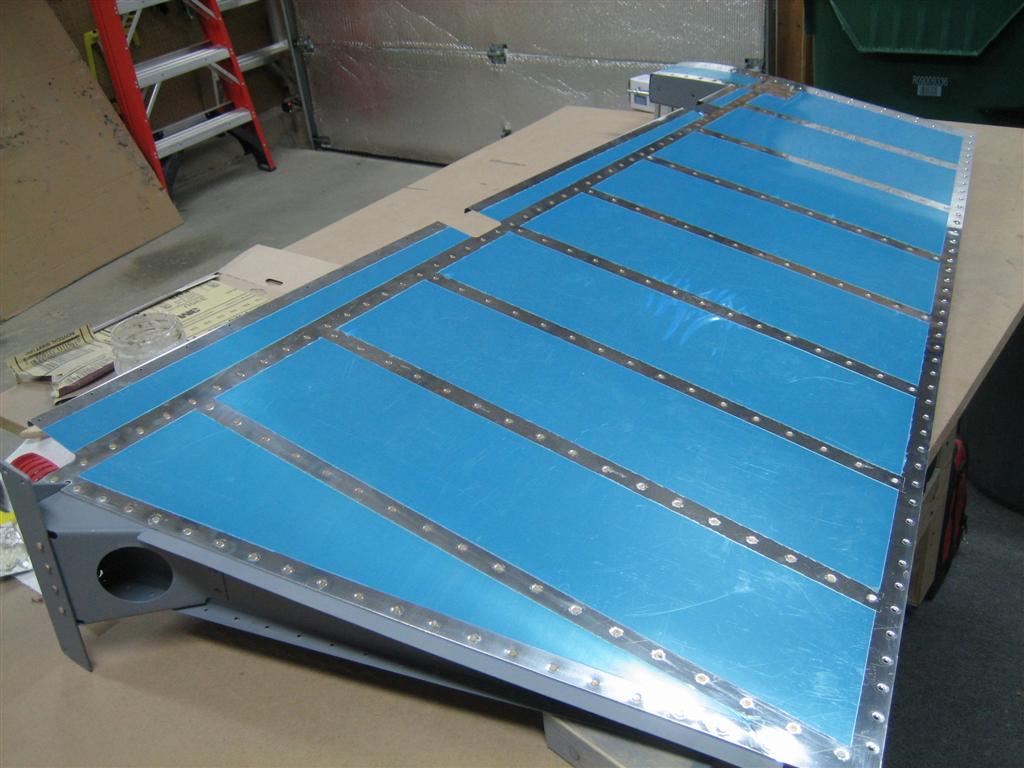
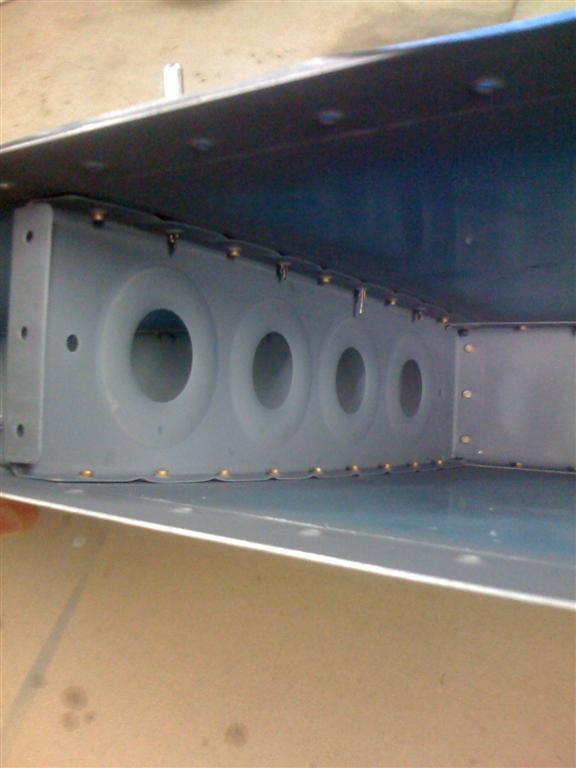
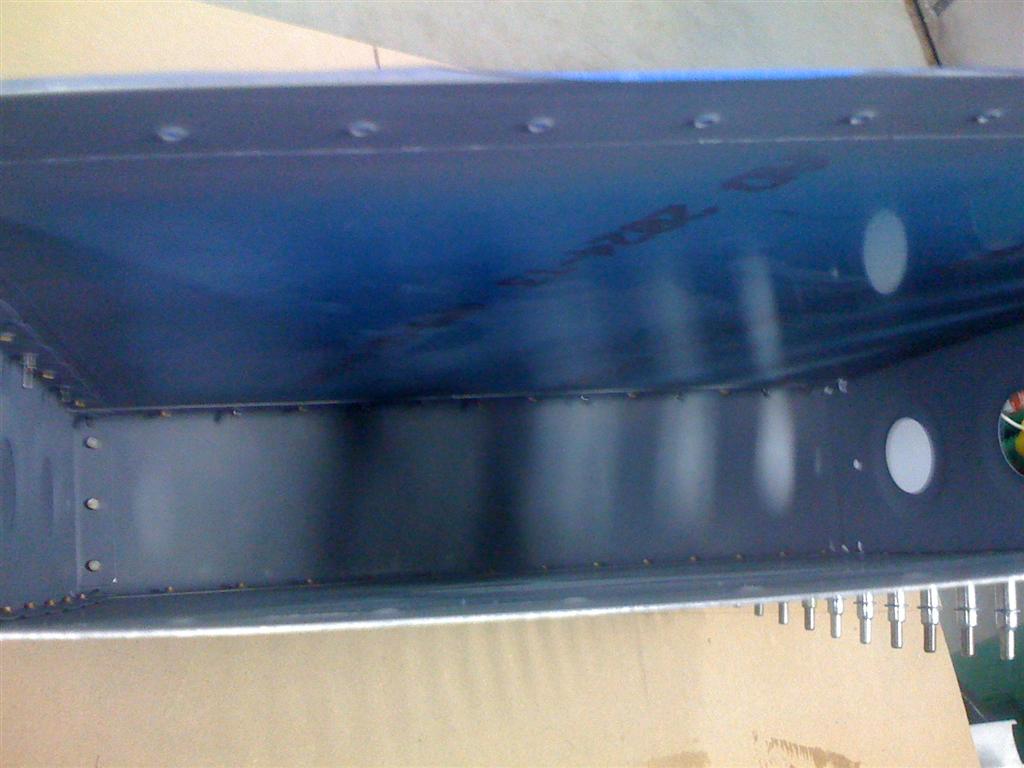
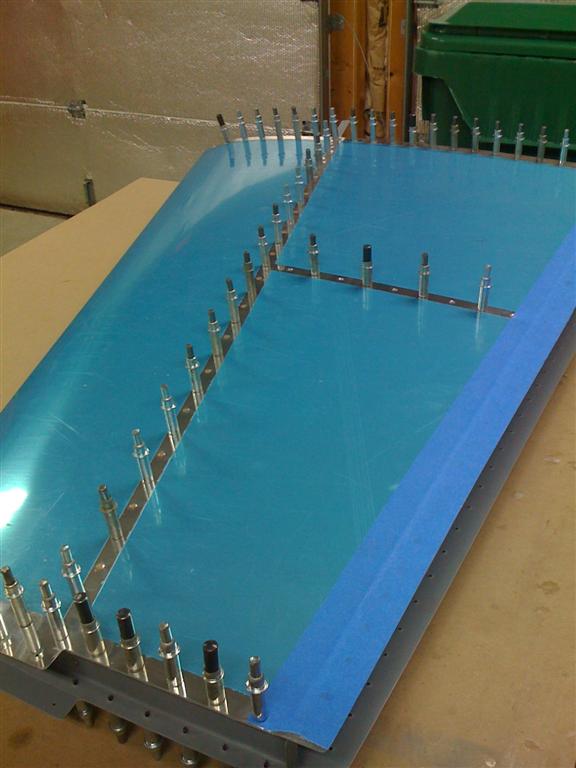
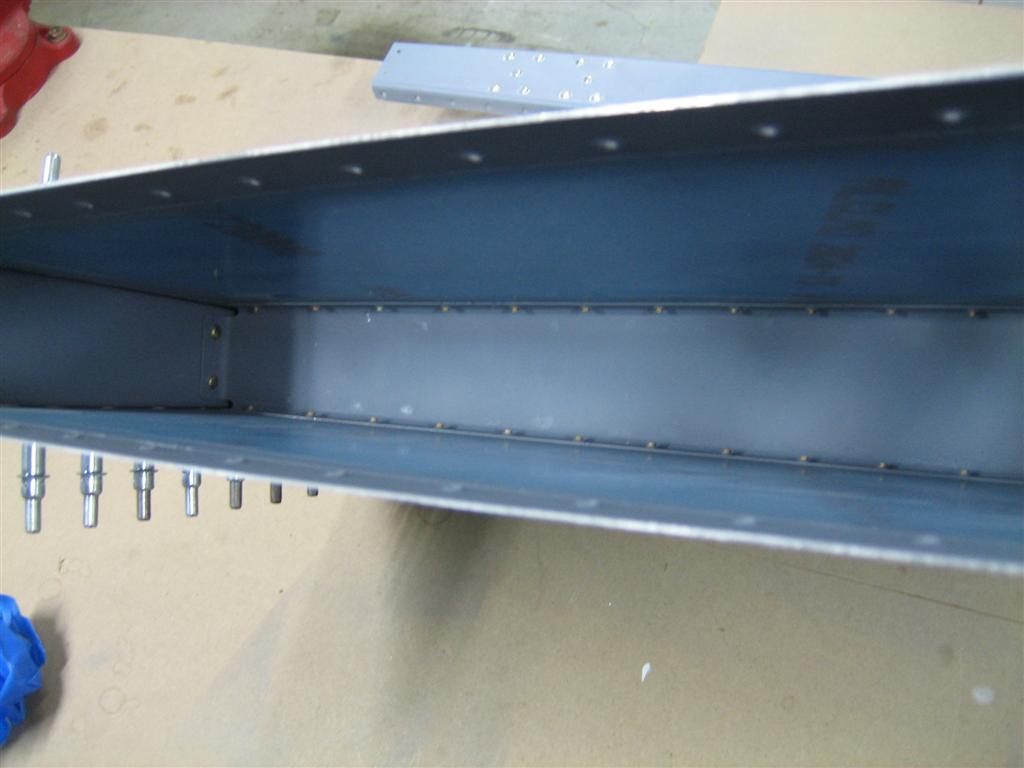
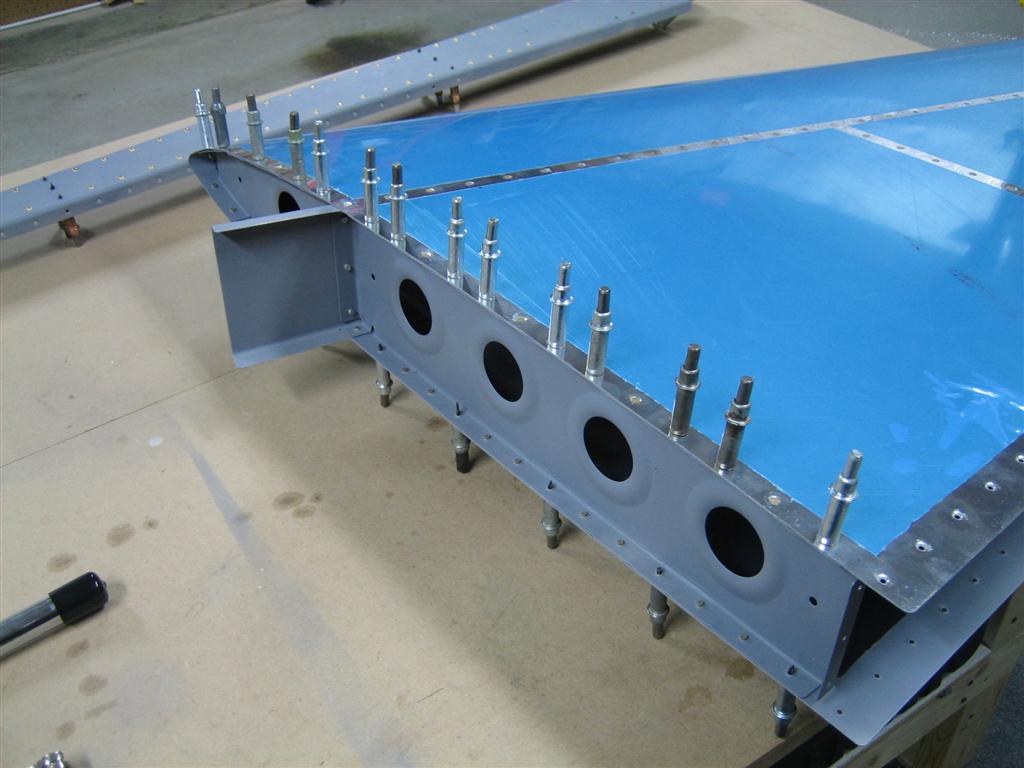
All I had left to do after rolling and riveting the leading edge was finish up a few rivets in hard-to-reach places and then finish screwing in the rod-end bearings.

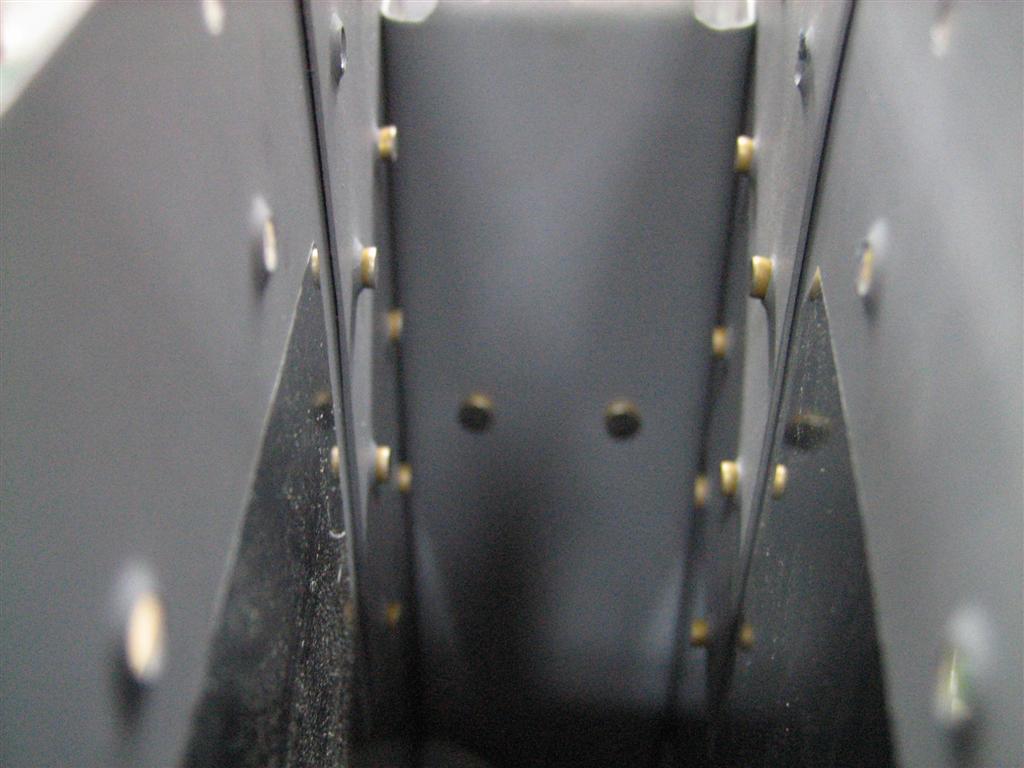
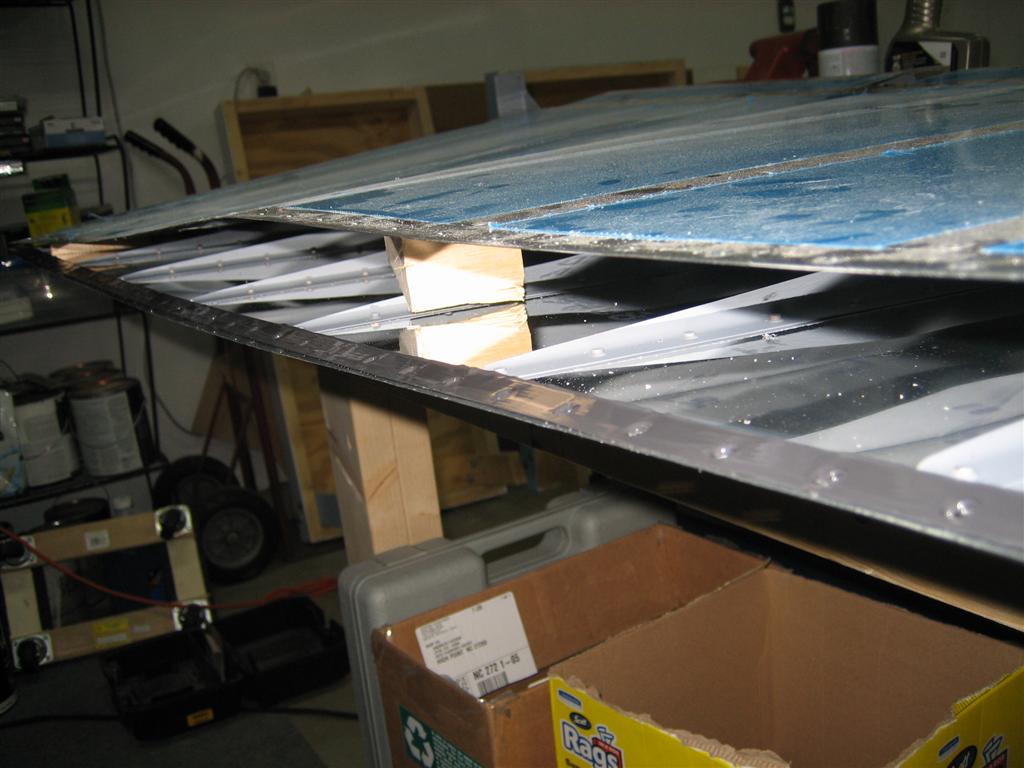
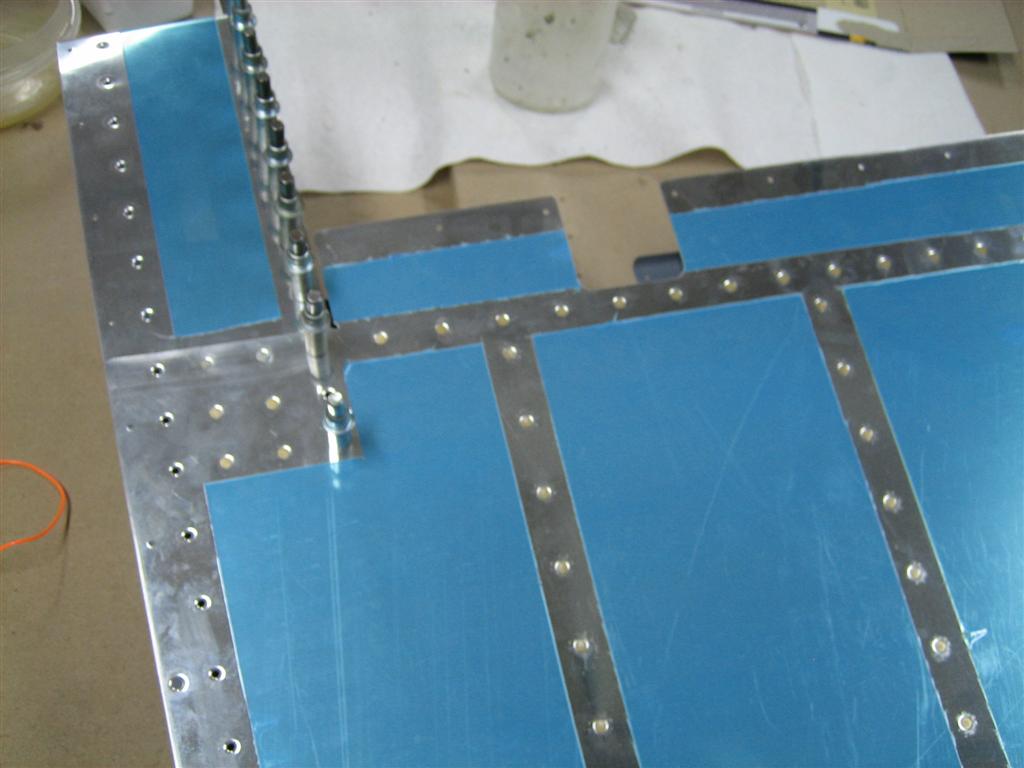
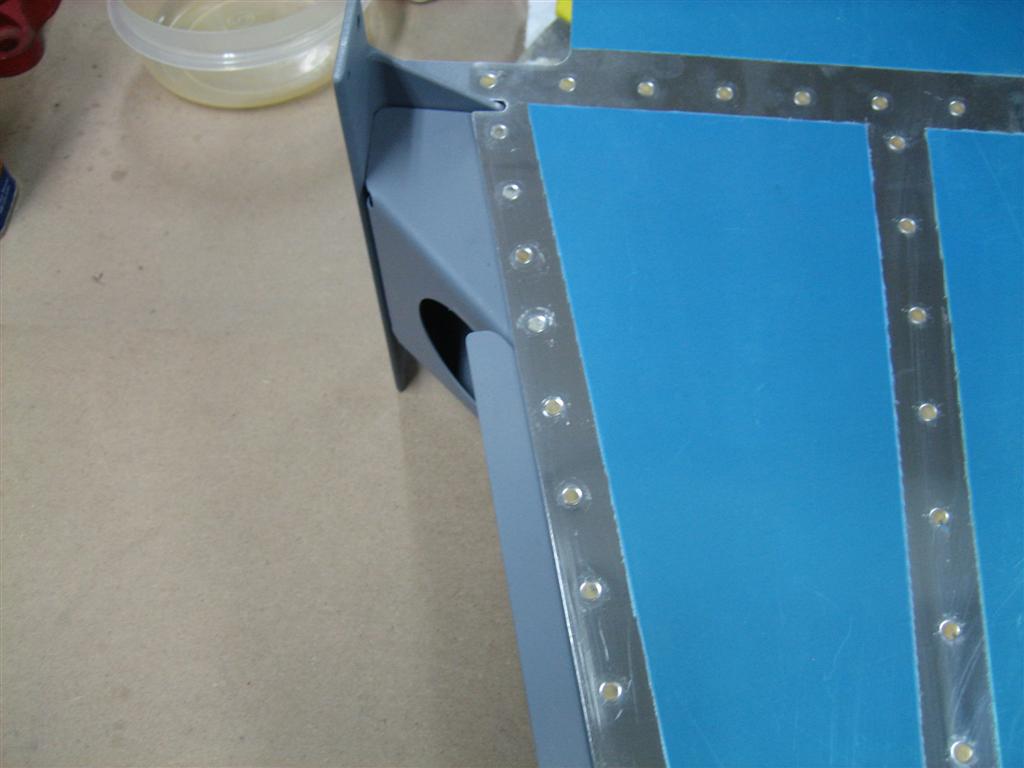
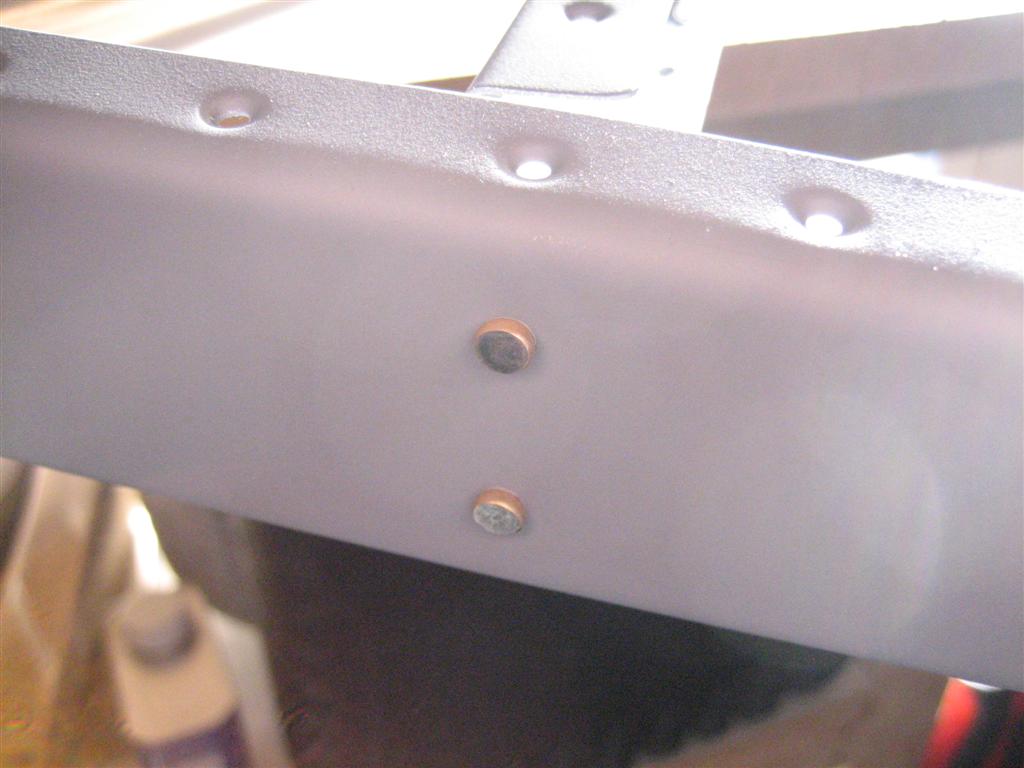
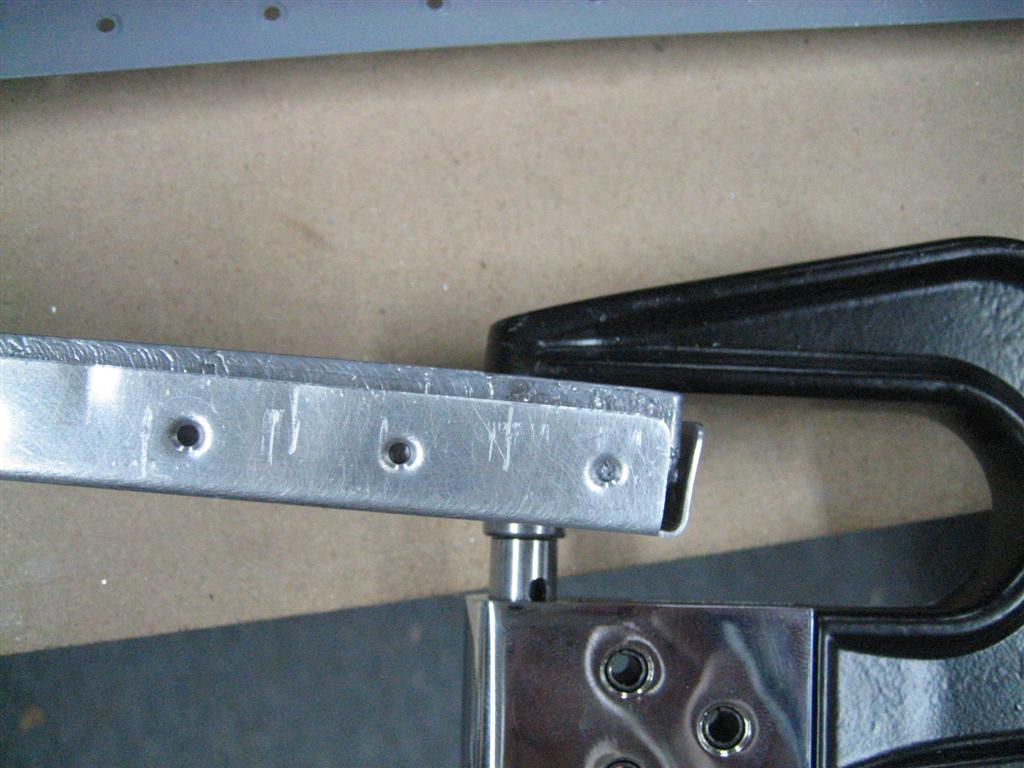
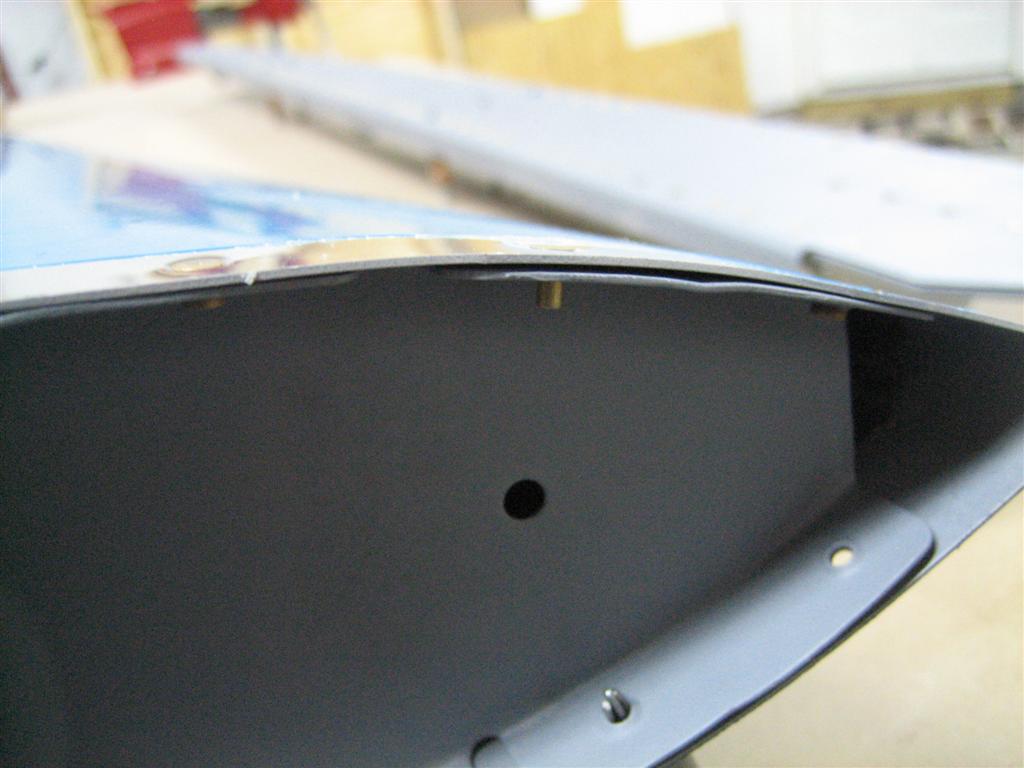
The hard-to-reach rivets in this picture are the top two. For the other side, my squeezer actually fit in here when the opposite side rivets weren’t installed. The shop heads prevented me from cleanly setting these, though, so I had to use a thin steel plate as a bucking bar. Worked well.
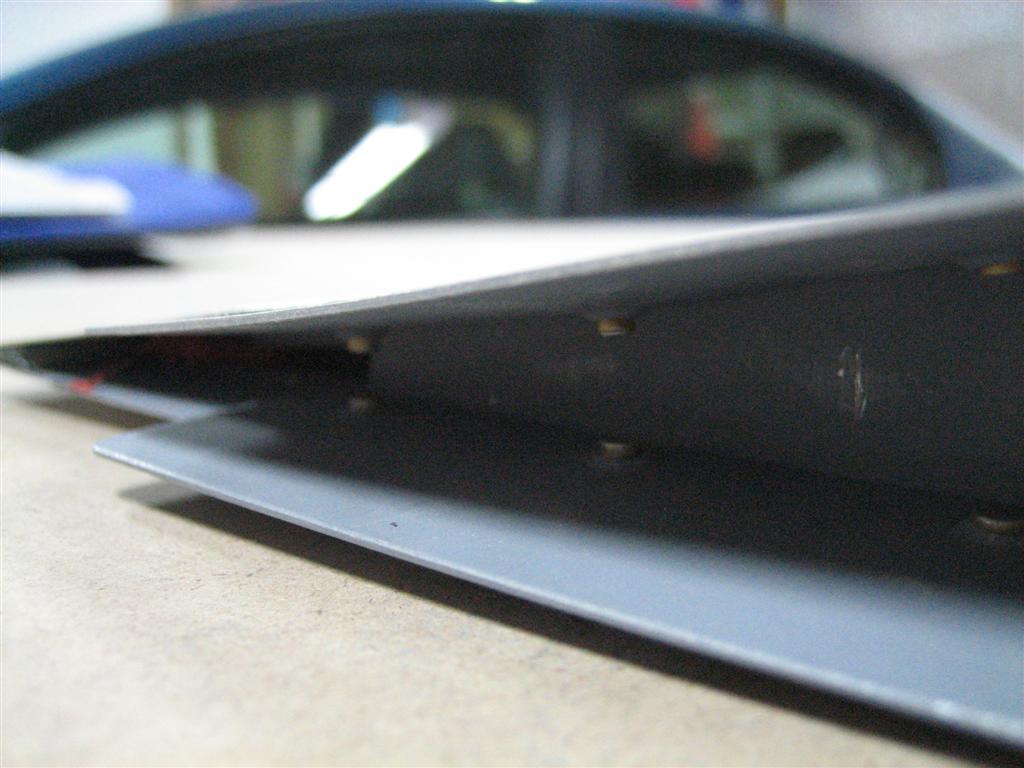
Two hard to reach rivets bucked.

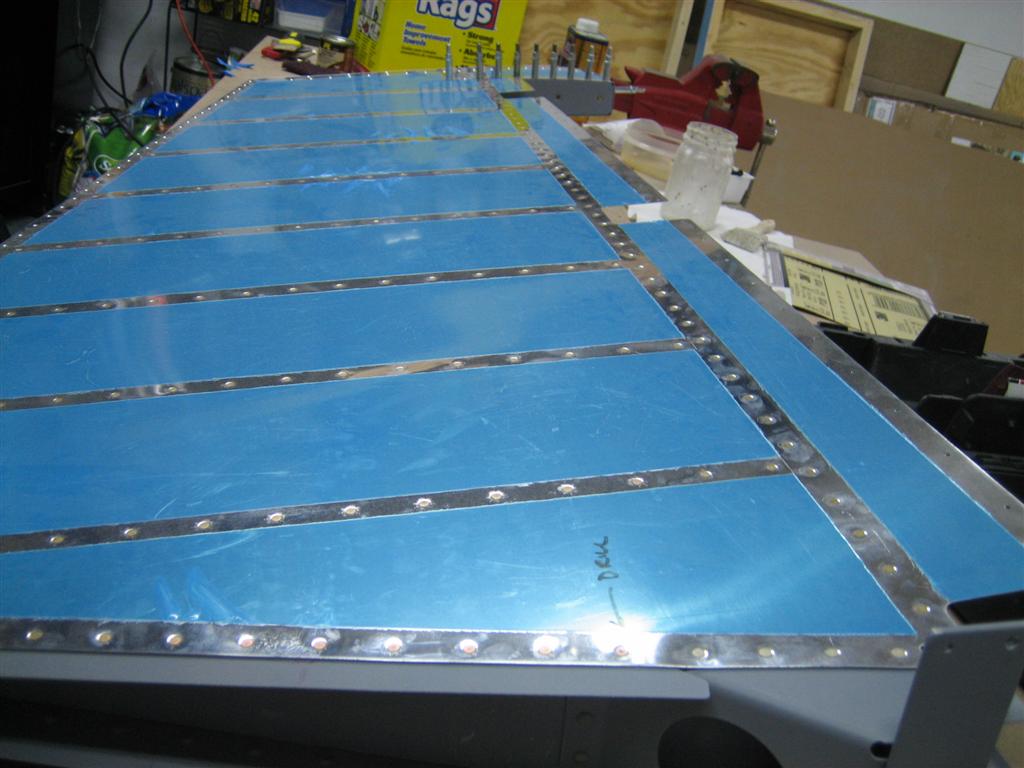
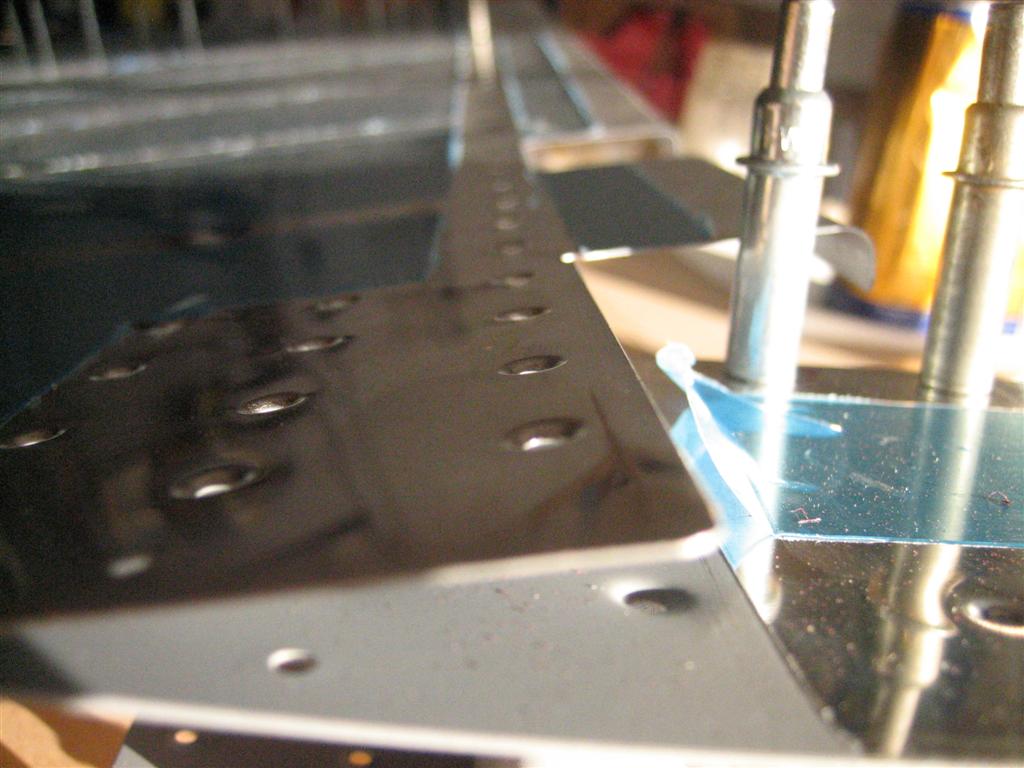
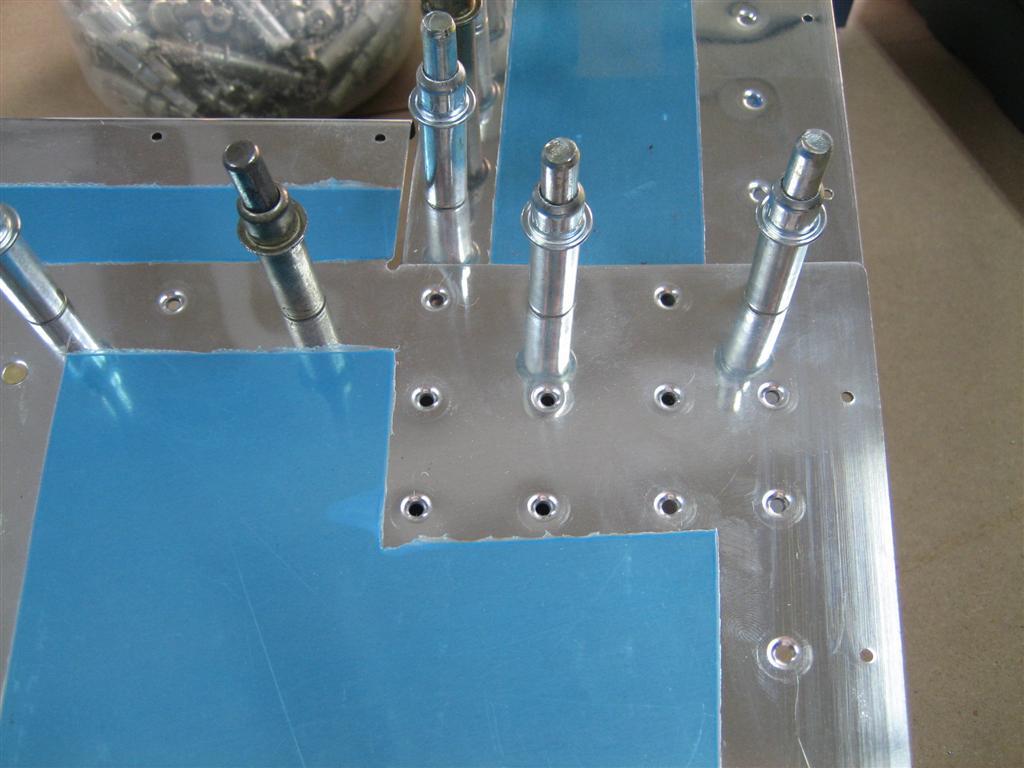
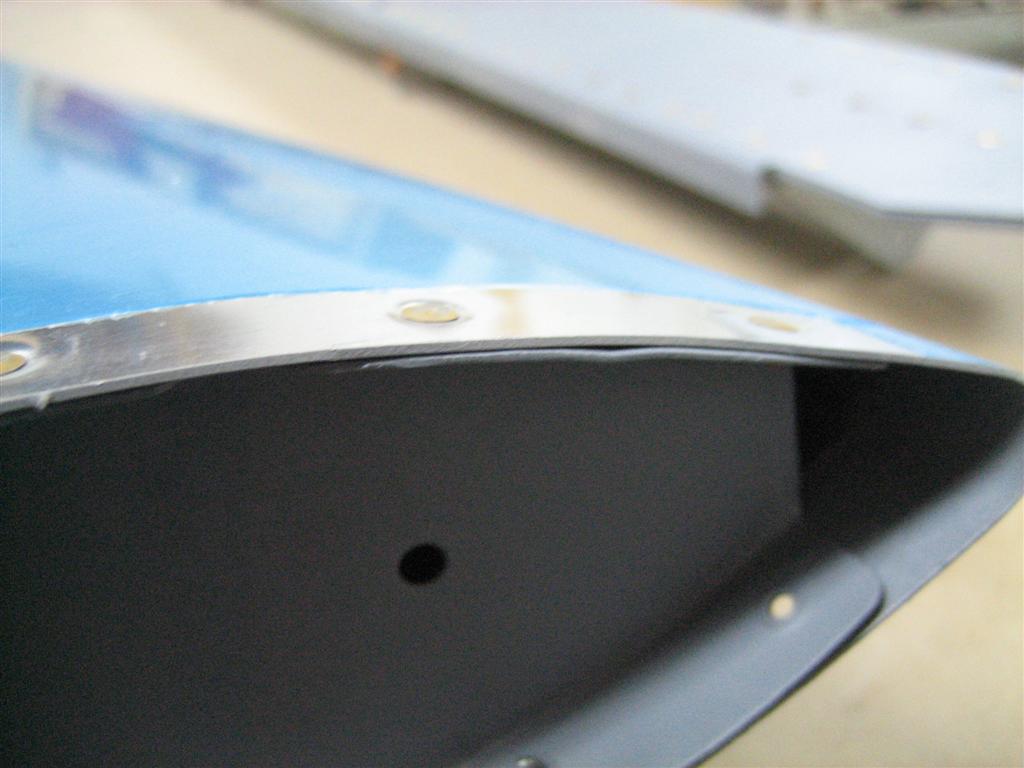
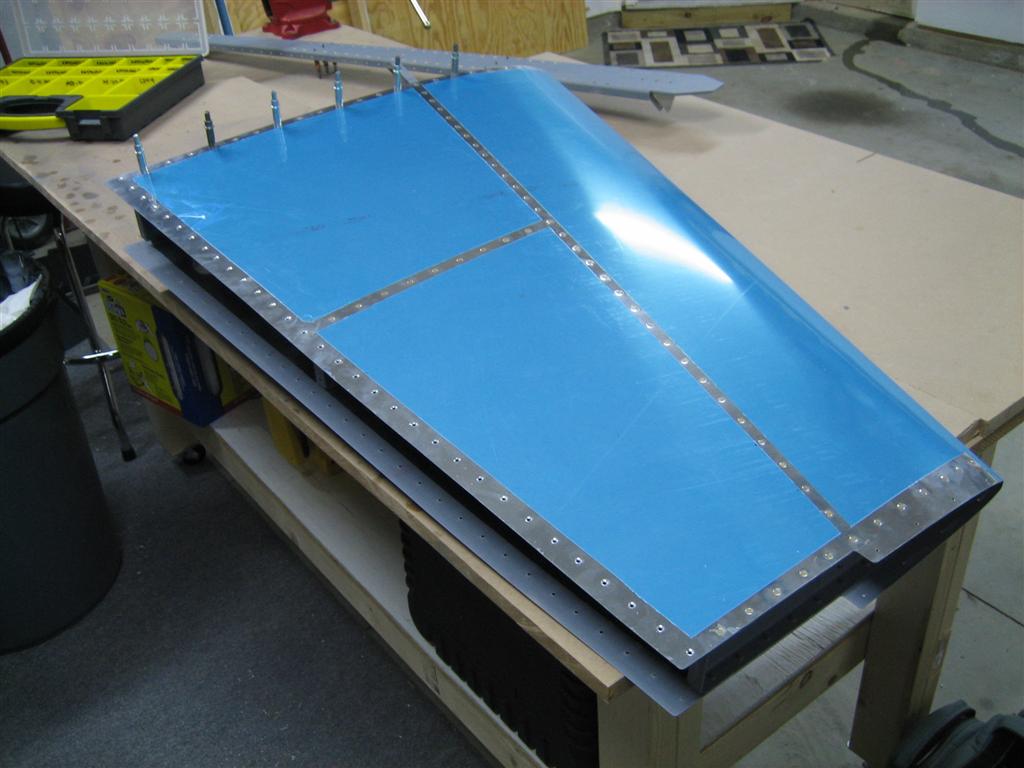
Here they are from the right lower side of the rudder skins. (I haven’t been using blue tape on the rudder as much and this is a mistake. I know it would have been a lot of blue tape, but it makes the skins look so much nicer. I will be using tape again after riveting to protect the skins.) I don’t think the rudder is going to end up polished, but I just hate the way those scratches look.
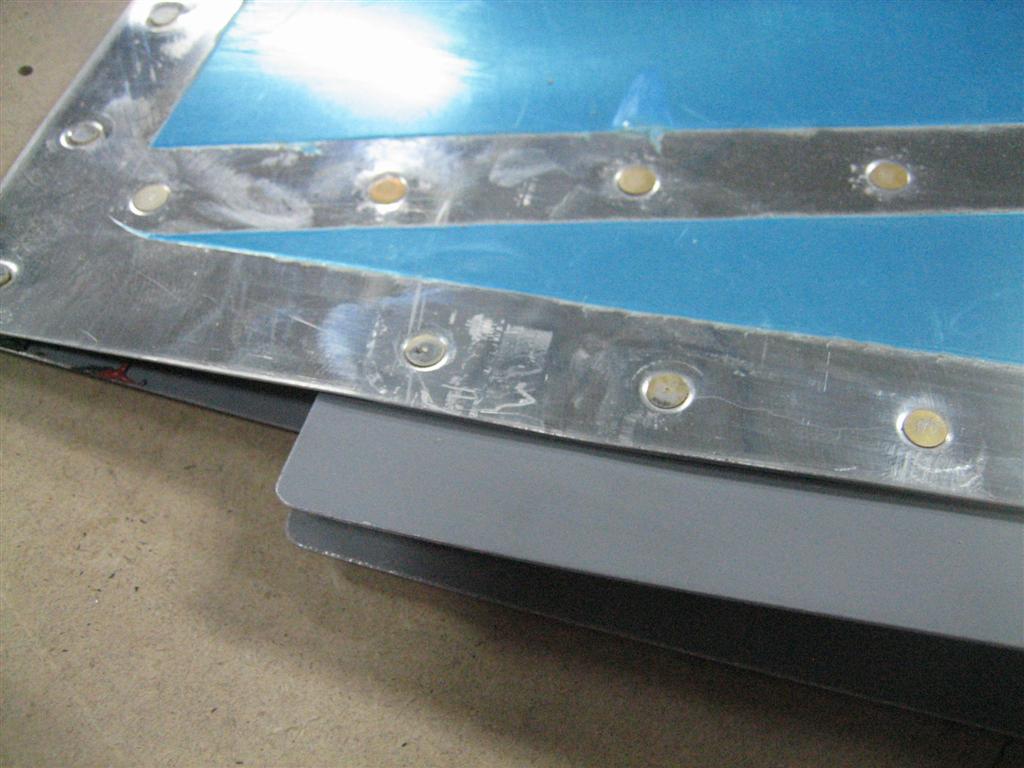
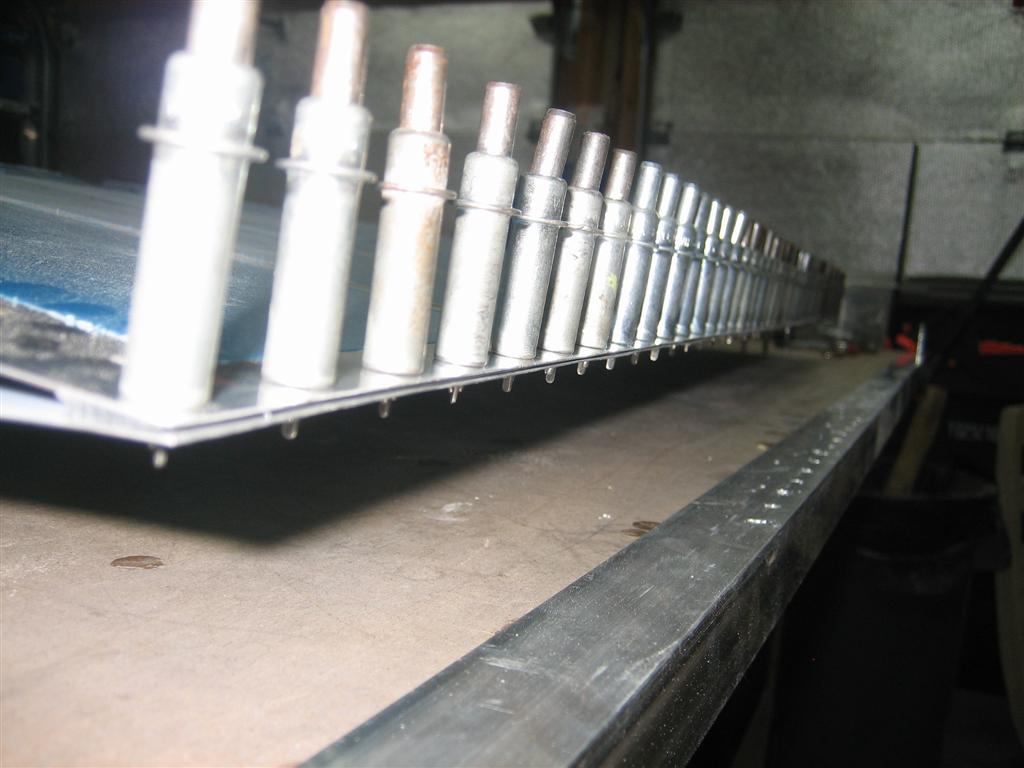
Nice and flush.

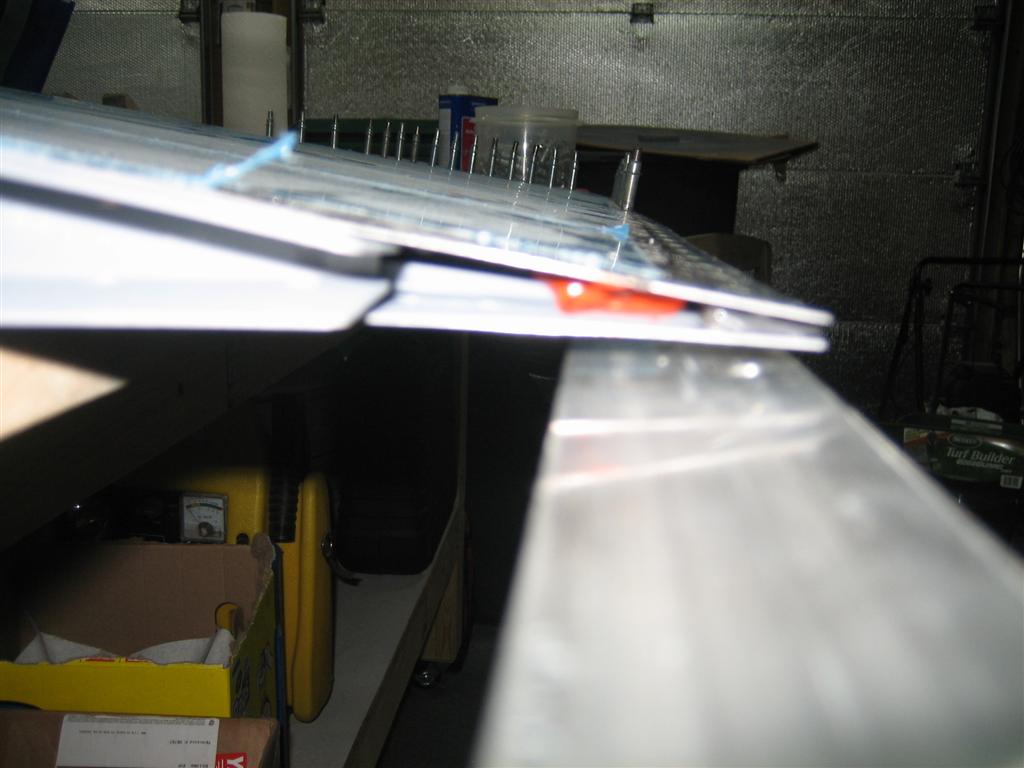
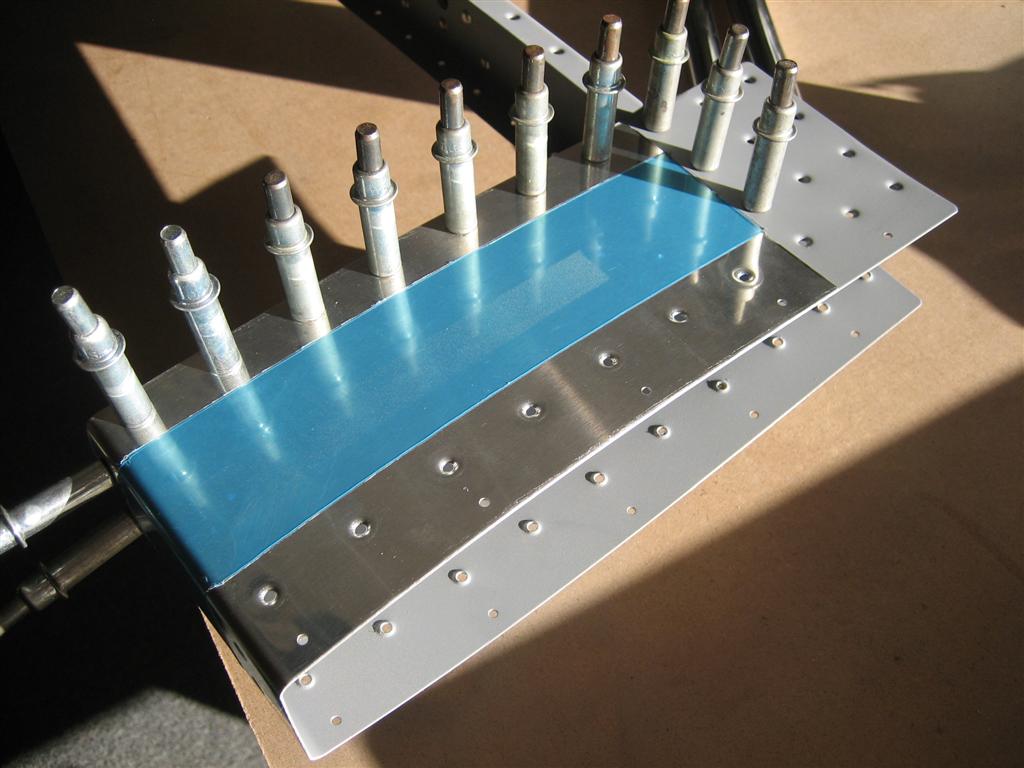
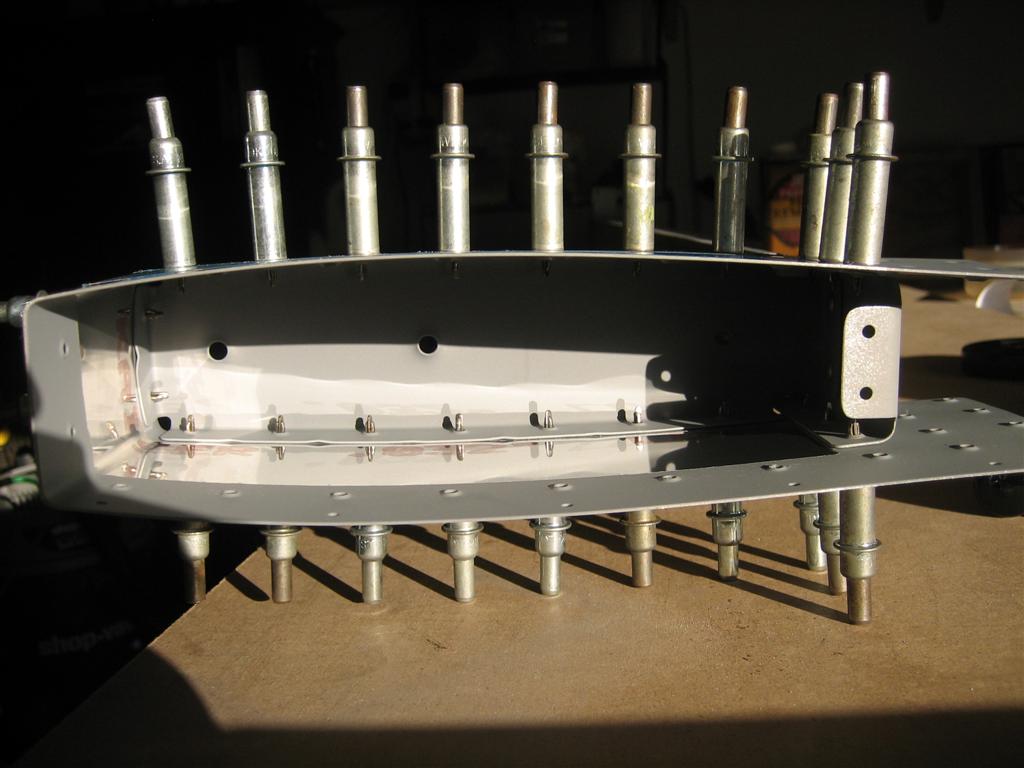
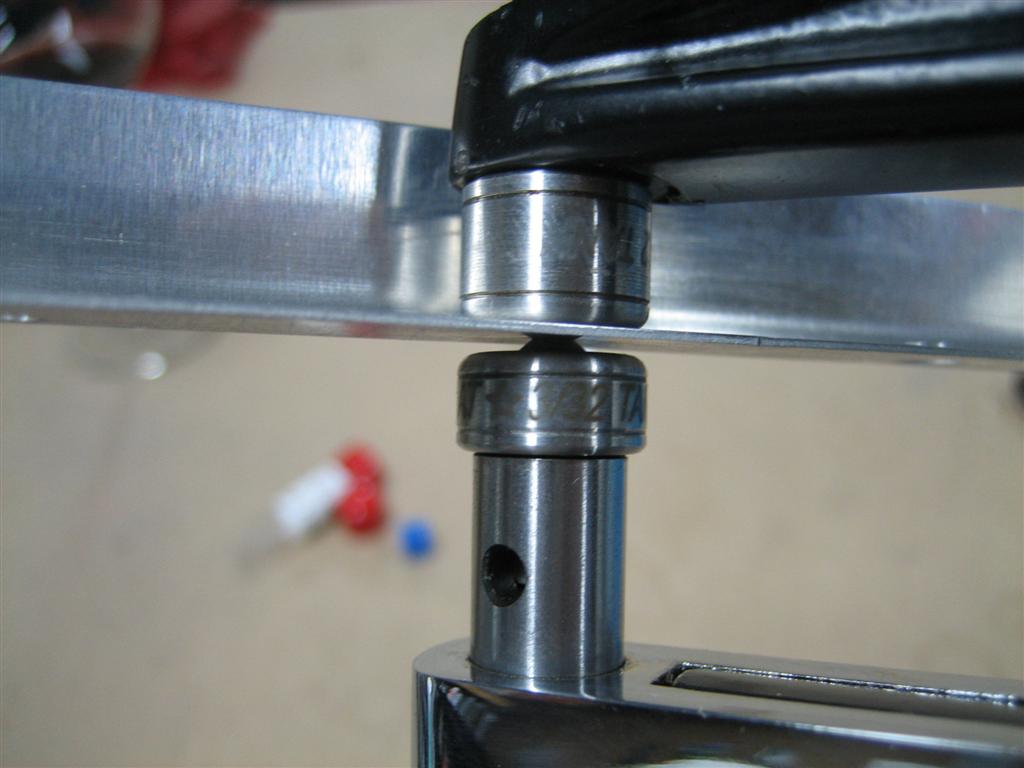
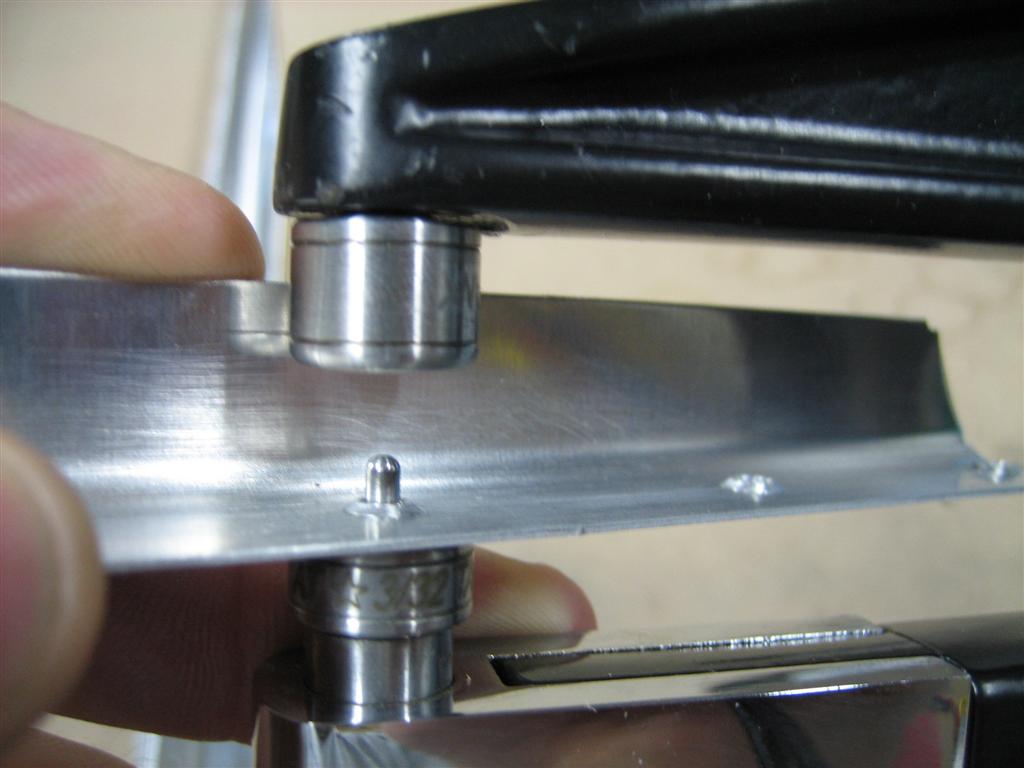
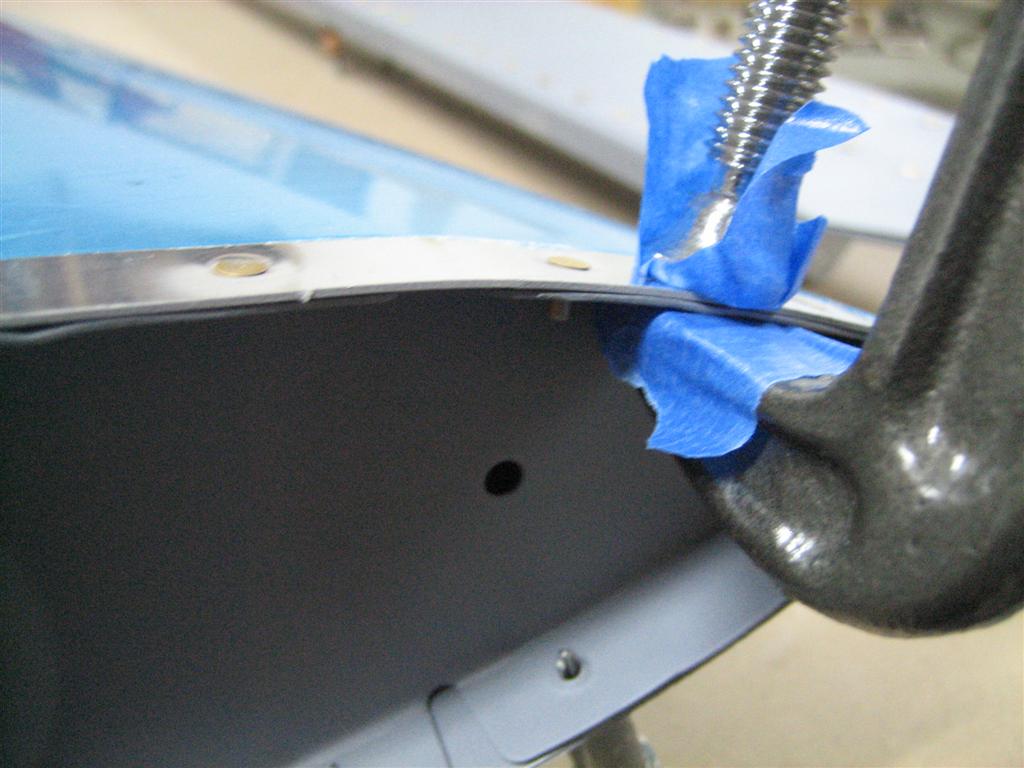
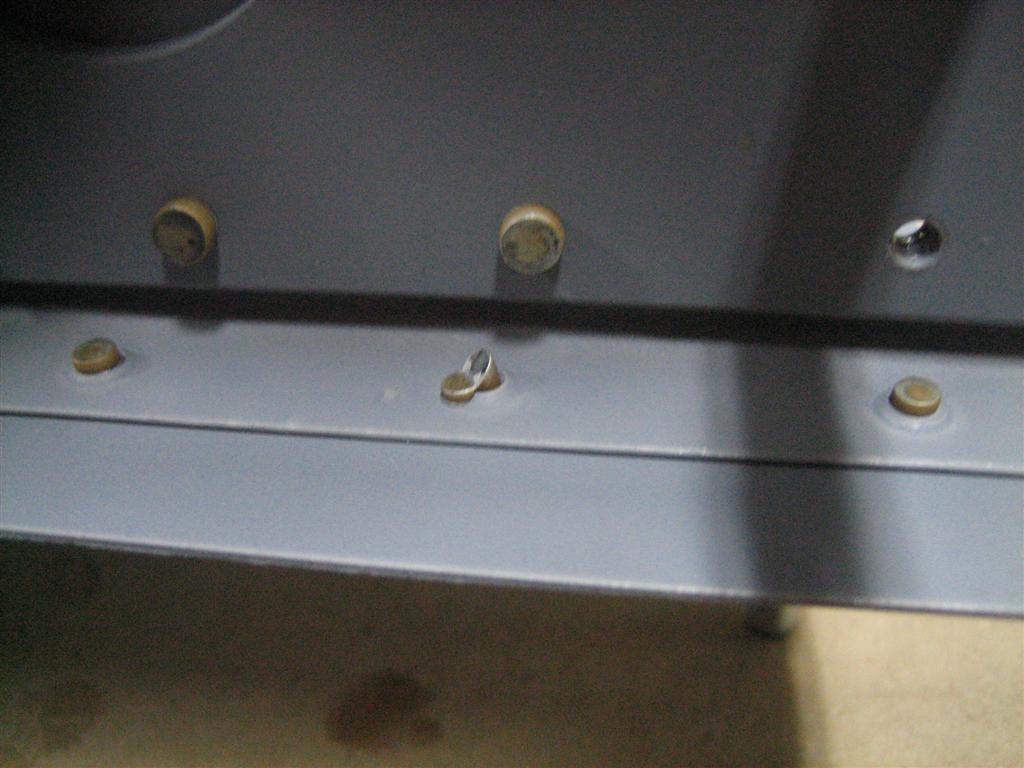
For the tip rivets (there were four that were hard to reach), I used a thin steel plate as a bucking bar for three of them, but then only had about 3/32″ clearance between the unset rivet and the shop head from the set rivet on the other side. I improvised by using a backriveting plate, the right rudder skin, then the already set shop head, then a screwdriver, then the unset rivet, then the left skin and finally a flush set. This worked out really well.
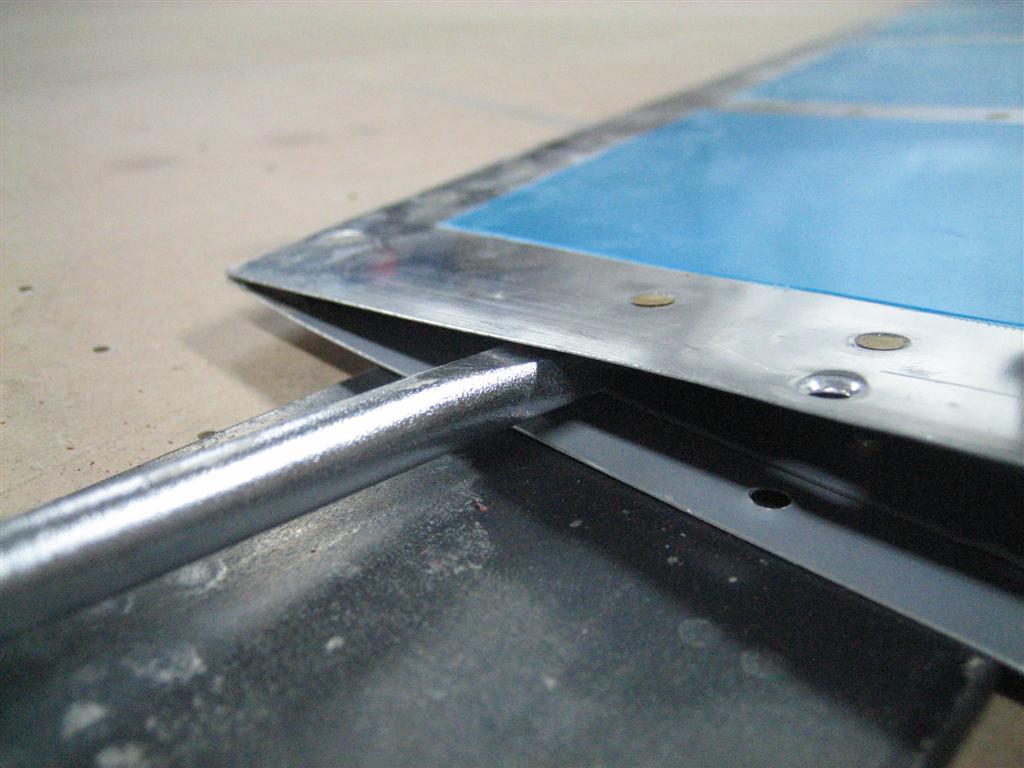
My setup for riveting the last (aft) rivets on the rudder top.

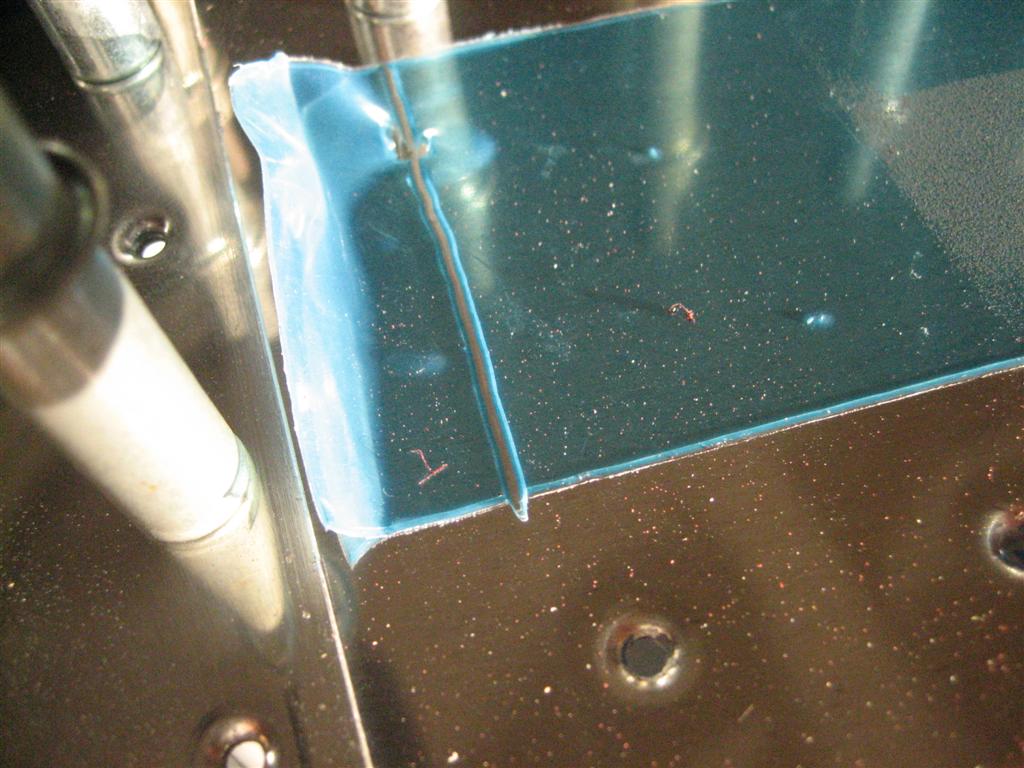
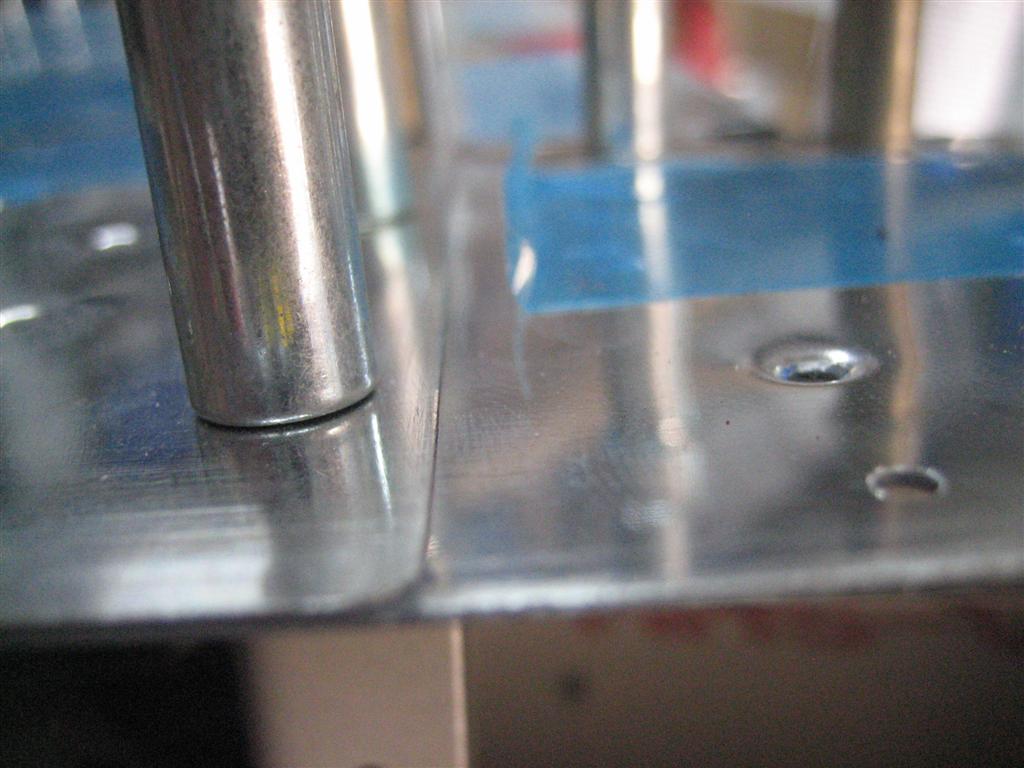
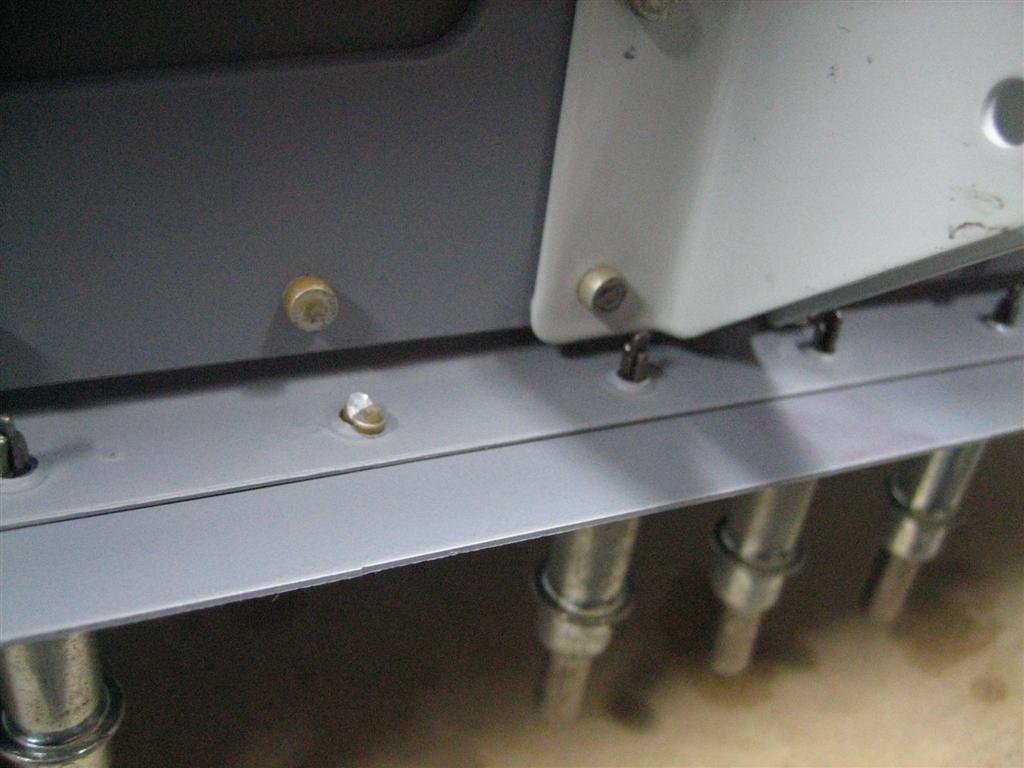
Here’s another shot with a flashlight assisting the digital macro setting on the camera. The point of the picture is the screwdriver, but it looks like I am going to have to replace that upper rivet on the right.
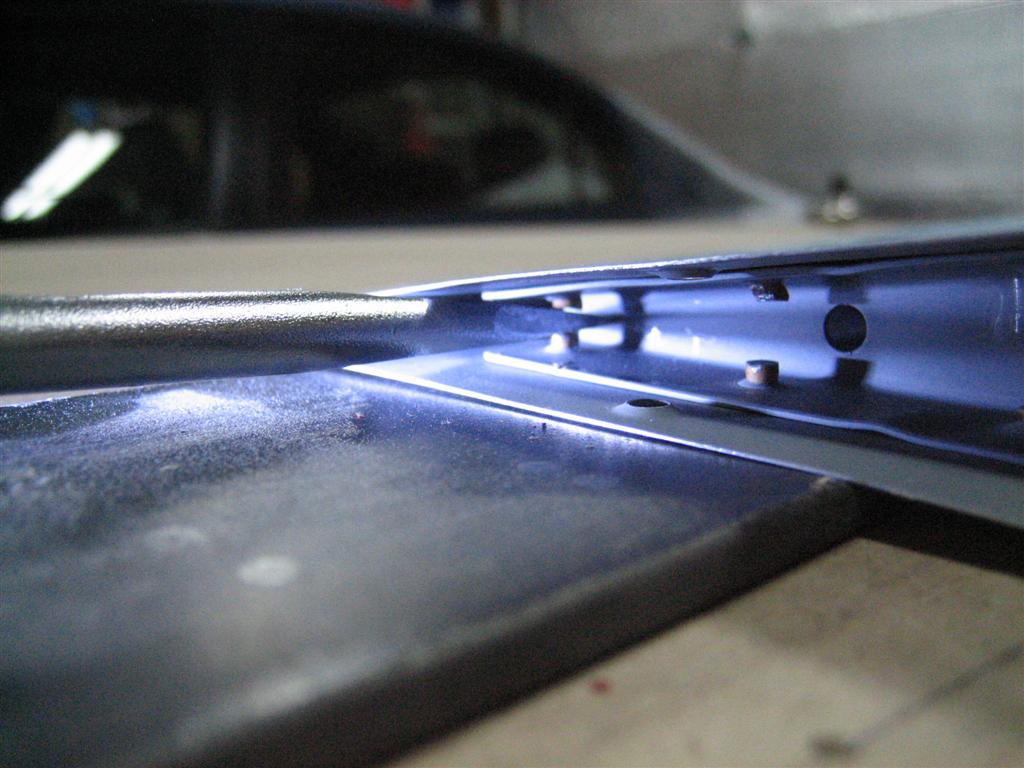
This worked well, but YIKES, look at that rivet on the right...also, the lower shop head doesn't look big enough. I'll get out the rivet set gage and test it.

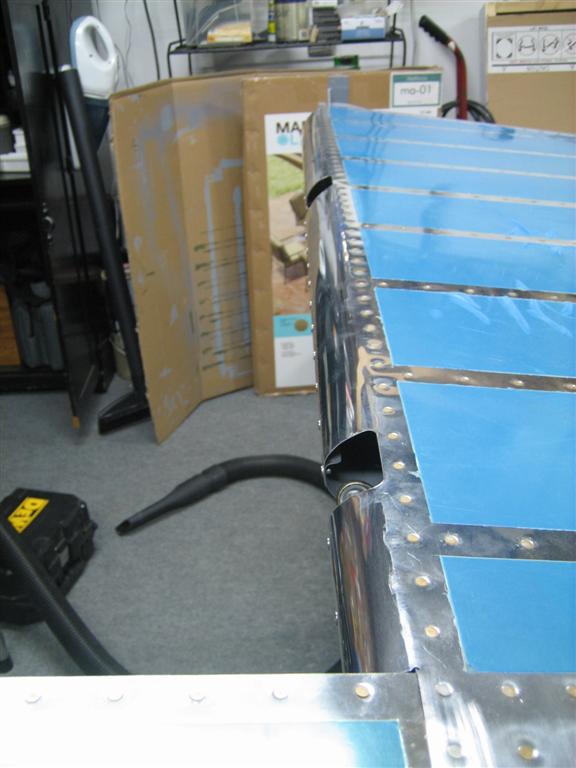
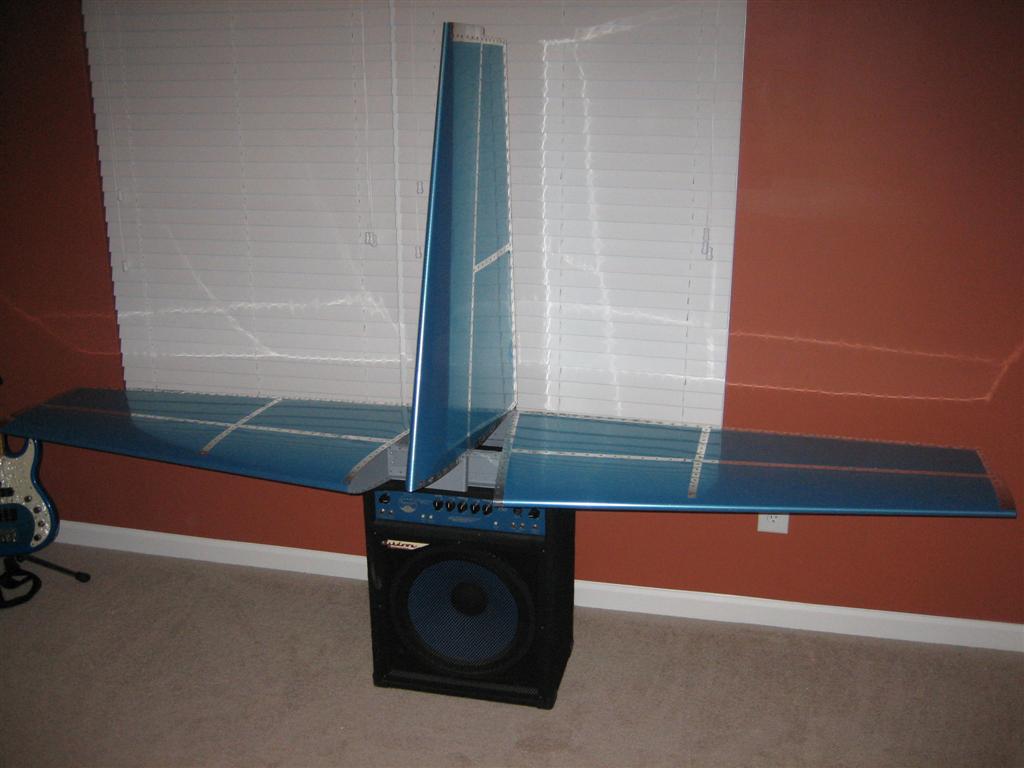
Then, I turned the rod end bearings into the rudder by hand (I haven’t made the rod-end bearing tool yet), and with about 30 seconds of trouble, I figured out a great way to slip the AN3 bolts into the hinges of the vertical stabilizer with the rudder attached.
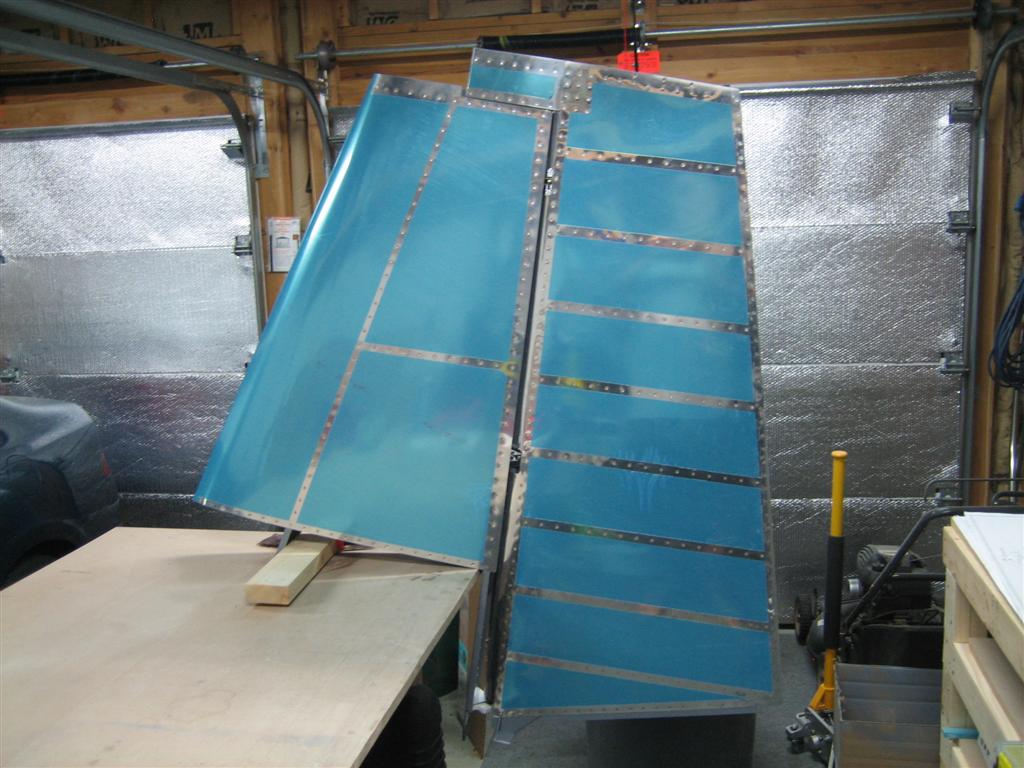
Sweet. This is an awesome step in the project. My first assembly. And it moves!

The bearings aren’t adjusted yet, and there are no fiberglass tips, but I’m so excited. More pictures!
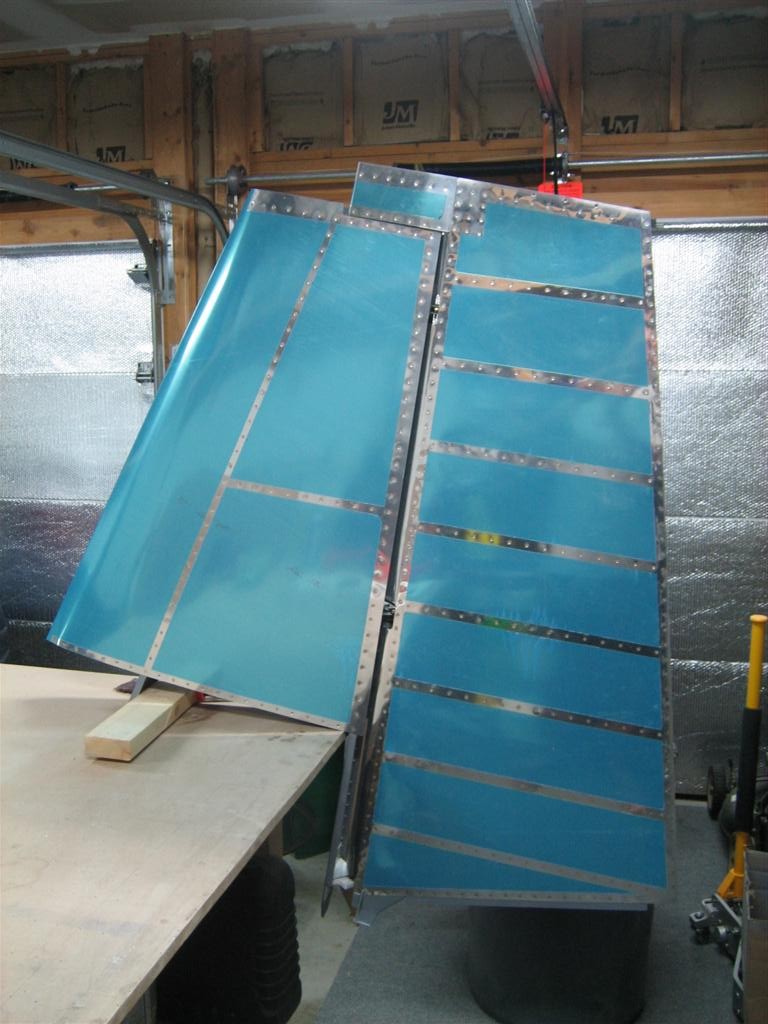
A vertical picture. So nice...

I’m not sure if you can see it, but I have the internal rudder stop in there, too. (Although I don’t think it goes on the bottom hinge. I need to read up on it.)
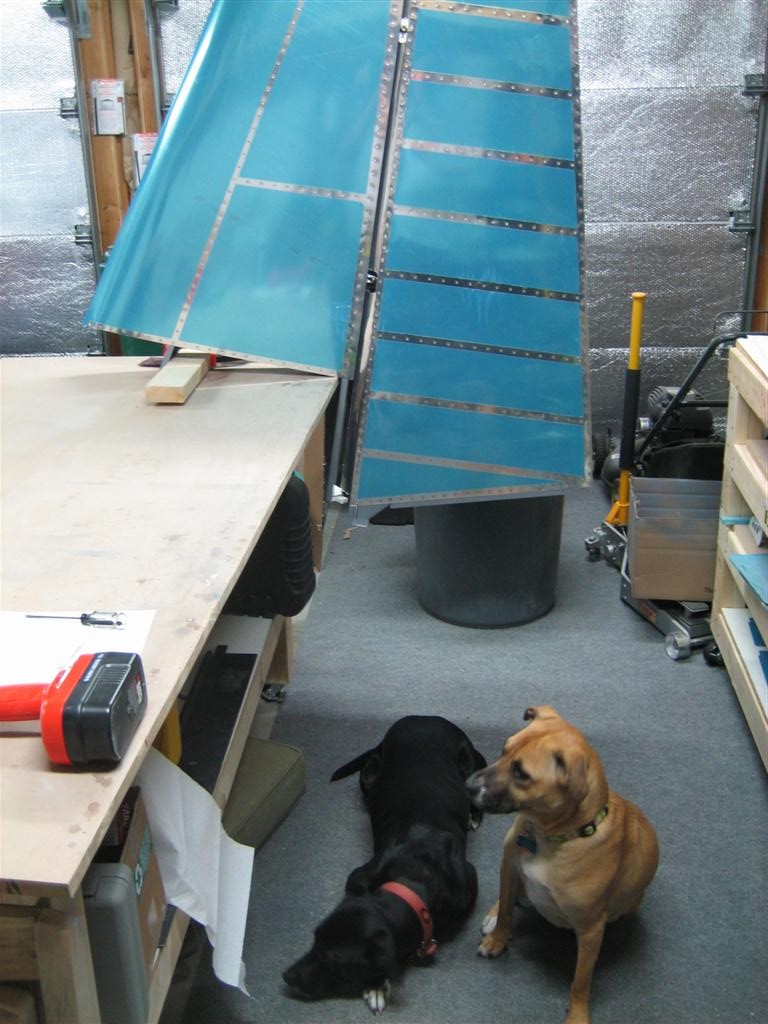
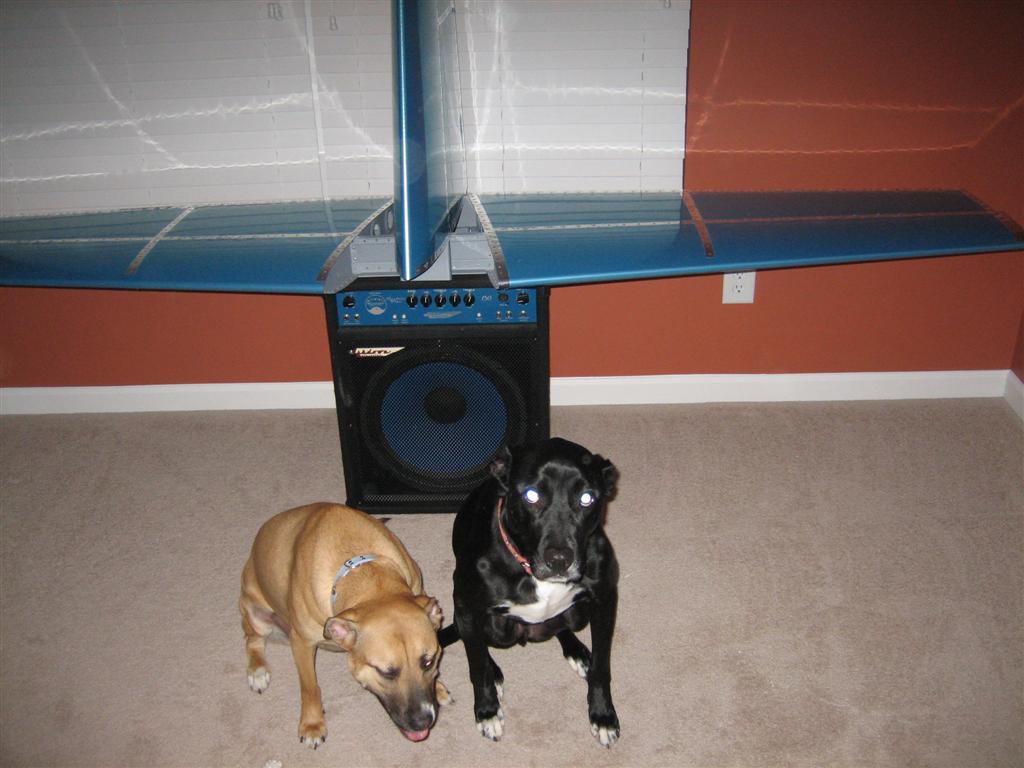
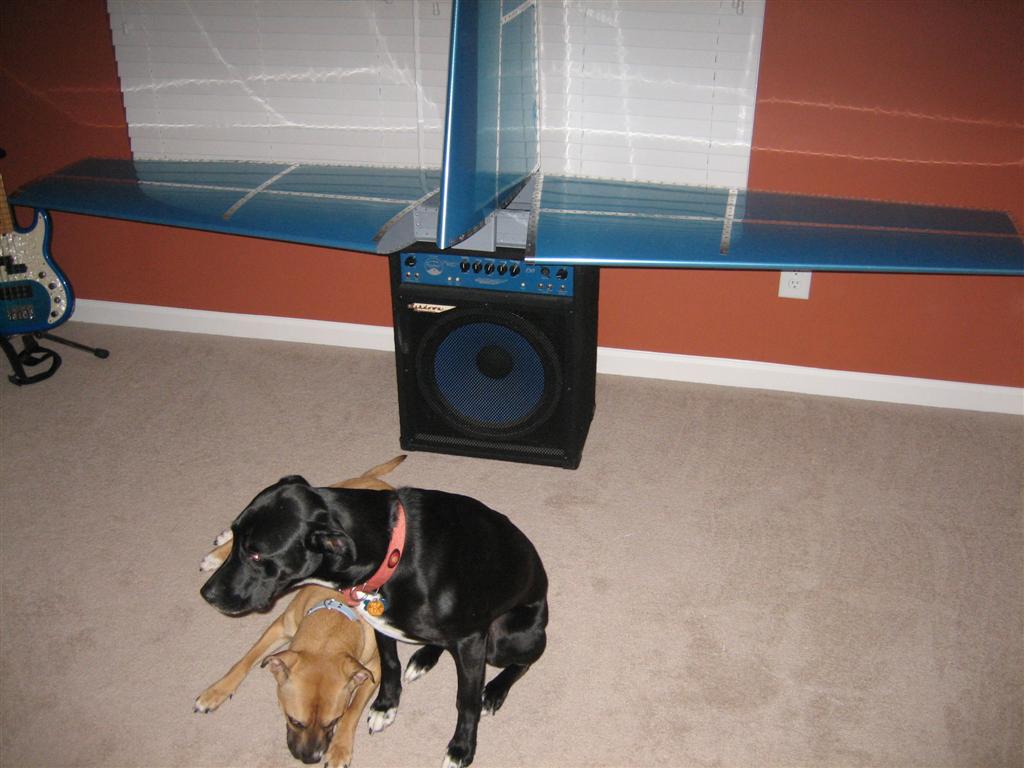
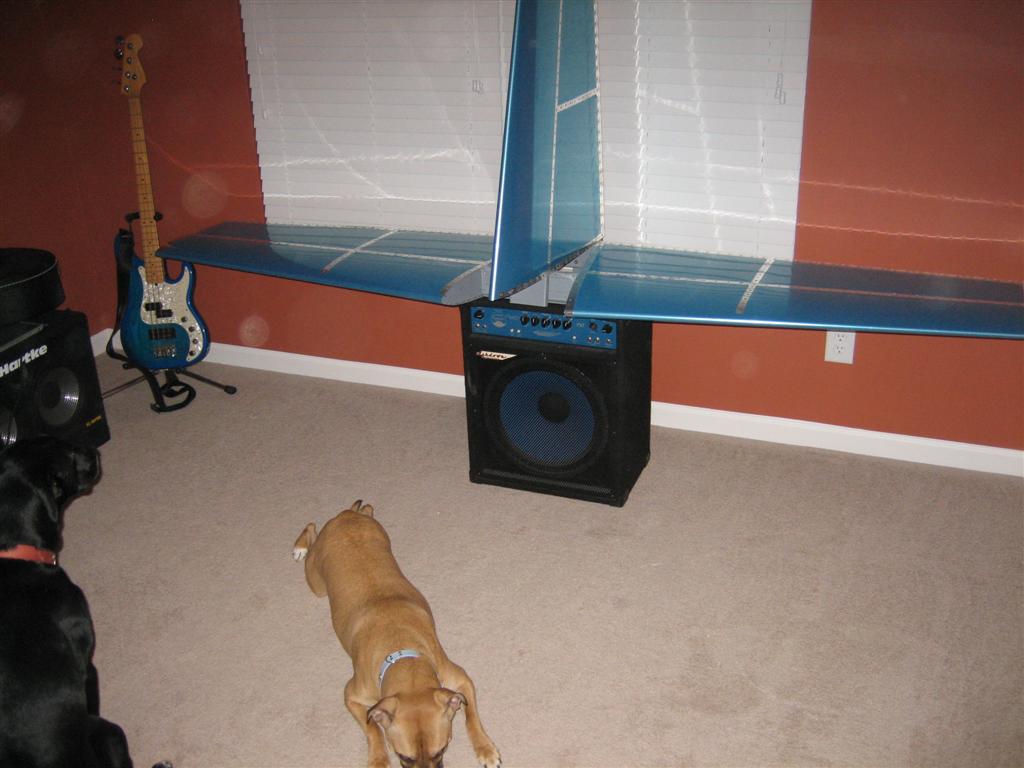
And the requisite picture with Jack and Ginger.

Jack is a little skittish about being in the garage (where I usually shoo them back inside.) Ginger clearly didn’t like being out here either, so she was slowly scooting her butt up toward me trying to inch away from the airplane discreetly. Cute, Ginger. Cute.
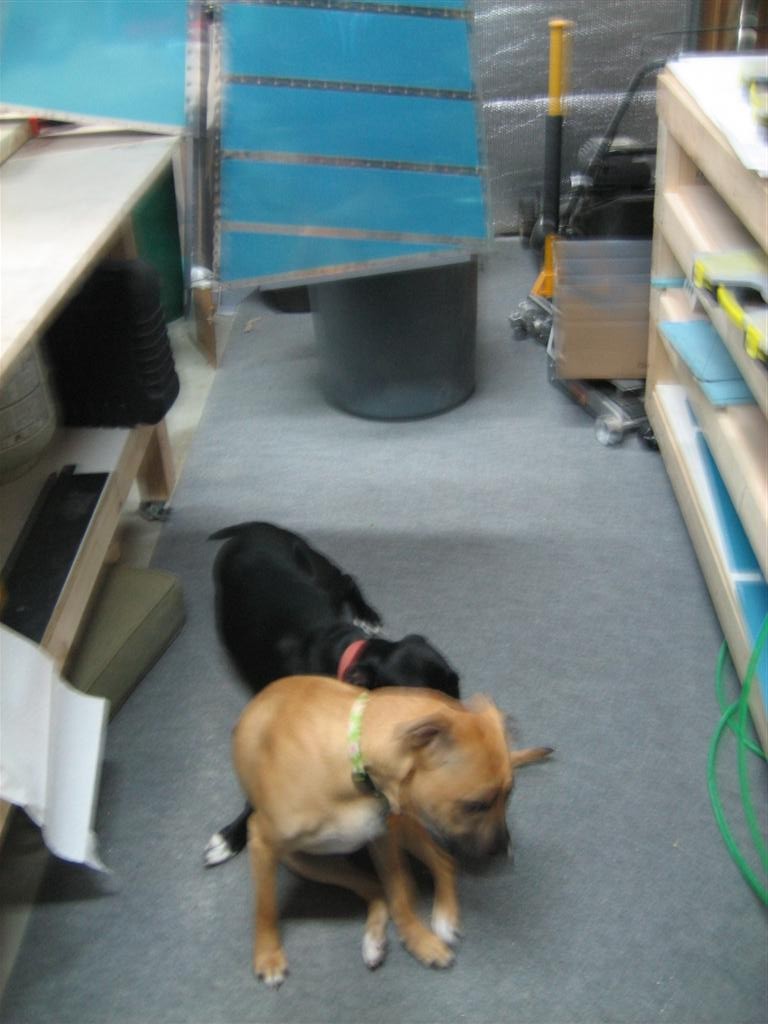
Jittery dogs. They would rather be in on the couch watching TV.

Okay, dogs, you can go back inside.
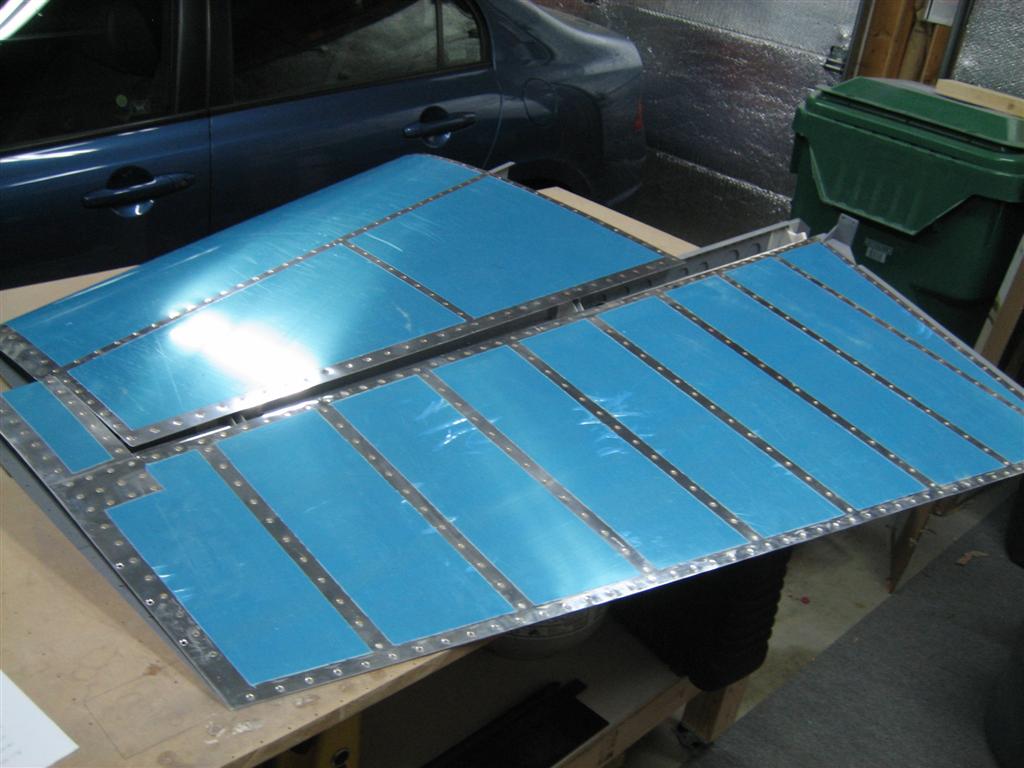
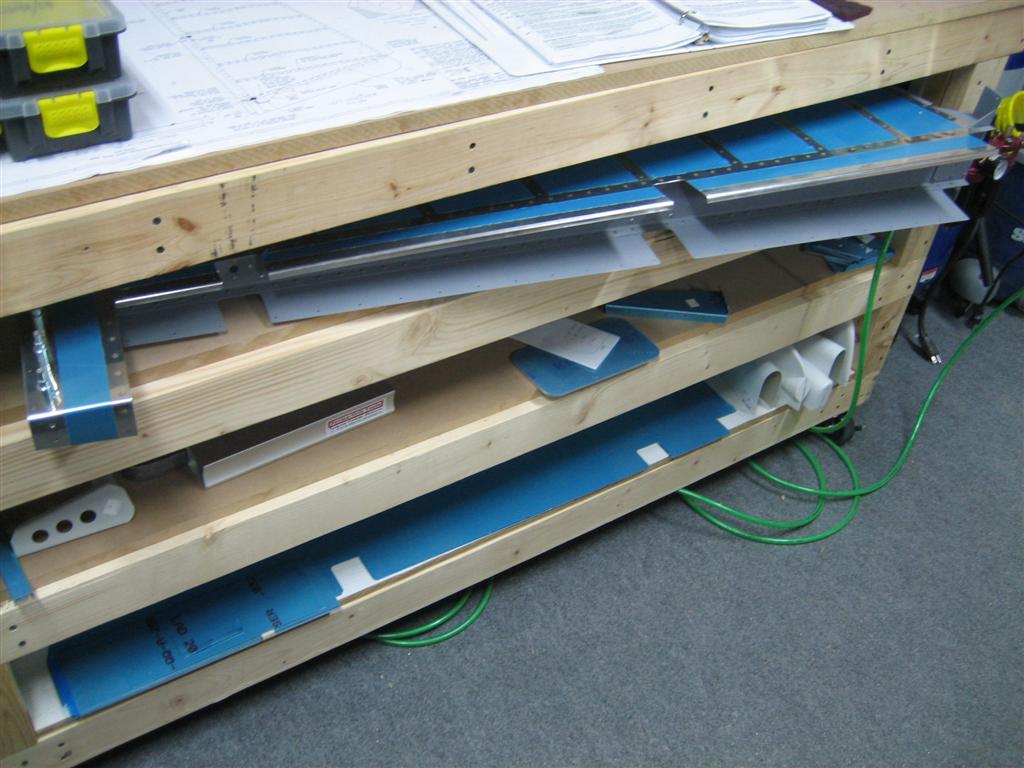
Finally, I laid the assembly back down on the workbench for night night time. I'll take these apart and store them again in a few days.

And at the end of the night, I looked down and had spent an hour on the project. Look at that, I’m at exactly 100 hours! Two big accomplishments in one night. (Also, ten rivets. Don’t want to belittle them by being more excited about the hours.)

To do:

  • Clean up a few rivets
  • clean and re-prime some bucking bar scuffing of the ribs
  • Mount the fiberglass tips
  • Figure out how the internal rudder stop works.
  • Clean up some trailing edge dings.
  • Do a couple more once-overs to clean up any edge issues throughout the empannage.
  • Move on to the elevators.

Prev | Next


Rolled Rudder Leading Edge

April 1, 2010

Prev | Next

All I came out to the shop today for was to roll the leading edge and set the 25 measly little blind rivets. This should be simple, right?

WRONG.

This was by far my worst building night so far in the project (although any night building is better than a night not building). So frustrating. There was a point where I thought I had mangled the skins so badly that I was going to have to build a new rudder.  Read on.

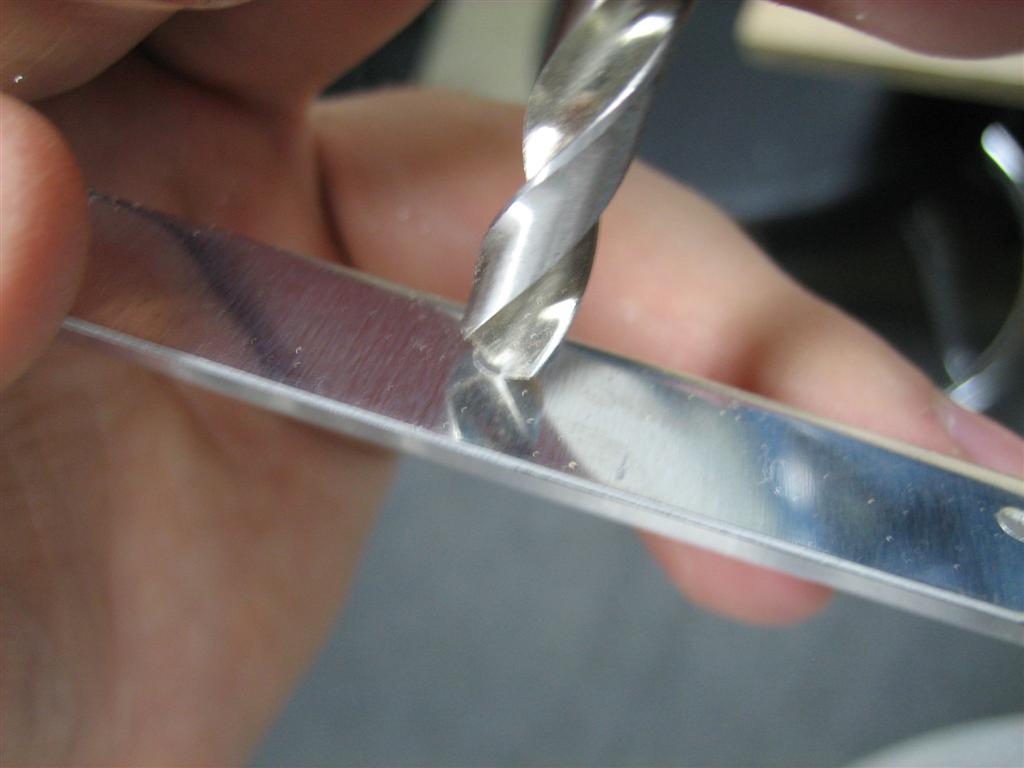
First thing, I’ve read to go ahead and drill all of the holes to #30 and deburr now, because if you wait until after rolling, you may enlarge the holes and/or have a very hard time deburring the holes you’ve matchdrilled.

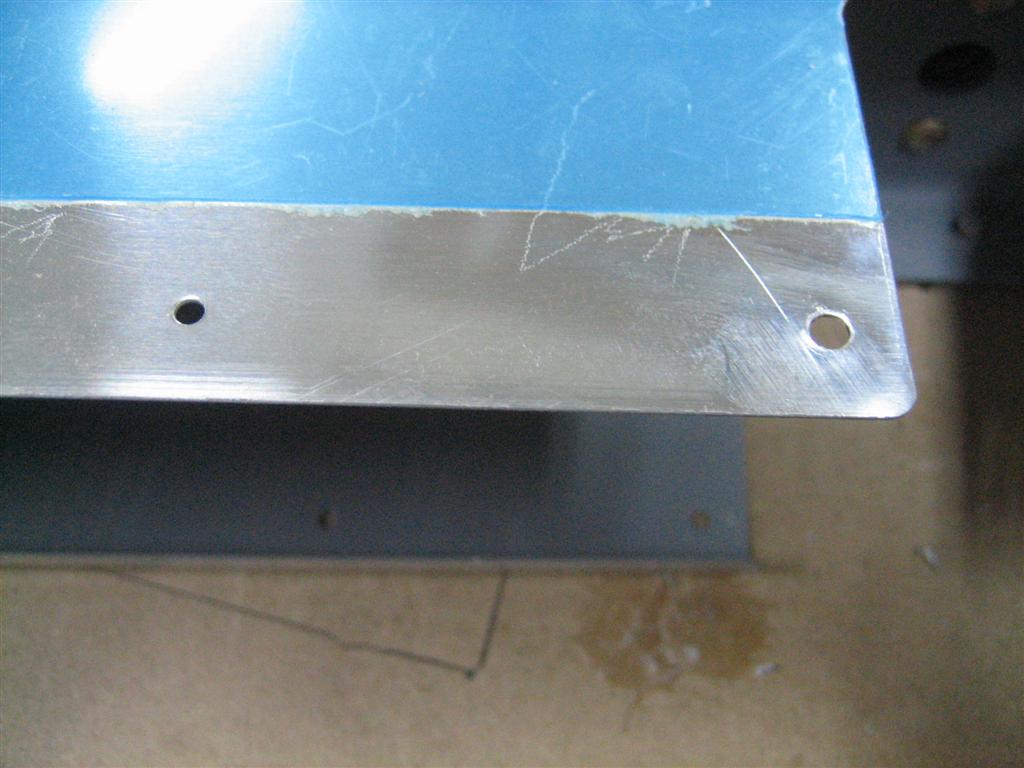
An example of the original holes on the left, and the #30 drilled hole on the right.

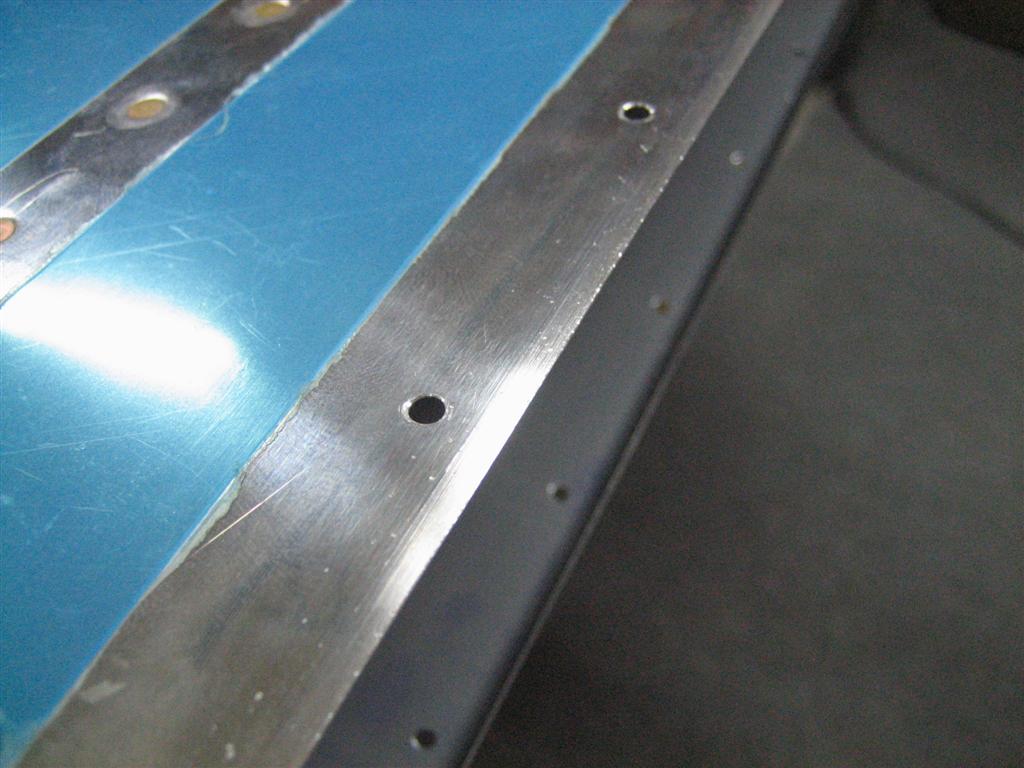
More holes after drilling.

I had to play with the angle a little here to capture the edge rolling. You can see the bright section of the skin just right of the hole. The reflection is catching the overhead light above me and to the right. I used hand-seamers here with great success.

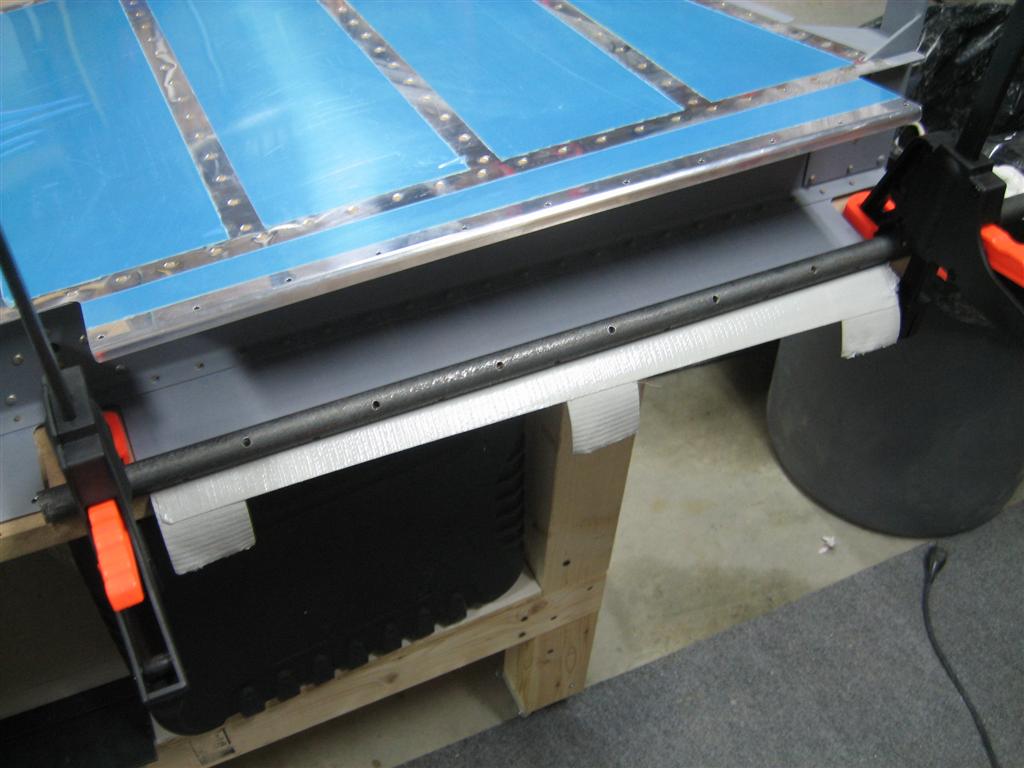
Then, I decided to try a method I found somewhere (although I can’t find it again today) to bend the skins. Here, I’ve got my steel rod ready to be taped to the left skin’s lower leading.You basically clamp around the steel pole to the table so that as you roll, the whole rudder slides toward you, but the steel rod stays close to the table and you don’t end up with a crease.

This would have worked, but my clamps were too big, and I only got to roll a half inch or so before they caught on the skin and prevented further rolling.

My setup. Later, I added longer pieces of tape along the whole length of the spar to minimize different tensions on the very edge of the leading edge.

Then, I put my camera down for almost an hour. I was so frustrated. Apparently, the 3/4″ pipe works great for the areas where the spar flanges is closer together, but not down here.

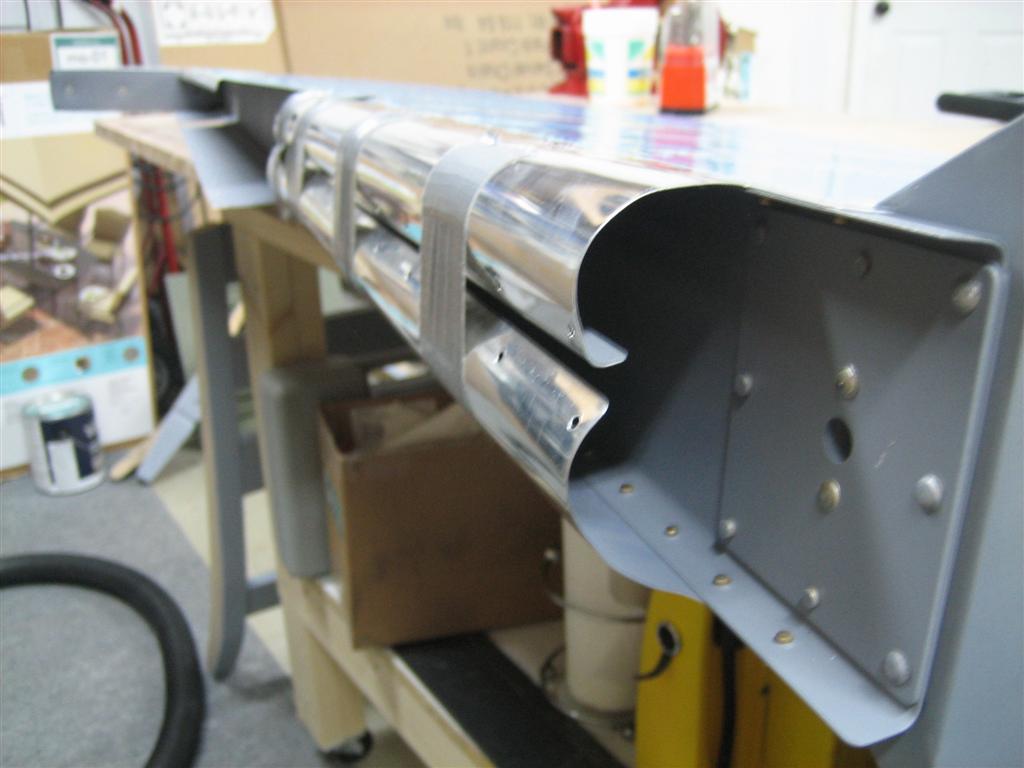
OMG OMG OMG OMG. I thought at this point that I was going to be building a new rudder. The bends aren’t really that good, and there is no way I’m going to be able to salvage this. You can see the skin rolled nicely near the tip, and then not as much near the spar. It should be the other way around.

After extensive (read: time consuming, careful, dirty-sailor-mouth-filled) working with my hand and duct tape, I finally got it clecoed together.

With the duct tape, I had a piece from the right to left side in between each hole. I would squeeze the skins together, and then use the other hand to go down the line and tighten all of the duct tape straps. back and forth about 10 times, and it finally started to look okay. Phew.

Okay, it’s not so bad now.

Here’s the first rivet (AD-41-ABS) going in. Once you set the rivet, you can see that it squeezed the area around it a little. I’m  okay with that. notice, though, that the edge rolling made the seam look really good. I am happy with that part.

After more blind riveting, I temporarily stuck the lower rod-end bearing in the lower hole. It’s starting to look like a rudder.

Lower rod-end bearing.

Then I finished up the other two sections of the rudder (with equal frustration) and got the rod end bearing in the middle hole.

Middle rod-end bearing.

Finally, I got the whole leading edge rolled and riveted.

Upper rod-end bearing temporarily installed.

It actually doesn’t look that bad.

Not too bad. There is some slight creasing just forward of the spar rivets in a couple places, but it’s nothing I can’t live with. 

Be warned about this part. It sucks, and I don’t want to have to do it again. (Can’t wait for the elevators!)

1.5 hours. 25 of the most difficult rivets I’ve set on the project. I’m looking forward to finishing off the last few missing rivets on the rudder and moving on to the elevators. Not before I bring down the VS and mock them up together. I’m thinking of even upgrading the site to accept videos and putting videos of the mock-up on here. We’ll see.

Prev | Next


More Trailing Edge Work

March 28, 2010

Prev | Next

After last night’s bad fitting trailing edge, I decided to mark where the dimples weren’t sitting properly, and enlarge the countersink ever so slightly.

The problem is that if you make the countersink large enough to accept the dimple perfectly, you create a knife-edge on the wedge. I guess that is why they have you use the aluminum as a drill guide for the countersink bit. After deburring the few knife edges that I got, it ended up working pretty well, but some of the holes are enlarged a little. With the pro-seal and the double-flush rivets, I am not too worried, but it still bugged me a little. It appears other builders have run into this issue as well.

Another shot of the not so good trailing edge before enlarging the countersinks.

Before I thought I would be able to tackle the rest of the trailing edge today, I got some of the “not-reachable-with-the-squeezer” rivets. here’s a shot of some shop heads for the counterbalance skin to skin rivets.

Decent shop heads.

I also finished up the rivets for the counterbalance rib.

More shop heads.

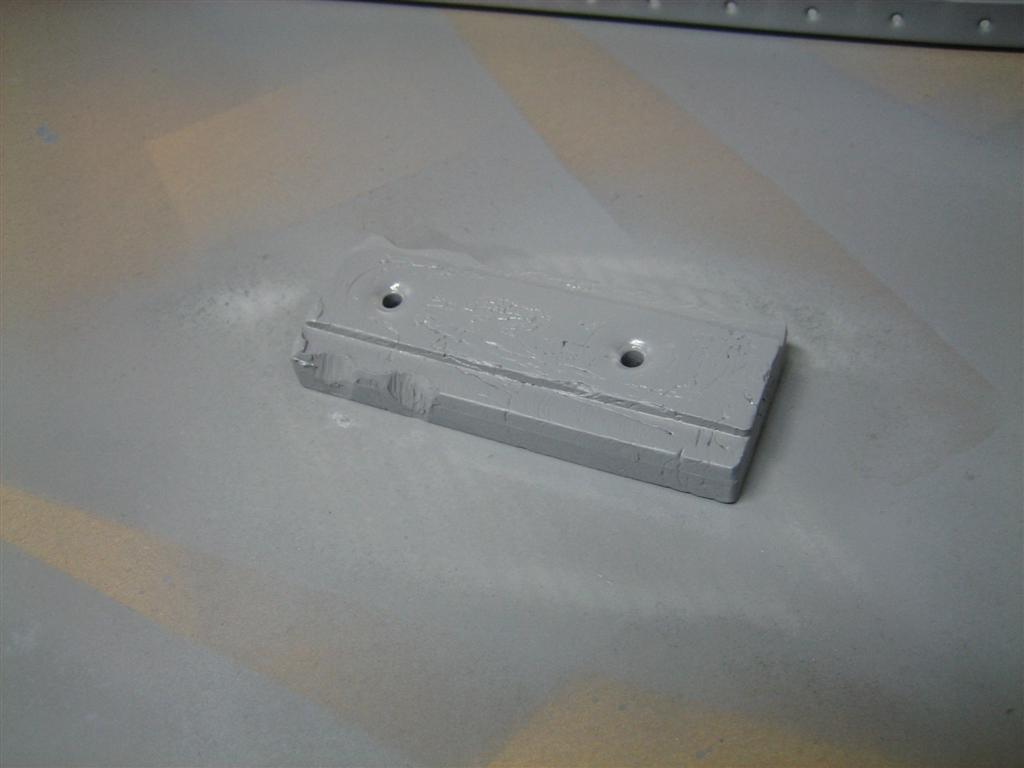
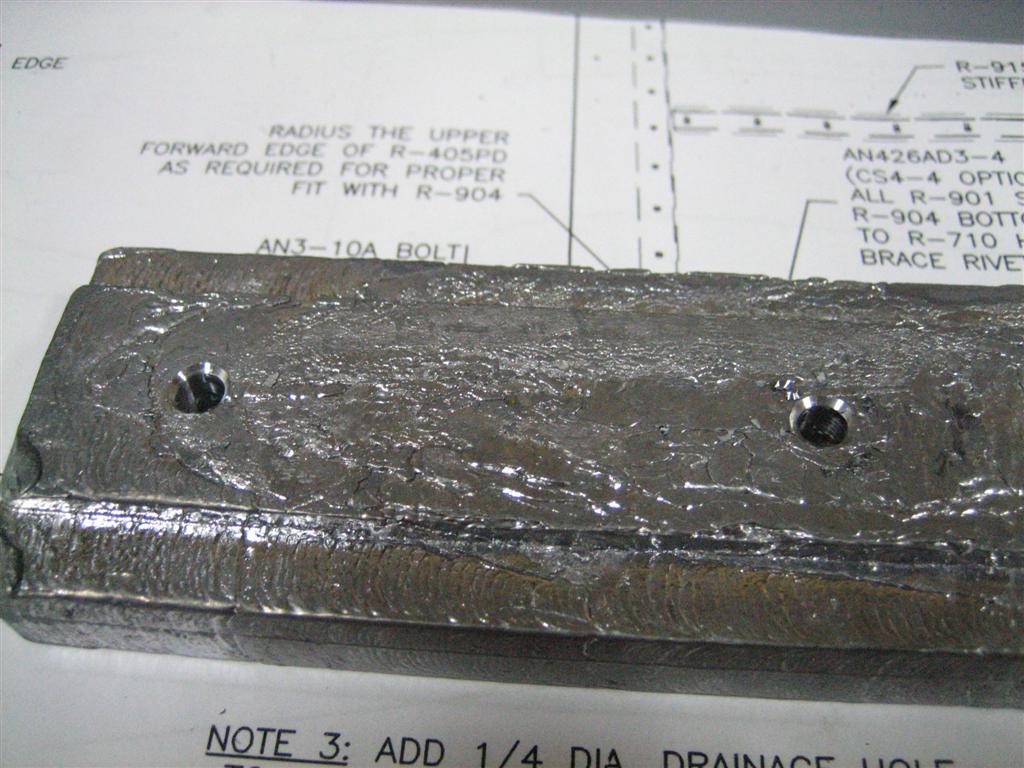
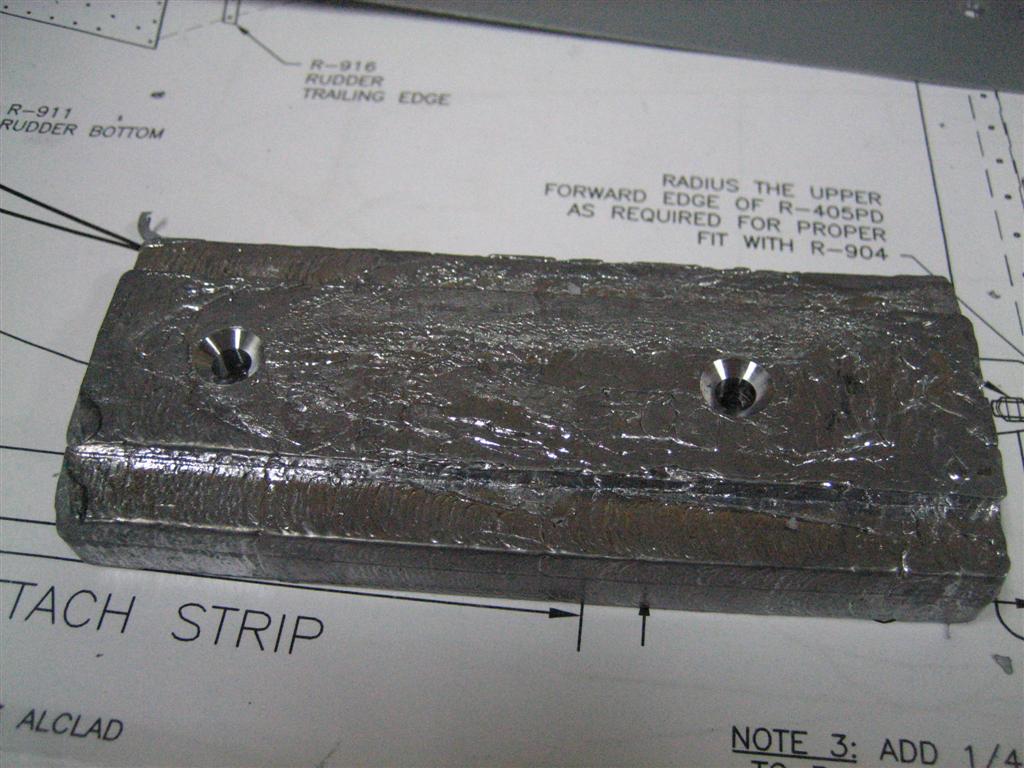
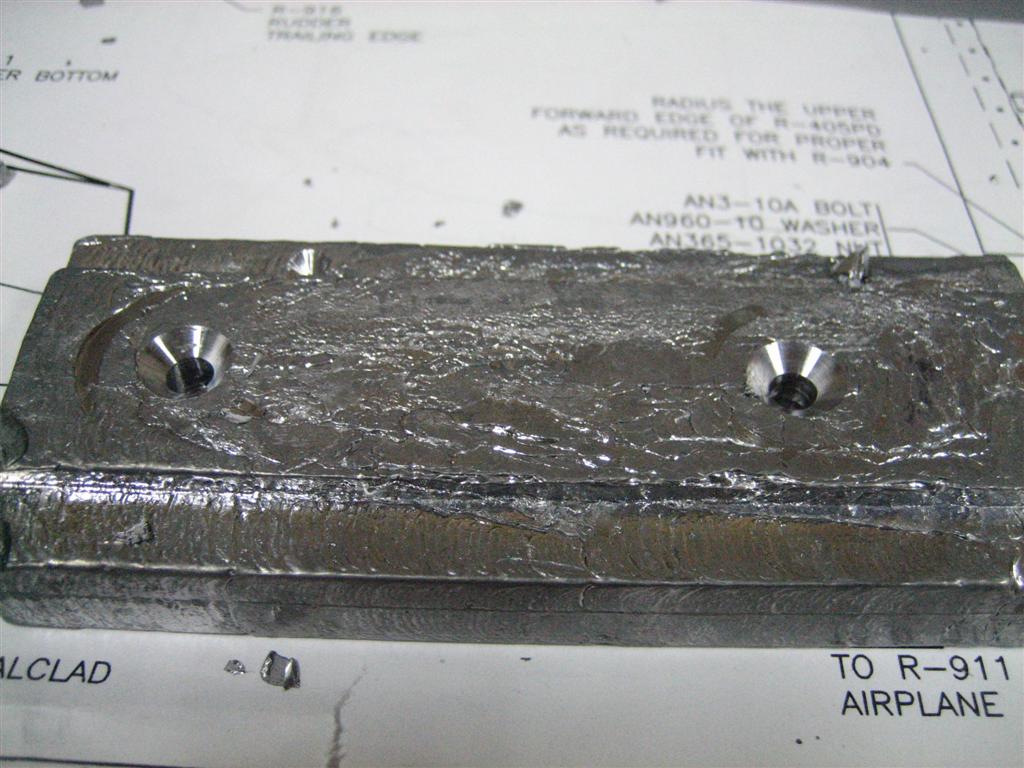
Then, I installed and removed the counterbalance enough to be able to file away some weight so the lead cleared the shop heads of the interfering rivets.

Nice tight fit today.

Here's the counterbalance. The best file for this left big cutouts, so don't judge me for these.

I also finished dimpling the tip rib and got it edge-finished, cleaned, and primed.

Waiting for primer to dry is like watching a pot of water boil. I can't complain though. It's dry to the touch in about 15 minutes.

Even though that was plenty of work for the day, I decided to tackle the trailing edge. I had everything I needed (Lowe’s didn’t have any RTV, but then I remembered I had some at home from my motorcycle habit, so I was in luck).

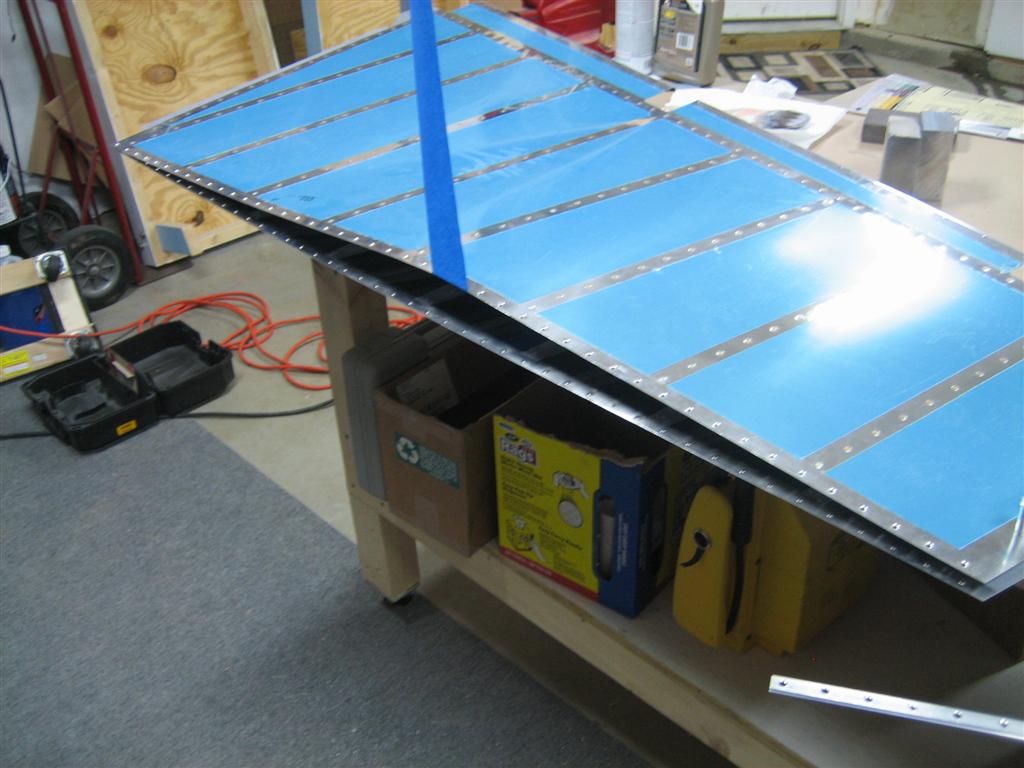
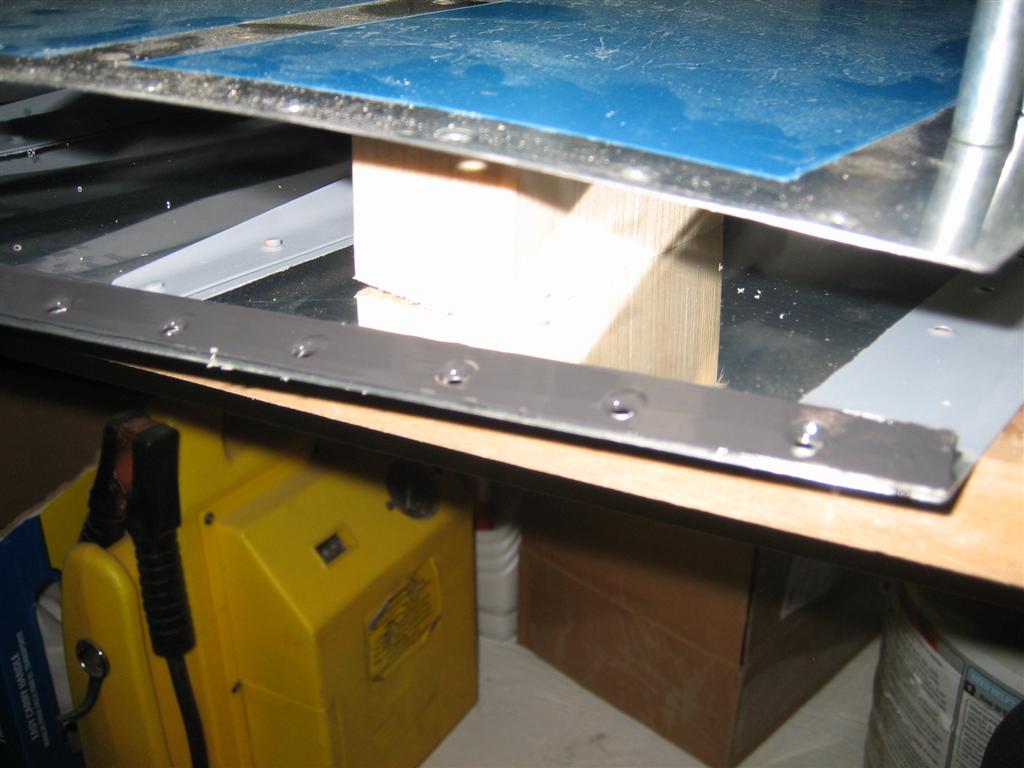
Here's me attempting to design a way to keep the trailing edges apart. This sucked, and I ended up using scrap 2x4 in between the stiffeners.

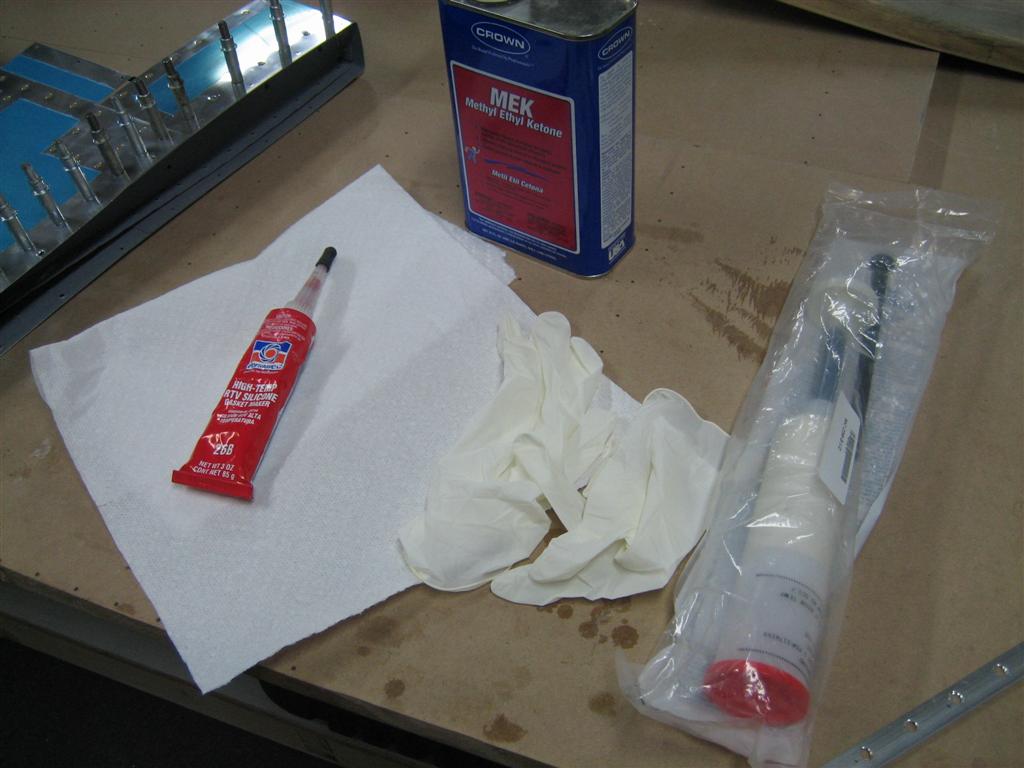
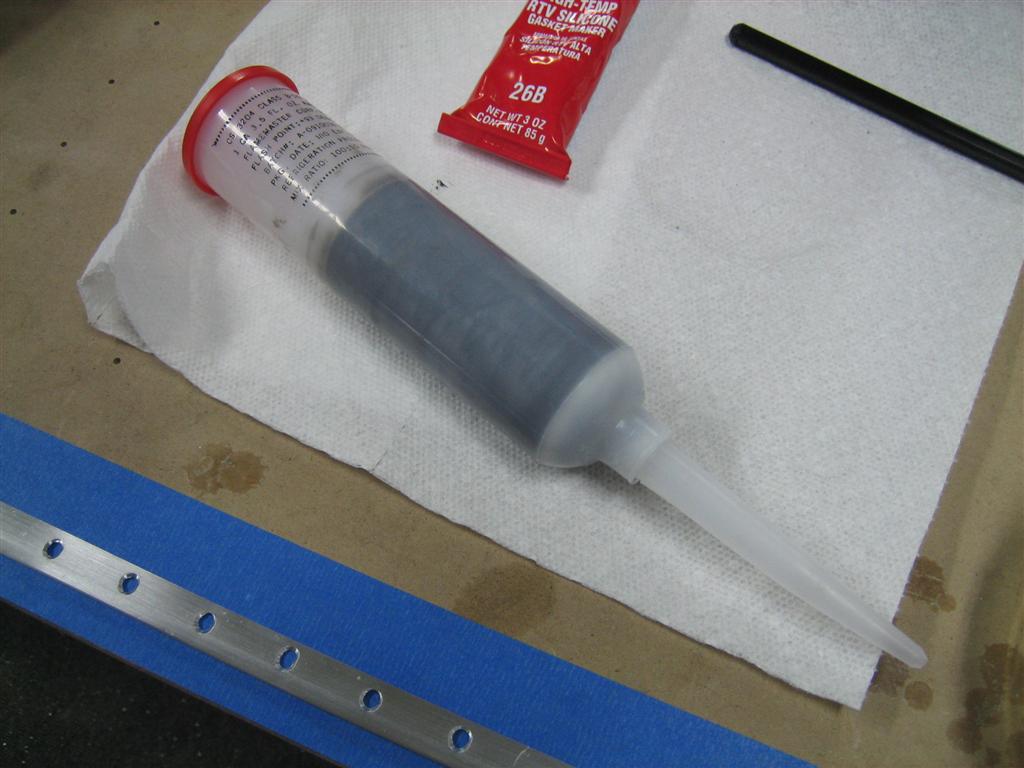
Here’s my tools. RTV, MEK, gloves (I used about 8 pairs) and the tank sealant.

Tools.

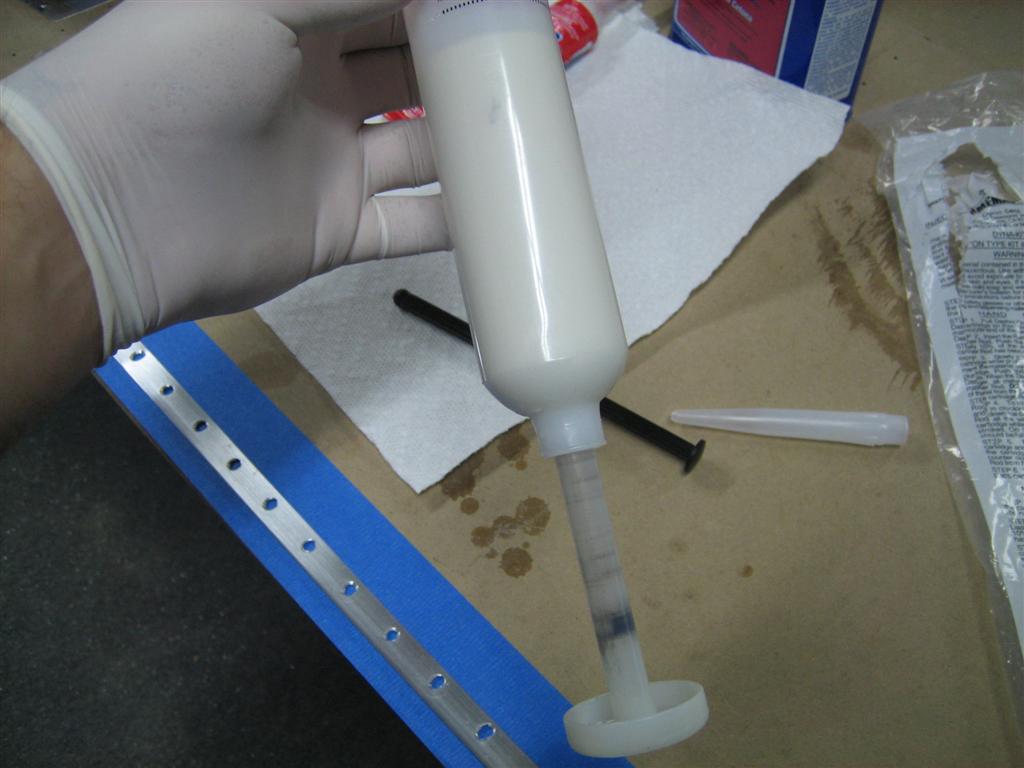
Don the gloves, and get ready to mix. I had to read the directions about 15 times before I understood. The hardener (I think) is in the tube part of the plunger. You stick the black piece (behind the big tube) into the hole in the plunger, and as you push the plunger from the bottom to the top, you push the black part so the hardener in the plunger is expelled into the larger tube. Confused yet?

Ready to mix. (I've already cleaned all of the parts.

After pushing the black piece (back on the table now) up to start the mixing process, you twist the plunger head while moving up and down, which starts to mix.

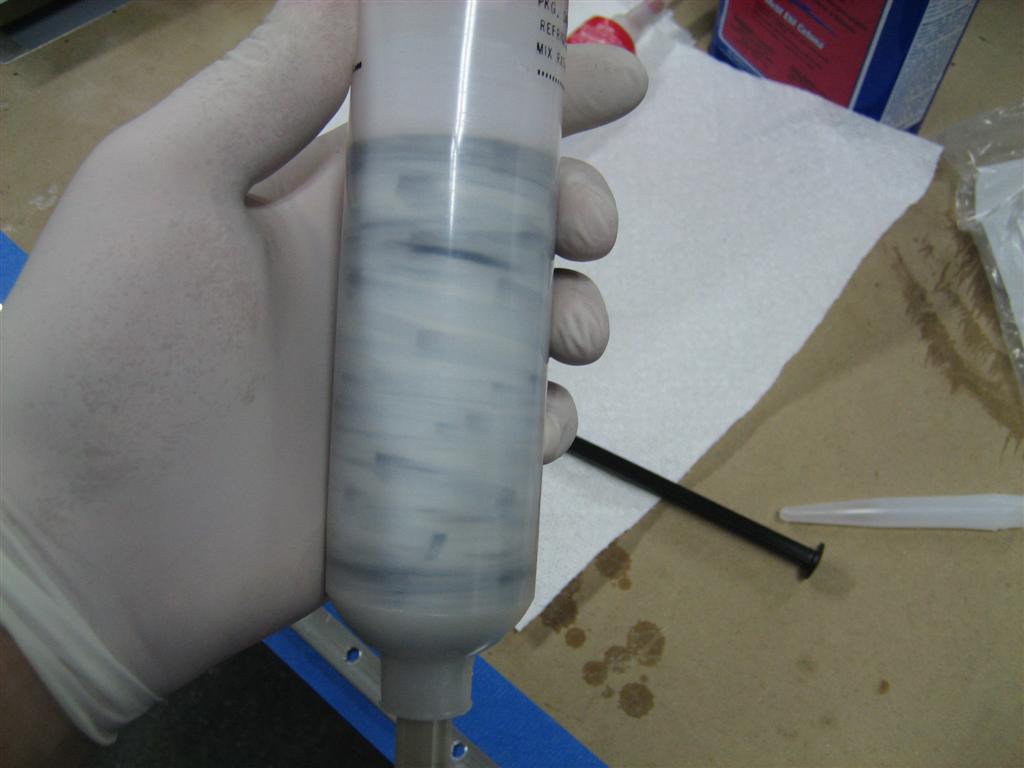
This is after about 75 strokes, which is what the directions say you have to do. I had to keep going. (I may have been doing something wrong, I don't know.) I kept going after this to get a more uniform "black death" color.

Then you unscrew the plunger shaft and screw in the nozzle. Okay, where is my caulking gun? I don’t have a caulking gun. OH MY GOD I FORGOT A CAULKING GUN.
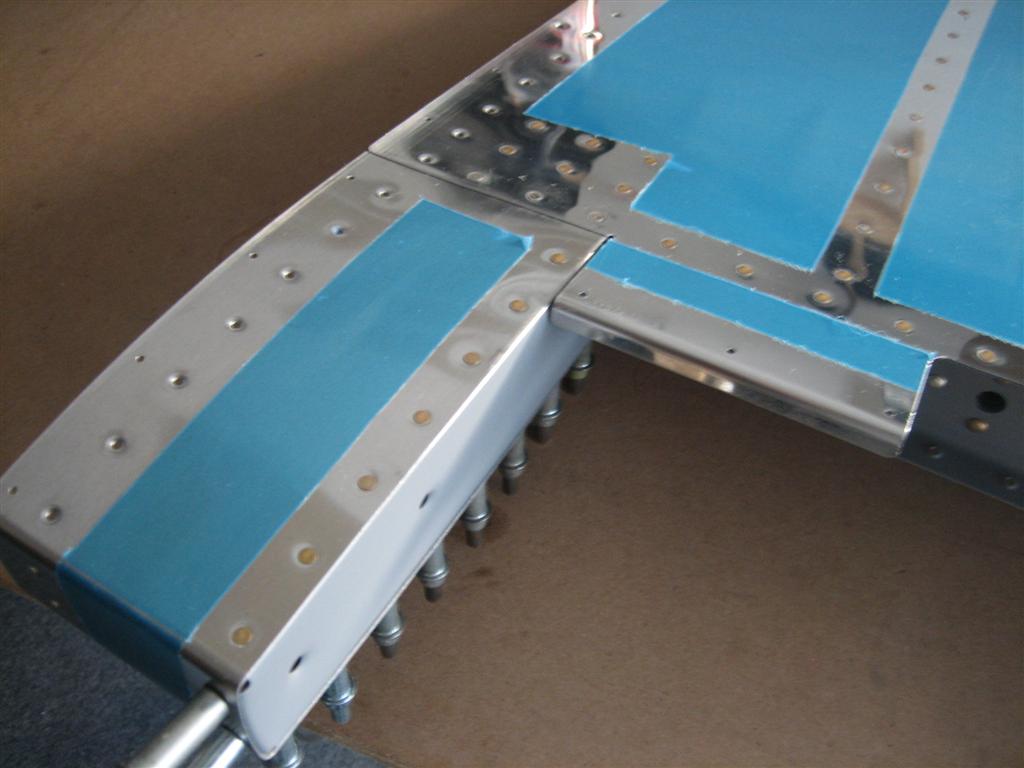
Here it is fully mixed.

That’s okay, I just stuck the handle of a large screwdriver down the tube and it worked great.

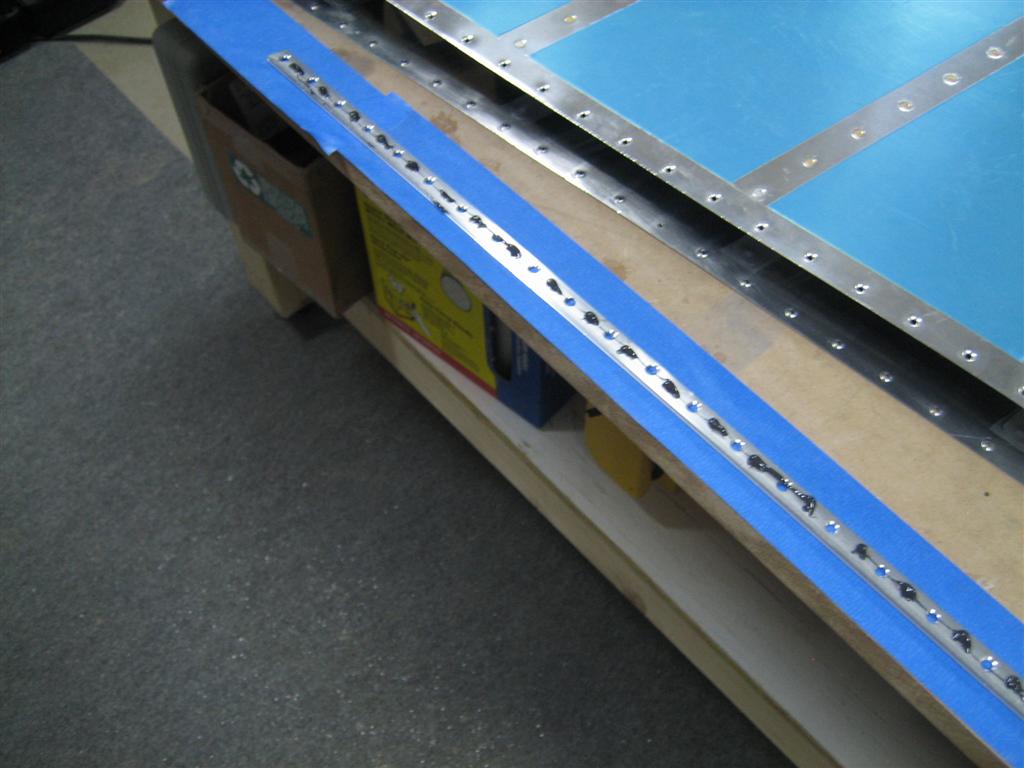
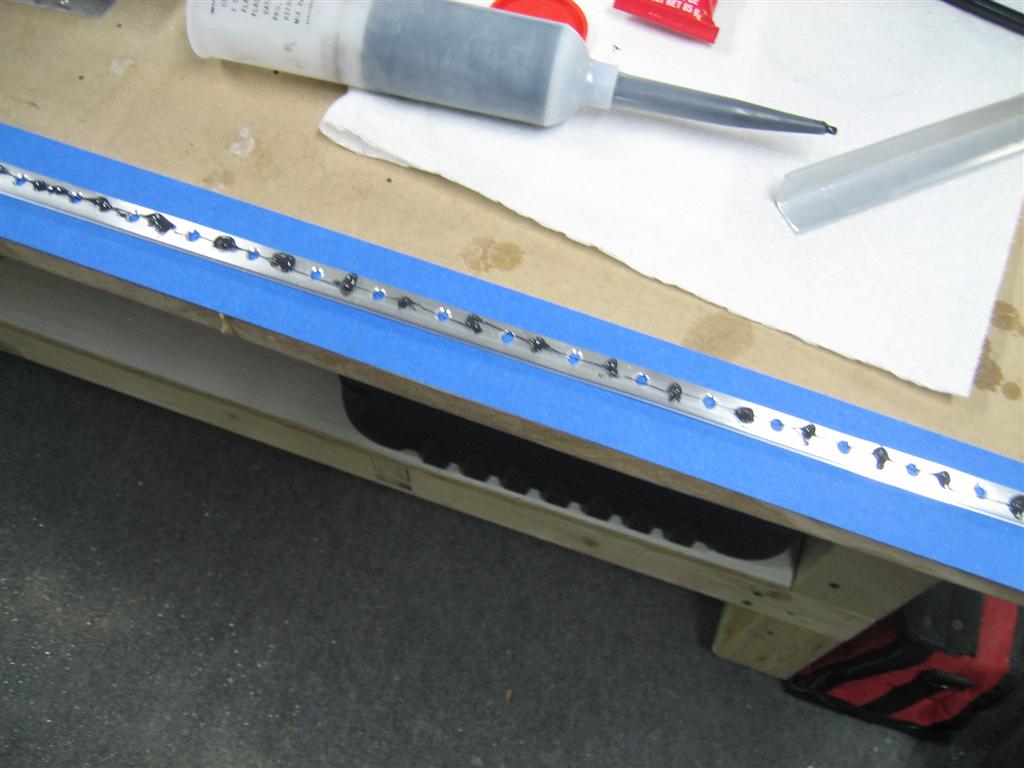
Here's one side, ready to be spread out. I put a dab between each hole, and then used a scrap piece of aluminum to spread it out nice and evenly.

Another shot. This seemed to be an appropriate amount of sealer.

After that step, things started getting messy, and I had to change gloves a lot (it gets everywhere), so I stopped taking pictures. After I got both sides covered, I laid it into the scuffed and cleaned trailing edge area of the skin.

Look how good that looks. (Also, you can see my 2x4 spacers.)
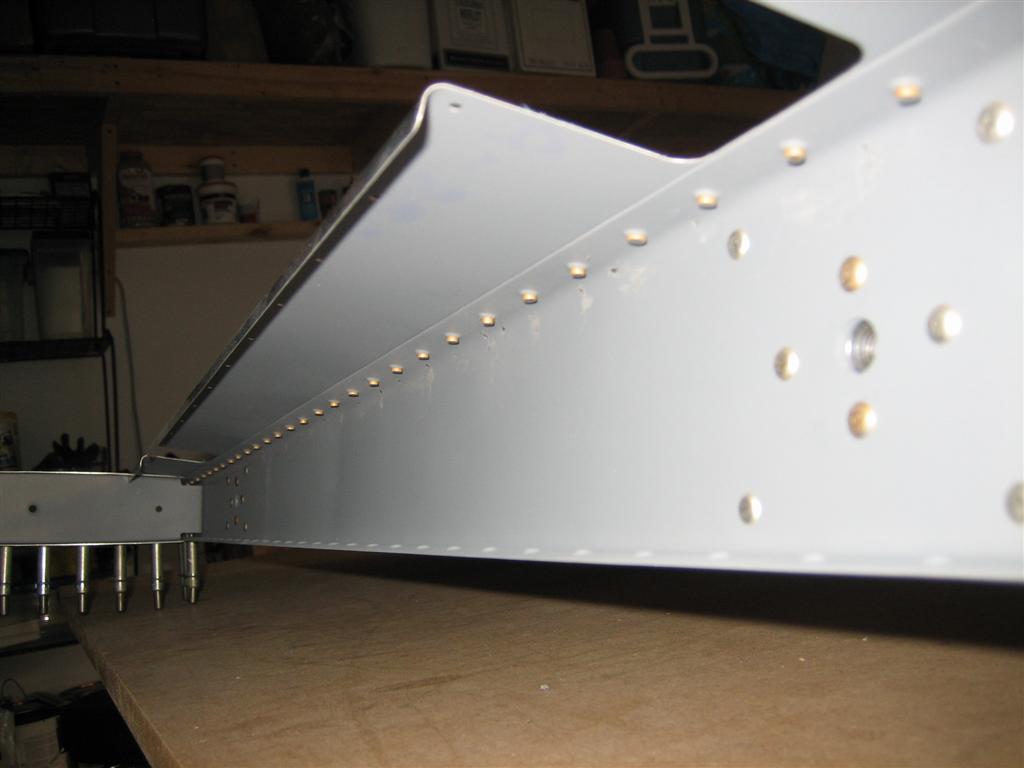
Another shot.

Of course, I did a marvelous job putting a perfectly penny sized glob of RTV on the last (aft rivet) of the stiffeners before I removed the wood spacers and closed up. (The wood spacer near the bottom of the rudder was a pain in my ass. I lifted up the trailing edge a little with the top skin, so it stopped squeezing the block, and of course the block slid down toward the front of the rudder. Of course now I can’t let go, but I’m too far away from the other workbench to reach all of my long-reach tools. Ever see one of those situations where a guy has one foot in a boat and one foot on the dock, and he’s stretching and stretching? That was me. Except I finally reached a BFS (big freaking screwdriver) and managed to get the block out without contaminating any tank sealant or RTV.

Here's a blurry shot of the bottom RTV glob. Glob is a technical term.

Then, I got the rudder clecoed to the angle, wiped off any excess sealant, and moved the hole thing to the top shelf of my workbench.

Storage, kind of. I'm going to leave this for a whole week while I start on the elevators.

I think it was 11 rivets.  2 hours before the trailing edge, one hour for the trailing edge. The next post is still from today, but I am tracking it in another section and in another column for total time, so it’s getting its own post.

Prev | Next


Got some more skin…riveted

March 25, 2010

Prev | Next

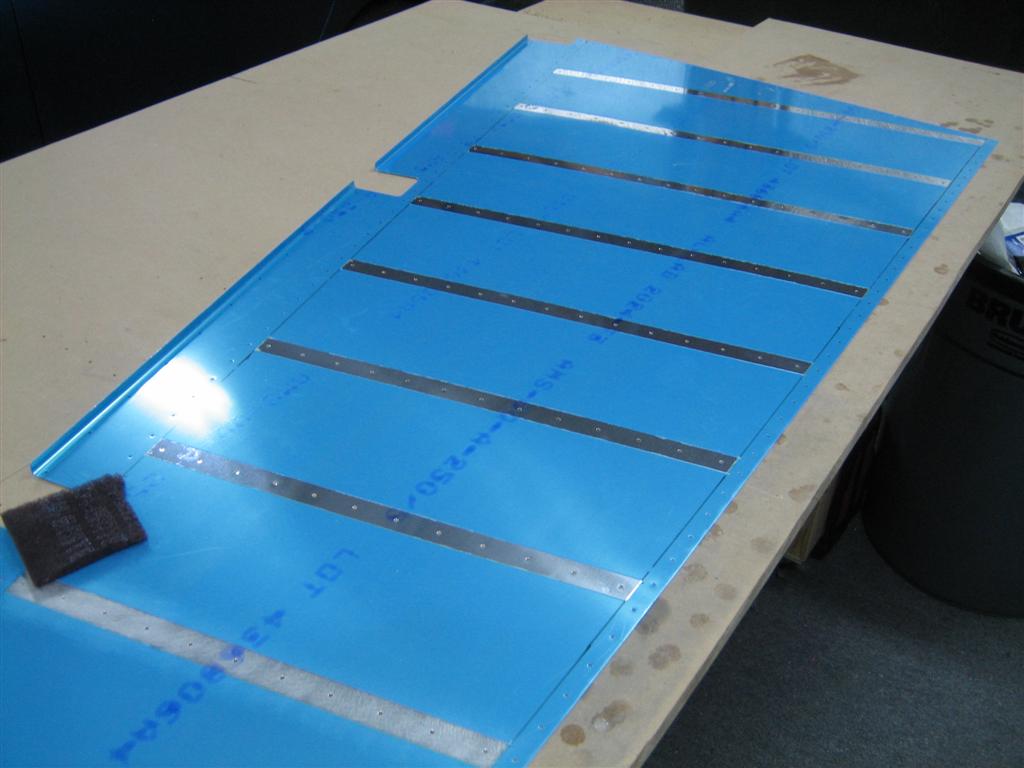
Before dinner, I managed to finish off the last few things on the right rudder skin and get it clecoed and riveted to the rudder skeleton. I still have to install the counterbalance, finish and prime the tip rib, and get those installed before moving on to the trailing edge, and then leading edge rolling.

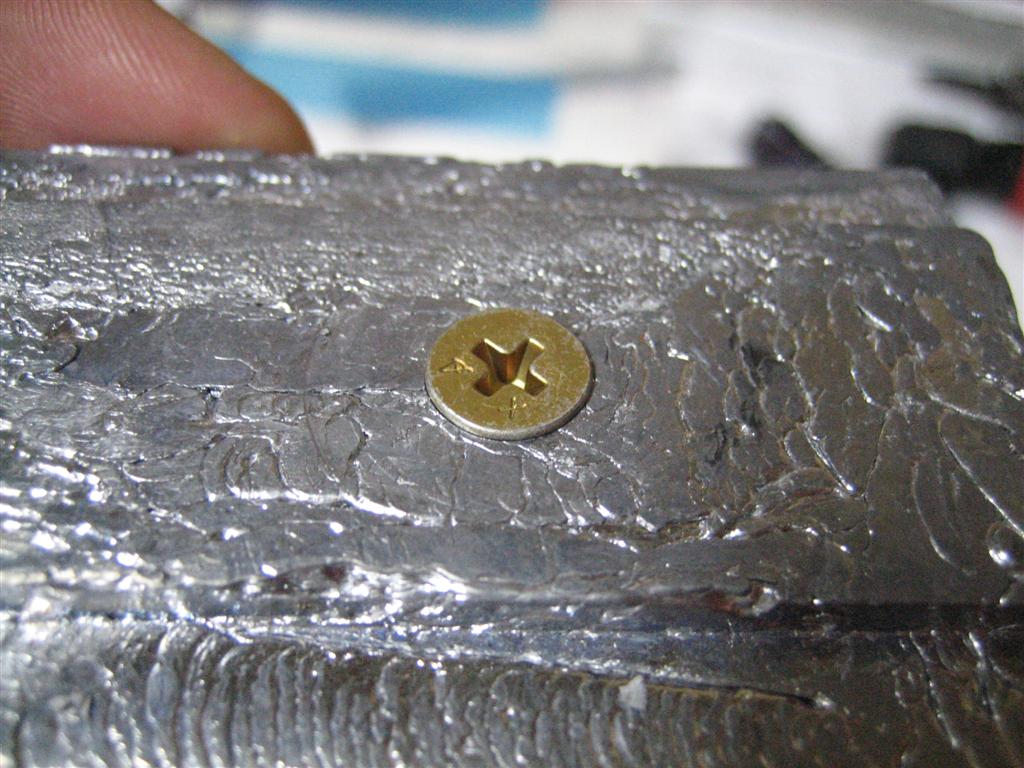
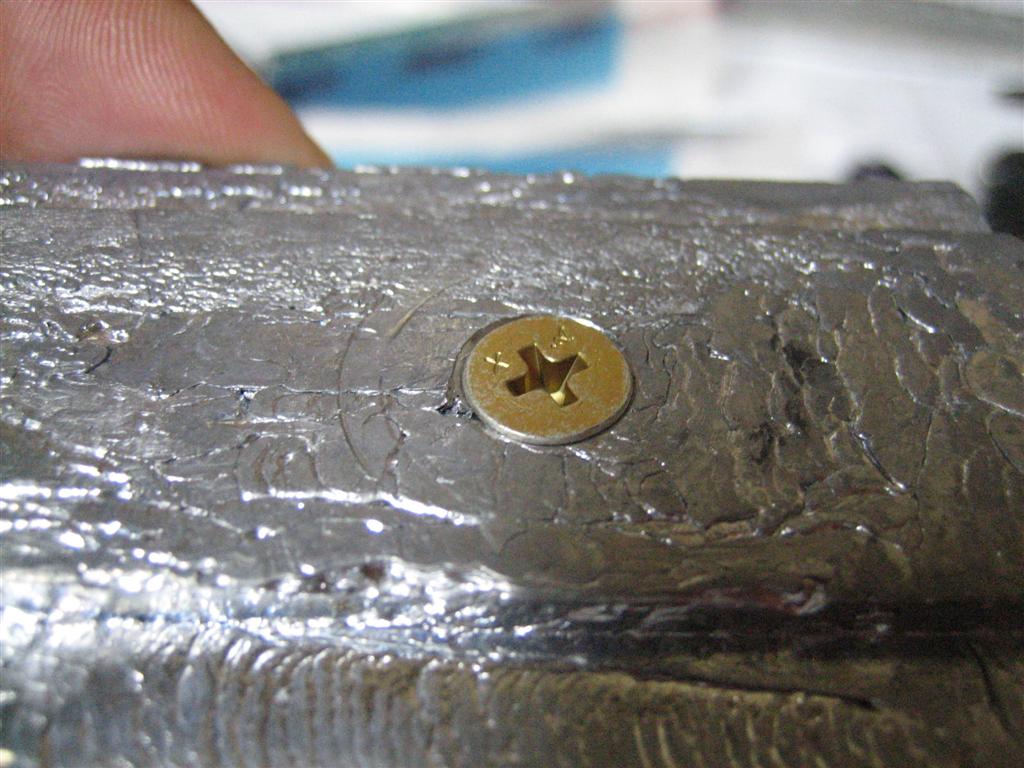
I’m holding off on the counterbalance because of the fasteners. The plans call out a AN509 screw and a AN365-1032 self-locking nut to hold the counterbalance in.
I know the FAA (AC 43-13) has deemed that an acceptable method for securing something permanently, but given the fact that I won’t even be able to inspect these fasteners (well, I could tell if they were loose if the screws turn from the bottom side, but would have to open up the tip rib to tighten them if needed), I wanted something a little more permanent (maybe not actually any better, but I’ll be able to sleep better at night).

I’m going to use MS17825-3 Locking castle nuts. They are also self-locking, but these will allow me to drill a hole in the screw and insert a cotter pin. I would bet that I also stick some red loctite on them. It would be a good bet.
Then I started looking around at the other fasteners used on the tail. All of the flight controls are installed using self-locking nuts, no cotter pins or safety wires anywhere.

I thought it would be easy ($20?) to put in drilled bolts with self-locking and cotter pinned nuts, so I made the following order from ACS. This should cover all of the counterweight and flight control connection installations for the tail.

17.00 of MS17825-3 LOCKING CASTLE NUT
1.00 of MS17825-4 CASTLE NUT
1.00 of AN3-10 BOLT DRILLED
4.00 of AN3-5 BOLT DRILLED
6.00 of AN3-7 BOLT DRILLED
100.00 of MS24665-132 COTTER PIN
1.00 of AN4-14 BOLT DRILLED

Then I got started on riveting. I didn’t take these pictures until after I had gotten everything done, so no intermediate shots. Sorry.

Bottom edge of the right rudder skin. This time, I didn't forget the fairing attach strip. (I need to figure out what to do about the last two holes. I'd like to avoid blind rivets, but may need them after all.)

Looking up the rudder from the bottom of the right side.

I got all the rivets my squeezer could reach. I'll have to buck these tomorrow.

There were only two rivets that needed to be drilled out (you can see both marked on the first picture today).

Here's one; the forward-most fairing attach strip rivet on the right side... the squeezer slipped.

Here’s the other one. It’s just sitting a little proud. Probably okay, but I am anal about this stuff.

Guess what I am planning on doing to this rivet.

Also, I noticed something about the alignment of the rudder top fairing attachment holes. Look at the holes on the left side of the picture (lined up from one side to the other) and then look at the holes on the right side. It appears as if Vans put the aft-most holes in slightly different spots so the fasteners wouldn’t hit each other when installed due to the low clearance in that area.
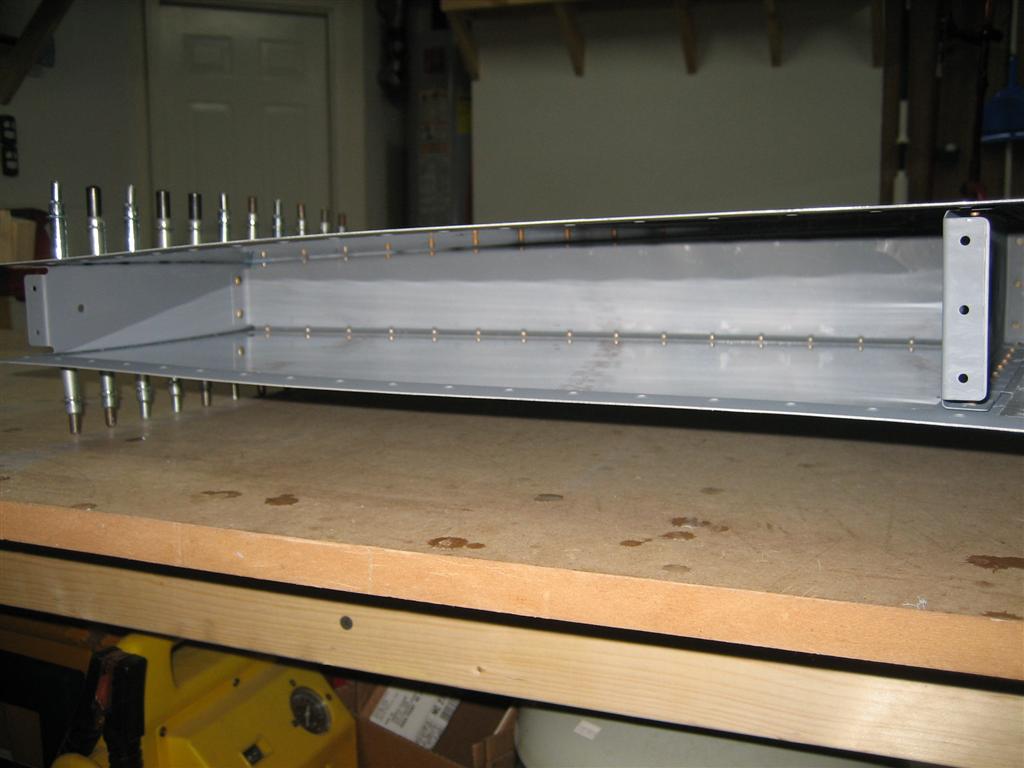
At first I thought there was something wrong, but then realized they were just thinking ahead. Bravo.

One hour today.  18 rivets on the bottom edge, 48 on the leading edge, and 6 where I could reach on the counterbalance skin to right rudder skin lap joint. That makes 72 total for tonight. 1333 total set, 85 drilled out for a batting (drilling) average of 6.38%.

Prev | Next


Got some skin…riveted

March 24, 2010

Prev | Next

After having performed the last of the rudder skin prepping the other day, I was ready to get riveting.

First thing, I pulled most of the clecos off of the leading edge so I could have access to the upper forward edge of the skin. It’s hard to see in this picture, but I gently “edge-rolled” the leading edge so the lap joint would sit flush after riveting.

Be very gentle here so you don't get a crease.

Because my trim job on the blue vinyl was a little long, I trimmed about another inch off. You can see the very slight edge roll in the reflection of the two clecos just left of the joint. I’m happy with it, and it sits very well on top of the counterbalance skin.

Man, there is a lot of dust.

Then, I started riveting. Here, You can see I’ve riveted the counterbalance skin to counterbalance rib joint, and every other hole down the leading edge. I’m just removing clecoes here to start finishing the leading edge.

Beautiful day to be working outside.

This was after about 50 rivets had been set. We headed in for dinner at this point.

Nice rivets, so screwups, but not as nice as the backriveted stiffeners. I thought about backriveting here, but I would only be able to backrivet one side, and I didn't want them being dramatically different.

One more picture before dinner. If you look closely, you can see the very nice lap joint.

And a picture of the shop heads. A few of these (maybe 5th from the right and similar) will need a few more hits with the gun, they don't look quite set enough.

Before dinner, I went and got my mail, and my internal rudder stop had shown up. $25 to get the external stops off the airplane. Worth it for me, although I think Craig is making a killing on these. If you want one, order them at the VAF posting.

Internal rudder stop. I'll install (and take plenty of pictures) once I get the rudder done.

After dinner, the girlfriend wanted to work out in the garage some more (what a crappy girlfriend; she wants to work in the garage all the time… /sarcasm off), so I finished up the left side of the rudder.

Left side of the rudder, done.

I was going to take more pictures, but I got distracted because I riveted the skin to bottom rib WITHOUT INCLUDING THE FAIRING ATTACH STRIP.

Awesome, that was 16….no….17 (i messed one up putting it back in) rivets I had to drill out.

Perfectly.

Good.

Rivets.

<sigh>

But, I did get solid rivets in all of the holes near the horn brace. My 3″ yoke with a 1/2″ flush set kind of looks like a longeron yoke, so I was able to reach all of these.

Here's a closeup of the attach strip after everything was all said and done.

All in all: 84 rivets set, 17 drilled out (ugh!) over an hour and a half.

Prev | Next


Riveted R-912 Counterbalance Rib

March 23, 2010

Prev | Next

After priming the R-912 counterbalance rib and R-913 counterbalance skin last night, I thought I would get those installed on the skeleton. First thing to do is check the plans for a rivet callout.

What!? No rivet callout? That means I have to think!

No rivet callout for the R-912 to R-902 spar attachment.

I grabbed the shortest AN470AD rivet I could find…AD4-4. That seemed to be good.

This one will work.

And an after picture. Wuhoo!

Successfully set rivets.

I squeezed these. I’m still not totally happy with my squeezers ability to squeeze AD4 rivets.

Not too shabby.

Then, I grabbed the counterbalance skin and clecoed it on. My squeezer is only a 3″ yoke, so I can’t reach any of these holes.

My squeezer isn't long enough to reach these holes, and the girlfriend is outside helping me with some deck chair refinishing, so no rivet gun tonight.

Another picture of those two clecoed on the skeleton.

It's nice outside, so I had the garage door open. Lot's of sunlight in the afternoons.

Finally, I got the left skin clecoed on to check for fit and complete any remaining edge-finishing required before riveting.

Left rudder skin to counterbalance skin holes.

To be determined: whether I should edge-roll the forward edge of the rudder skin where it overlaps the counterbalance skin.

It looks good now, but might pull up when I rivet. I think I'll edge roll this. "Avery? Please send me your edge roller tool. Thank you."

Two rivets set today. Half hour total.

Prev | Next


Dimpled R-912 Counterbalance Rib

March 21, 2010

Prev | Next

Not a huge day today, but I did go shopping. Recently, the self-etching primer has been getting to me unless I am completely outside the garage while priming. Sometimes, I can always be completely outside, so this might make it bearable in the garage.

MEK, a respirator, and some latex gloves.

When I started looking around the shop, I found this monstrosity just laying there, dead, out in the open. He must have crawled through the spider spray I laid down around the perimeter. He’s huge.

That's a quarter.

Anyway, I am not too happy with the outside rivet I installed yesterday. I ended up using a double offset set as the bucking bar, and I just don’t like the shop heads.

Bad shop head there on the left.

Same there on the right.

I got them drilled out, and figured that the materials on both sides were thick enough to ignore the “shop head on the side with the thinnest material” rule. I put the machined heads in here, and bucked from the front.

These look much better, even though they aren't all facing the same direction.

Here they are from the other side.

I am much happier with these.

Then, on to the counterbalance. Because I don’t have a #10 dimple die, I decided to countersink these, and use them as the female die.

First try. Obviously to shallow, but I wanted to approach it slowly.

Another iteration.

Another iteration.

Check it with the screw. Nope, not yet.

Closer.

Another try.

There we go.

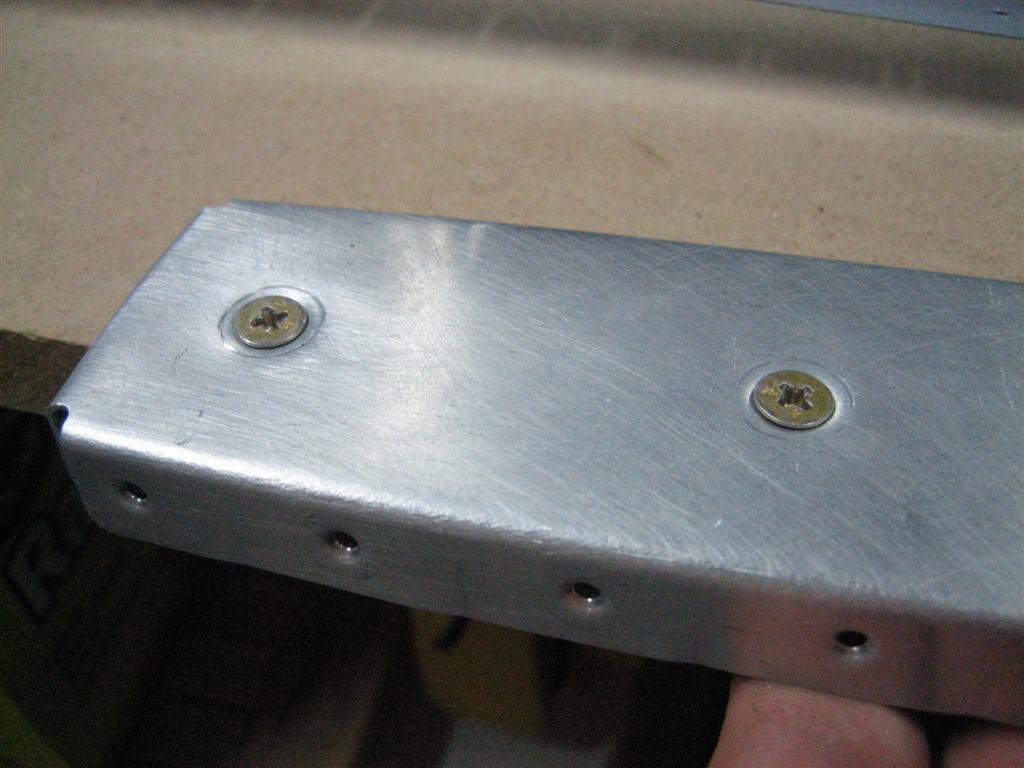
Then, after trying a few things to see how to dimple the rib, I ended up putting the screw in the hole and using my squeezer (with no “upper” set so the screw goes through the hole in the yoke) as the dimple die.

This worked surprisingly well.

Here are the final dimples. If I had it to do over again, I would spring for the #10 dies. I’m sure I”ll have to use them throughout the project. I’m going to put them on the list.

Final dimples. Not perfect, but good enough.

2 rivets drilled out. Half an hour. Not bad for a busy Sunday.

Prev | Next


Skin Devinyling, Stiffener Dimpling

February 21, 2010

Prev | Next

We got a ton of work done on the house this weekend (paint, patio furniture), and a little work done on the airplane.

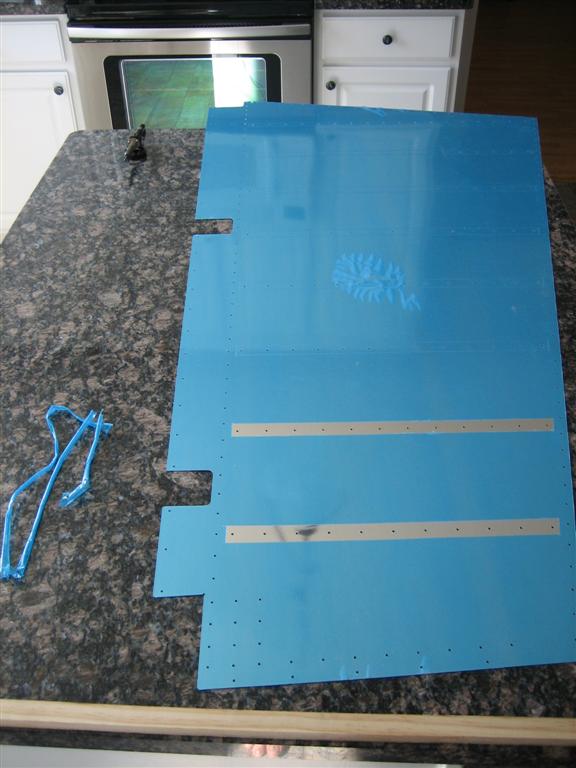
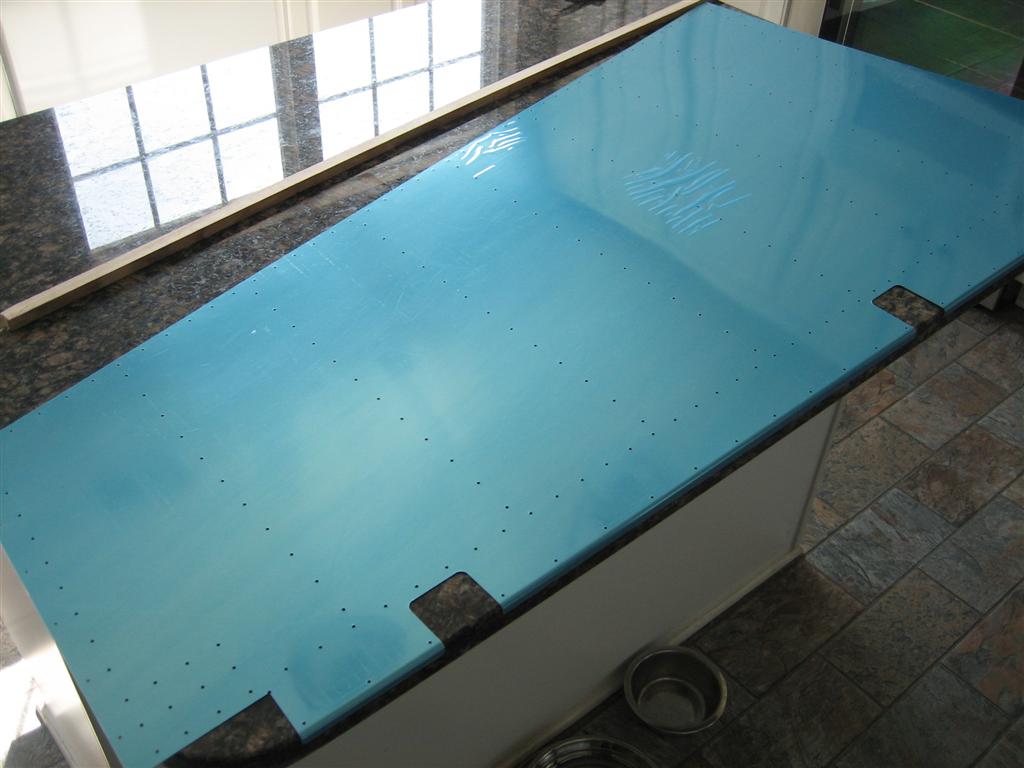
Yesterday morning over coffee, I brought the right rudder skin into the kitchen and started devinyling. After giving it a lot of thought, I am only going to remove the vinyl (and then scuff and prime) the rudder stiffener locations right now. Later, after matchrilling the skins to the skeletons, I’ll devinyl, scuff, and prime those mating surfaces.

A couple strips done.

After finishing up the exterior side of the skin, I flipped that bad boy over and started on the interior side. I was more careful about tracing lines here, because this is where the primer will go. (Although no one will ever see the inside of the rudder skin once I have it assembled.)

Here's my wooden stick I use to devinyl in a straight line.

After finishing the right skin, I brought in the left.

Here we go. Hmm. Dog bowls are empty, I think the pups must be hungry.

Here is the interior side of the left rudder skin.

Pretty devinyled strips. I think the exterior of the skin is done, too.

Then it was off to do some errands, one of which was a stop by Harbor Freight. I got a mailing the other day, and they had some fantastic deals on some things I wanted.

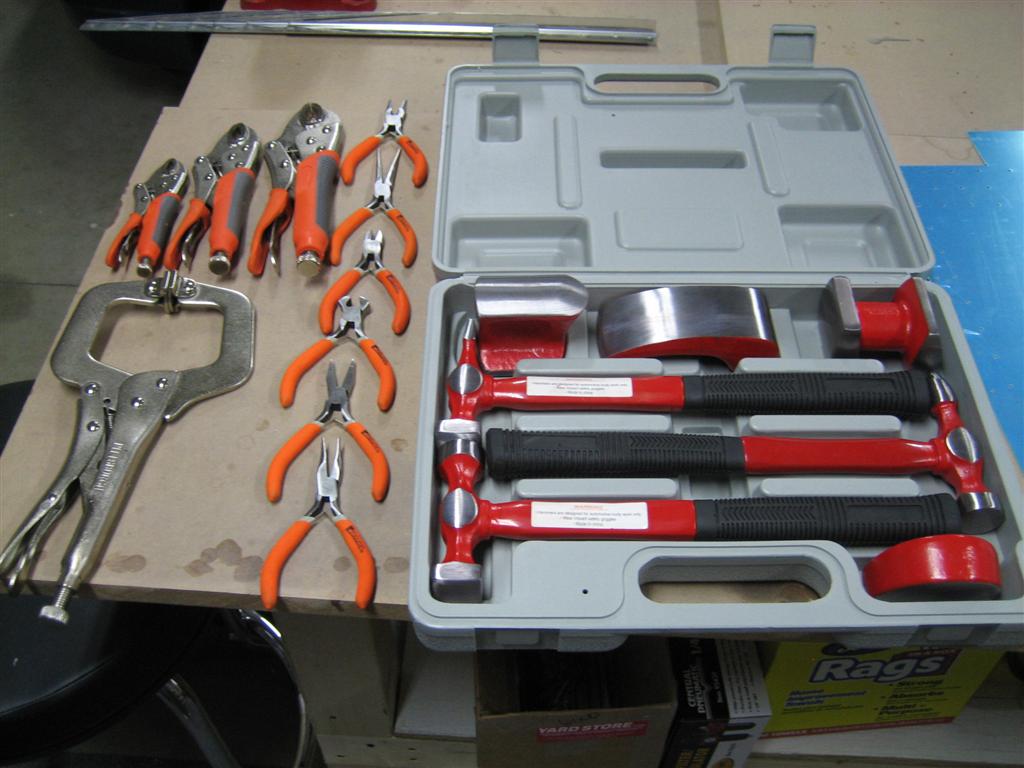
7-Piece Body Repair Kit. First, the “body repair kit” was $19.99. Look at the 4 bucking bars in there! I don’t really care about the hammers, but my small bucking bar was not really cutting it for some of the rivets I needed to buck. The best improvement with these new bars…hand holds. They have little cutouts in the side for your fingers so you can get a great hold on the bar. I’m happy.

11″ Locking C-clamp. These come in handy for clamping things around flanges. I needed one of these, and ended up walking away from Harbor Freight for about $6.

3-piece locking pliers. I have a small set of needle-nose locking pliers and love them, I figured for $4.99 for 3, I couldn’t go wrong. The quality isn’t the best (the screw mechanism is a little sticky), but they should work.

6-piece presicion pliers. I have a couple of these from various places and I love them. 4 pliers, and 2 cutters. I’m most looking forward to the extra long pliers second from the top. Those will help me overcome my huge sausage fingers.

Hooray shopping.

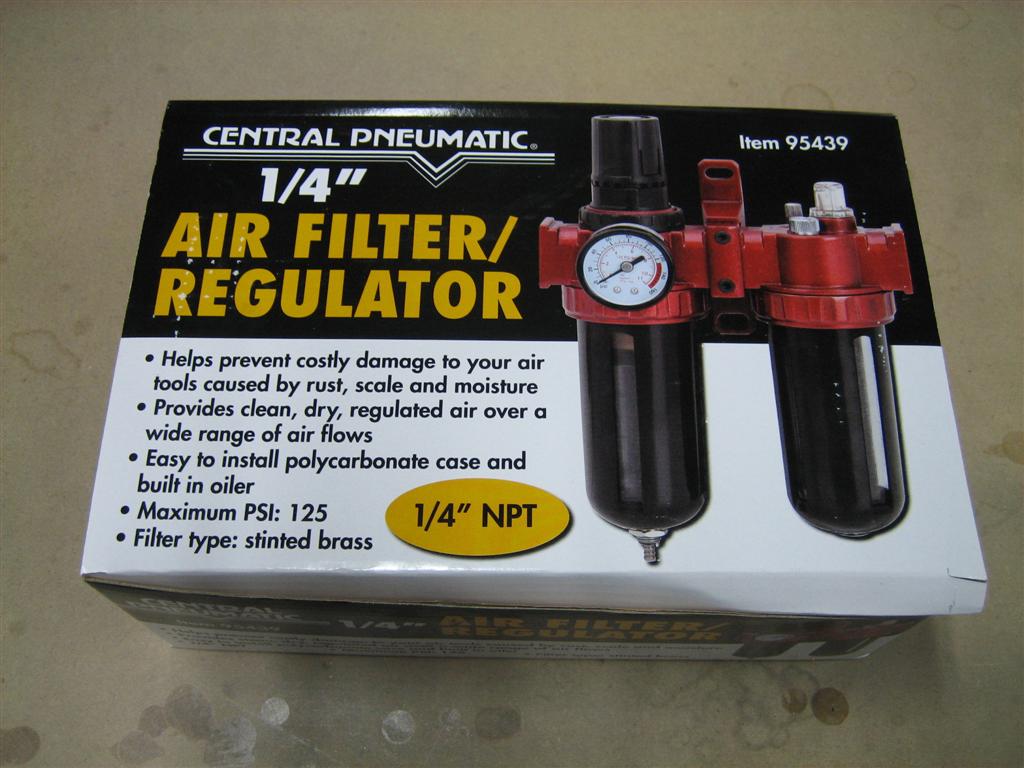
Also, I grabbed this $19.99 air filter/regulator. I wanted a better regulator/filter/oiler, and this one looks like it will fit the bill. I hope the quality is high enough to not disappoint me.

Air filer/regulator. Should work well, and will relieve me from having to oil my tools every day.

Next, I spent a ton of time deburring the skins. I think it is something like 119 holes per skin, times two sides, times two skins. Yes, my fingers hurt. Here I am scuffing the inside of the skins after deburring.

Deburring and scuffing.

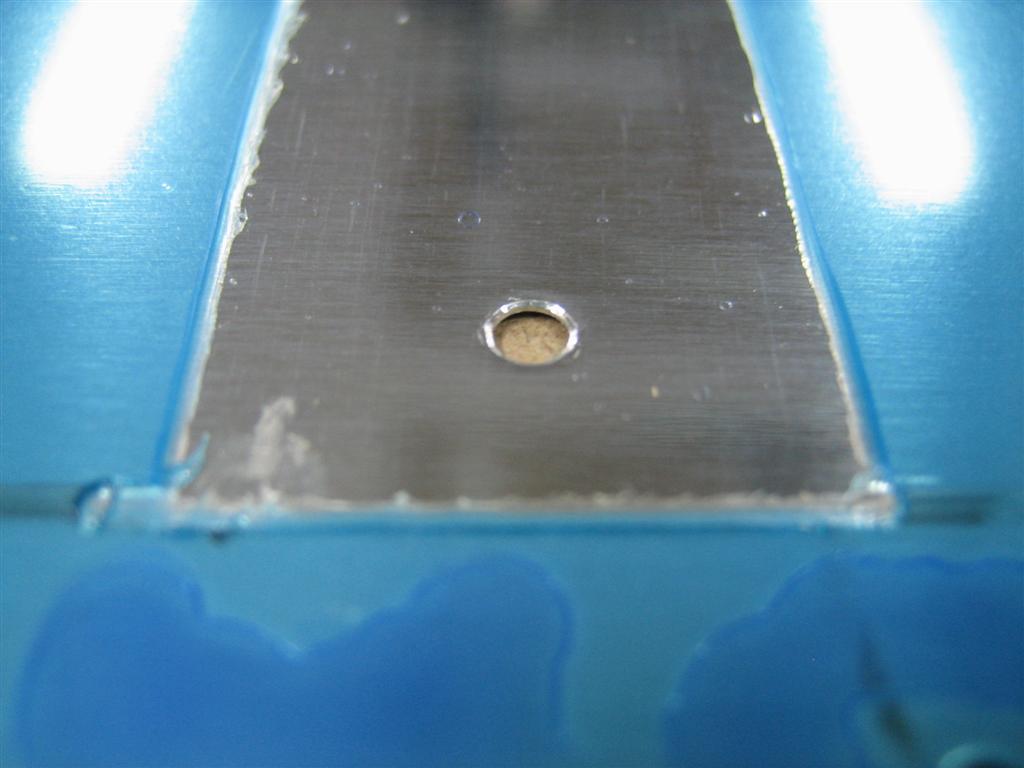
I was getting fancy with the camera, so here’s a closeup of one of the strips after deburring and scuffing.

Deburred and scuffed strip on the interior side of the skin.

And another picture of a strip before scuffing. This hole has been deburred, though. i should have taken a picture of an un-deburred hole for you. Sorry.

Deburred, but not scuffed.

While Mike Bullock has his Natty Boh, I have my Blue Moon (well, Rising Moon, their seasonal).

The moon!

Scuffing the left skin.

More scuffing.

All done!Finally, I finished scuffing the interior of the skins. After I get these all cleaned up (it will be harder to clean after dimpling) , I can get these dimpled and primed.

All done!

Here’s a nice closeup of me deburring the stiffeners.

Deburring the stiffeners.

After finishing deburring all of the stiffeners (which is two more deburr operations for each of the holes from the skins), I pulled out the squeezer and tank dies (for the skeletons, which I’m considering understructure).

I like playing with these.

I decided to go ahead and scuff and dimple the stiffeners now, while I can’t make any loud noises (post 10pm). I should have edge finished the stiffeners first, but I’ll still be able to use the scotchbrite wheel on them after they are dimpled. To save time, I’ll edge finish these while I am priming the interior of the skins later this week. Anyway, here are some dimpling shots.

Getting ready to dimple.

Squeezing.

The end result.

A few minutes of this, and the right stiffeners are done (still not edge finished, though).

Right side stiffeners done.

Wash, rinse, repeat for the left side.

Both sets of stiffeners done. Time for bed.

2.5 hours today. Boring, tedious work, but still the most fun a man can have with his clothes on.

Prev | Next


Vertical Stabilizer 99 Percent Complete

February 15, 2010

Prev | Next

Jack and Ginger were a little neglected this weekend while the girlfriend and I painted the master bedroom. I’m sorry, guys.

Anyway, tonight was all about them, so in the middle of playing, napping by the fire, and running in circles around the house, I managed to calm them down enough to help with the airplane a little.

With the few minutes I had, I managed to set the 22 rivets that were hard to reach with the squeezer last Friday night. A few of them, especially near the elevator hinge brackets, were still hard, but I managed to get them all set, even if it was after drilling a few out. I also set the three AN470AD4-6 rivets that hold the rear spar to the root rib and also install the three LP4-3 rivets that hold the rear spar to the middle rib.  Here are the dogs, once I got the vertical up into the ski equipment room, umm, I mean airplane parts storage room, umm, I mean burnt orange room.

The dogs flew again. This time with directional stability!

They aren’t really happy about being in the orange room in general (it is off limits, so they are very good about not crossing the threshold), but especially not when they have to pose in the airplane. I know for a fact, though, that they will love flying in it when it’s done.

Jack's not very happy about posing. He's ready to go.Jack's slightly less uncomfortable the further he is away from the "shiny blue thing that makes loud noises." Seriously, I heard him describe it that way.

Ginger’s okay, though. Especially when there is a bone on which she could be chewing.


Jack's slightly less uncomfortable the further he is away from the "shiny blue thing that makes loud noises." Seriously, I heard him describe it that way.

Finally, one without the dogs.

Tada!!!

All in all, a good night. 1 hour, 28 rivets set, 5 drilled out.

There are still a few more things I would like to do to the vertical, like drill out a couple of rivets and reset them, and clean up some of the skin edges, but for the most part, it can sit inside while I press on. I can’t believe it took me 16.5 hours for the vertical versus 44.5 for the horizontal. I think I would recommend to other newbies to start on the vertical. It seemed to be a lot easier, but I don’t know if that was because I had done everything once already on the horizontal, or because it really was easier. Whatever you do, don’t take my advice, though. You’ll die if you do.

Prev | Next


VS Skin Riveting, Part Deux

February 12, 2010

Prev | Next

I’m writing this on Monday for Friday night’s work, so we’ll see how much I can remember.

After a couple minutes of clecoing on the right side of the VS skin, I got started riveting. First, I set every other rivet along the VS-702 front spar and the VS-707 middle rib.

Left skin on the bottom, right skin on the top. That crazy long cleco keeps sneaking into the pictures.

After rivting the front spar and ribs to the skin, here’s an interior picture.

Lower interior of the vertical stabilizer.

Here’s a picture of my “every-other-rivet” style. It works well.

Ready for the remaining rivets.

There are 39 rivets (not counting the tip and root ribs) for the front spar and middle ribs. After setting these 39, I’m ready to pull off the blue vinyl from the interior.

Starting to look pretty. So is your face.

Another rivet picture. (I’m not sure I got these in the correct order…Hmm.)

VS shop heads.

More rivets.

More shop heads.

<sigh>

<yawn>

Had enough yet?

Even more shop heads.

Alright, now I get to start removing the blue vinyl. This is where the gravy is. After all that prep work and riveting, you get to remove the vinyl to reveal a beautiful shine on the inside. I can’t wait to do this on the exterior skin (just before polishing). Flash on for visibility.

Starting to remove the blue vinyl.

I left the flash on for this one so you could see inside.

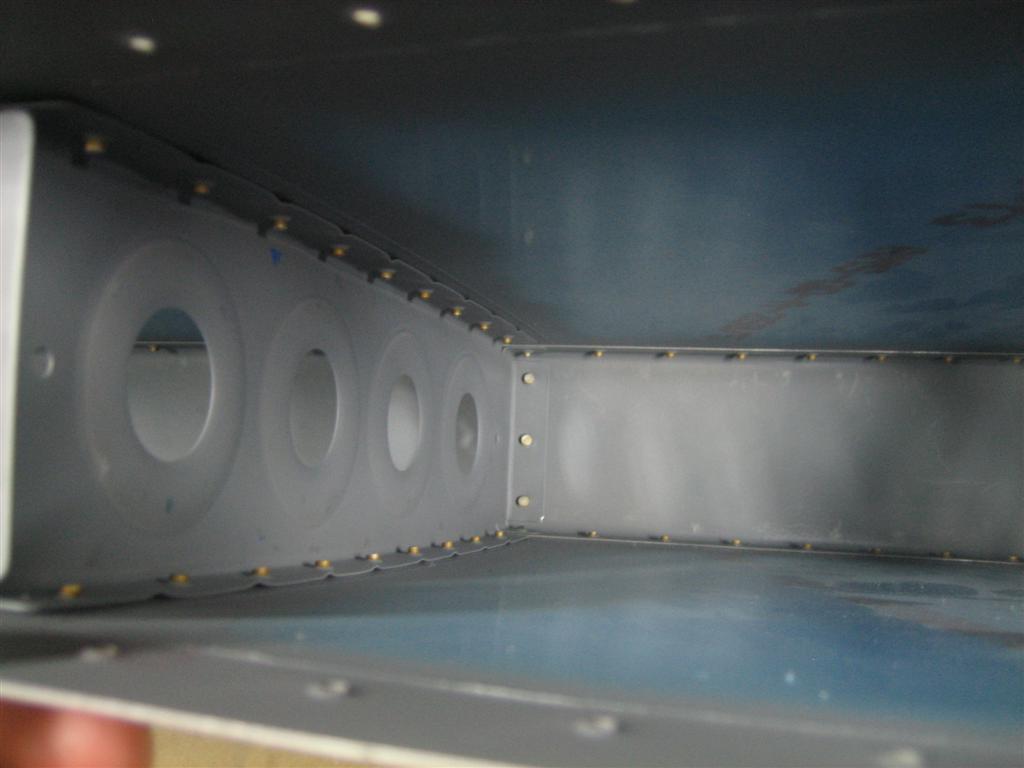
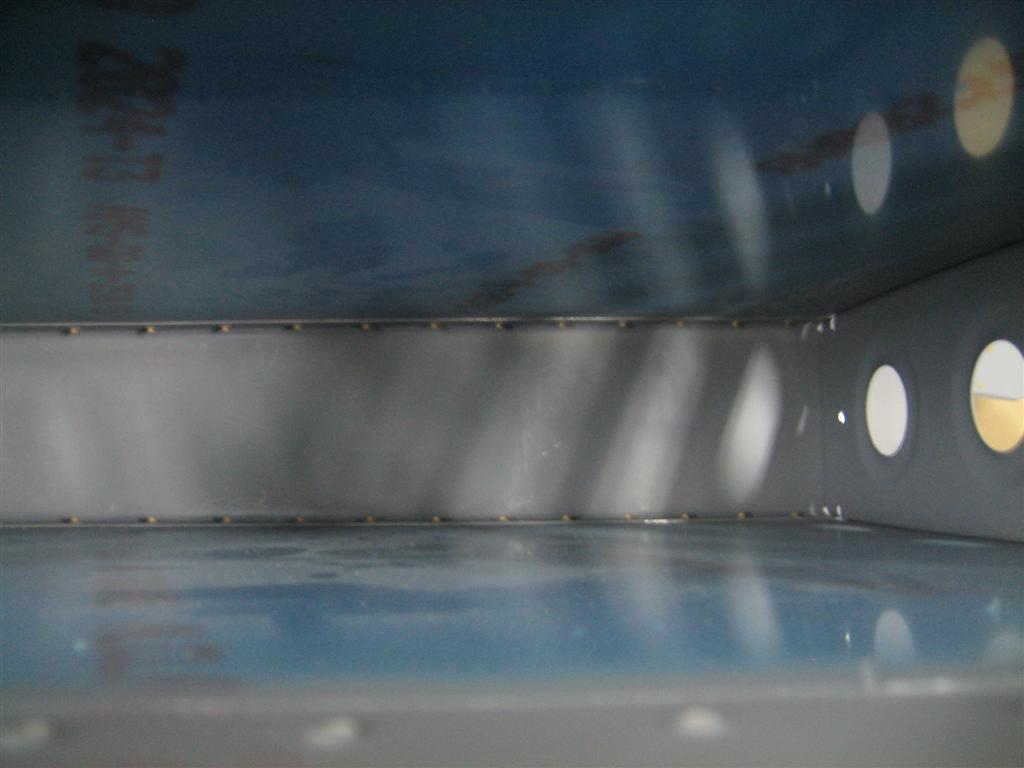
Inside the lower bay of the VS.

And the upper bay.

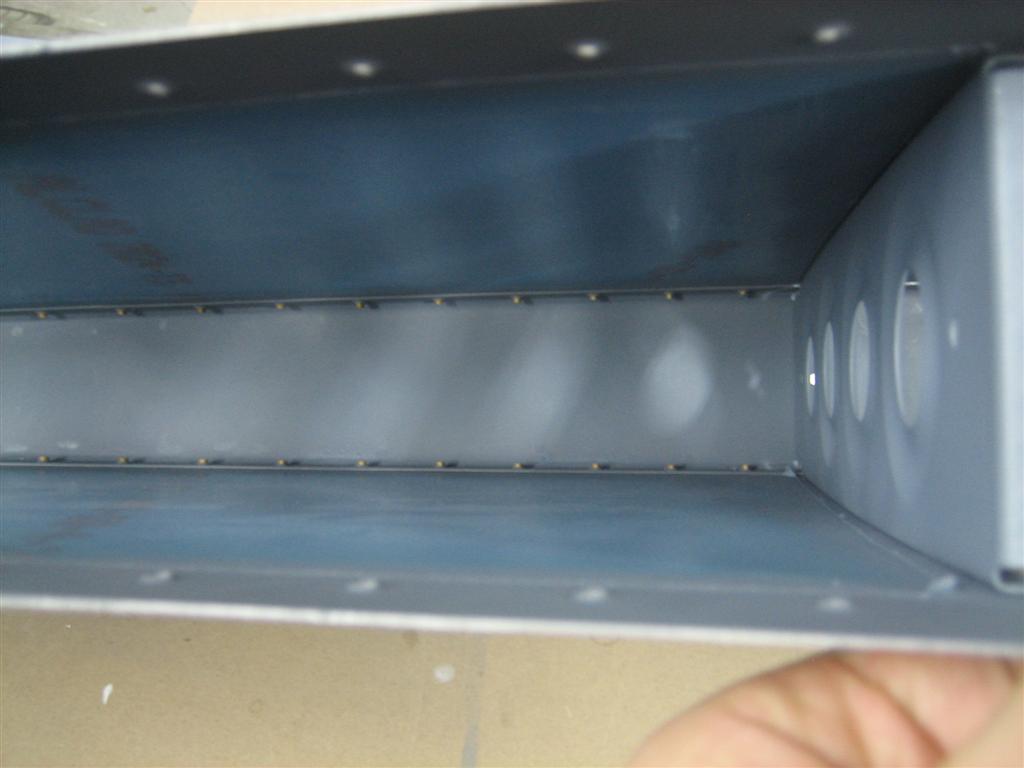
Upper bay of the VS.

After removing all of the vinyl, I moved on to riveting the tip (VS-706) and root ribs (VS-704 and VS-705) to the skin. All was going well, until I got the front of the root rib.

Anyway, for some reason the skin wasn’t sitting well on the rib. I later determined it wasn’t interference, just the natural curve of the rib.

The lower right side of the VS skin wasn't sitting very well on the root rib.

My solution? Use a tape-covered clamp to squeeze them together.

Alright, let's set this rivet.

That did the trick. Who’s next?

Looks perfect now.

Here I am riveting some of the rest of the root rib. I was very careful to not rivet the 6 holes on each side the instructions tell you to leave open for the empennage fairing. I probably won’t use all 6, but I can always squeeze these later, so why close any metaphorical doors?

In the middle of squeezing the root rib.

Here’s the VS (except the rear spar) all riveted together. Notice the 6 clecos in the holes to leave open.

Where's that rear spar?

I inserted the rear spar and started setting rivets. All was going perfectly, until I realized that most of the rivets couldn’t be set because of conflicting shop heads on the rear spar. I had tried two rivets that were close to having enough clearance, and I messed both of the shop heads up. Here’s one.

Bad rivet shop head there in the middle. Obviously.

And here’s the other.

Another bad shop head there on the left. See the cleco in the middle of the picture. The rivet that will go in that hole doesn't have a lot of room to be bucked.

I gave up on any other rivets that would be close with the squeezer. I’ve been doing so well recently with the gun and bucking bar, that I’ll just wait till I can make loud noises and set them with the gun.

Where I left off for today. I'll figure out how to set the remaining rear spar to skin rivets sometime next week.

One and a half hours today. 135 rivets set; some shot, some squeezed. Only a few will have to be drilled out later. Good night tonight. Hopefully next week, the dogs will get some directional stability.

Prev | Next