Practice Kit – Finished

October 4, 2009

Prev | Next

Sunday morning, I managed to finish off the practice kit. Here are the pictures.

Here are the skins riveted to the spar. Notice how I didn't make the jig to hold it to the table.

Here are the skins riveted to the spar. Notice how I didn't make the jig to hold it to the table.

Another shot of the skins riveted to the spar.

Another shot of the skins riveted to the spar.

After the skins were riveted to the ribs and the trailing edge wedge, I rolled the leading edge and clecloed it together. I haven't edge formed the top skin yet, hence the ripples.

After the skins were riveted to the ribs and the trailing edge wedge, I rolled the leading edge and clecloed it together. I haven't edge formed the top skin yet, hence the ripples.

The finished product.

The finished product.

Overall, I am happy with the results. I don’t think they are airplane worthy (I don’t know if I will ever be happy with the final product), but I feel like I am ready to start on the real kit. All of the riveting came out nice, but some of the other aspects (dimpling, countersinking, edge rolling) are still not up to par.

Biggest lesson so far:

1) Go slow, take your time, read the plans, and be careful.
2) The skins don’t look too bad, but I have a feeling there will be too many scratches to polish the final airplane. I’m planning on paint anyway, so I should be okay.
3) Other things, I want to acquire some of the tank dimple dies for the understructure. Some of the skin to rib seams didn’t sit as nicely as I wanted, and I think the slightly deeper dimples in the ribs will accept the dimple in the skin better.
4) Buy a bigger backriveting plate. I just have a 1 x1/2 x 36 inch steel stock. I had to be really careful to keep the rivets lined up. With a wider plate, I wouldn’t’ have had to move the skin around, which caused…
5) …scratches in the skin. Next time I removed the vinyl from the skin, I am going to immediately replace it with painters tape. All of the scratches on the skin are where I removed the vinyl. This can be prevented.
6) Priming. Using the self-etching primer is so easy, I think I may do all of the interior skin next time ( I only primed the rivet lines, where two pieces of metal would meet this time).
7) I need a no-hole yoke for the rivets near the rear of the trailing edge. I managed with a thin bucking bar, but I didn’t like the results. A no-hole would make this a non-issue.

Prev | Next


Finished the first assembly in the Practice Kit

September 29, 2009

Prev | Next

Tonight, I finished the first assembly in the practice kit. Only a few notes, and some lessons learned.

Big lessons learned:

  1. The soldering iron leaves a mark if you aren’t careful, be gentle, and go slow enough that it melts the vinyl.
  2. Deburring holes was very easy, even with just an oversize drill bit.
  3. Buy a nice countersink. I faked it with a drill bit, and the results will not be acceptable on the real project.
  4. Less scratches tonight, but still a lot. I need to get some scotchbrite pads and self-etching primer to rehearse the prep and priming phases.
  5. I want to experiment with priming before dimpling. I’ve heard people have had good results (said another way, no bad results due to priming a weirdly angled surface in the dimple.)
I got out the soldering gun and tried my hand at removing the vinyl covering in a straight line.

I got out the soldering gun and tried my hand at removing the vinyl covering in a straight line.

MY FIRST RIVET. It is so beautiful.

MY FIRST RIVET. AN426AD3-3. It is so beautiful.

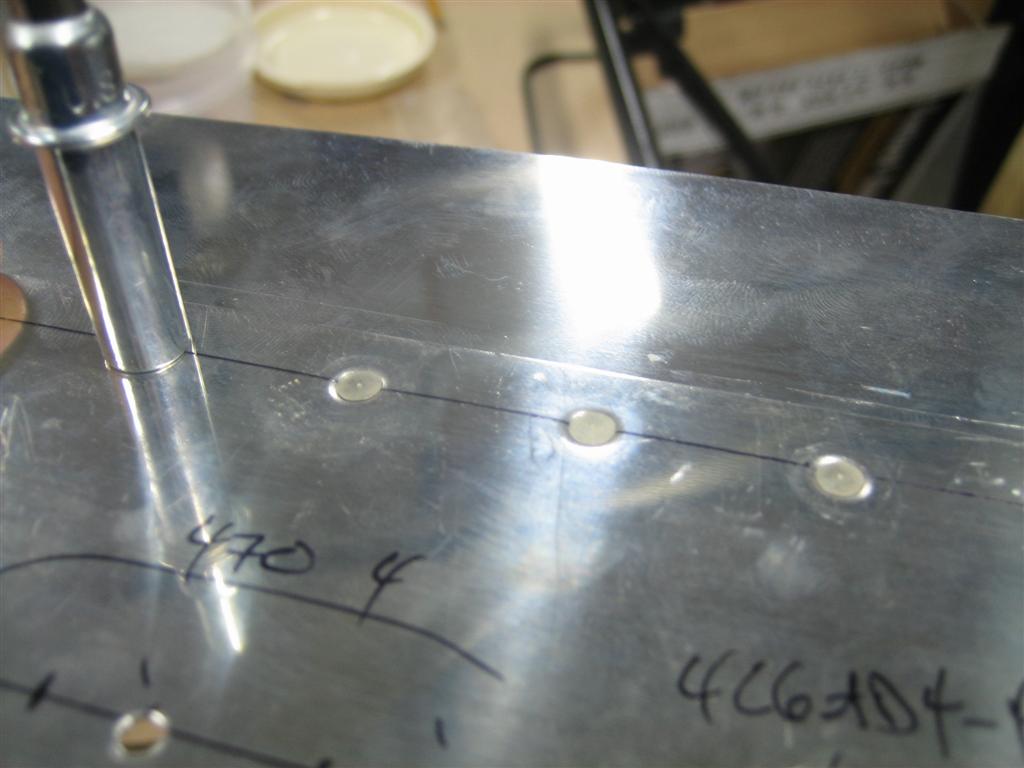
Three more rivets. I squeezed and bucked with flush and cupped sets. I am using a 4X gun, which means I had the pressure all the way down to 20 psig. It worked really well for the AD3s, but I might need more pressure for the AD4-4s.

Three more rivets. I squeezed and bucked with flush and cupped sets. I am using a 4X gun, which means I had the pressure all the way down to 20 psig. It worked really well for the AD3s, but I might need more pressure for the AD4-4s.

The final (and blurry) product. It's probably for the best that you can't see the fingerprints and scratches on it.

The final (and blurry) product. It's probably for the best that you can't see the fingerprints and scratches on it.

I am very happy that I did this part of the practice kit first. Now I know how to proceed on the real kit, and nothing with drilling, deburring, dimpling, countersinking, or riveting will be new to me, even on the practice kit. (I plan on displaying the practice kit prominently, so it better look good.)

Prev | Next